


The US government’s freeze on arms sales to Taiwan will have a number of consequences for both parties, former US deputy assistant secretary of state for East Asian and Pacific affairs Randall Schriver said yesterday.
Speaking to a gathering of the Taipei Foreign Correspondents Club in Taipei, Schriver said that any halt in weapons procurement was likely to have an exponential effect on Taiwan’s ability to defend itself.
Arms sales “are not something you can turn on or off like a spigot,” he said.
A prolonged arms freeze would also affect the ability of President Ma Ying-jeou’s (馬英九) government to negotiate with China on Ma’s key election platforms, such as increasing Taiwan’s international space and the signing of a cross-strait peace accord, he said.
The US, meanwhile, will have to deal with credibility issues if it refuses to follow through after offering and approving the sales of the systems.
Mark Stokes, Schriver’s colleague at the Project 2049 Institute think tank and a former country director for China and Taiwan in the Office of the US Secretary of Defense, also present at the talk, echoed Schriver’s remarks.
He said that the credibility of those in the US establishment that for years had accused Taiwan of not taking its own defense seriously was now being called into question, as the freeze had brought about a “reversal of roles.”
Stokes also said that Wednesday’s military helicopter crash in Taoyuan County had highlighted the importance of continually upgrading military equipment.
Asked whether the freeze could possibly extend into the term of the next US president, Schriver said the camps of both Republican candidate John McCain and Democratic nominee Barack Obama had made it clear to the Bush administration that they did not want to inherit such a situation.
He added that the best solution would be for the present US government to unblock the sales. A failure to do so would prove very costly for any new administration in terms of its relations with Beijing, as the last decade has seen China’s influence in the US capital increase tremendously, Schriver said.
He said that the combination of “highly skilled, articulate Chinese diplomats,” US corporations with interests in China, lobbying firms employed by Beijing and old China friends, such as former US secretary of state Henry Kissinger, made it difficult for the US government to pursue policies deemed favorable to Taiwan.
Commenting on the state of relations between Taipei and Washington, Schriver said that the nadir reached during former president Chen Shui-bian’s (陳水扁) term was not solely down to Chen, as actors in Washington had overestimated their understanding of Taiwan and contributed to the problems.
The cost of rebuilding ties with Taiwan would also be higher now that China has such a powerful presence, he added.
He said that although the Ma government had made a big effort to improve the cross-strait situation, what it was doing to strengthen ties with the US and Japan was still unclear.

PRAISE: Japanese visitor Takashi Kubota said the Taiwanese temple architecture images showcased in the AI Art Gallery were the most impressive displays he saw Taiwan does not have an official pavilion at the World Expo in Osaka, Japan, because of its diplomatic predicament, but the government-backed Tech World pavilion is drawing interest with its unique recreations of works by Taiwanese artists. The pavilion features an artificial intelligence (AI)-based art gallery showcasing works of famous Taiwanese artists from the Japanese colonial period using innovative technologies. Among its main simulated displays are Eastern gouache paintings by Chen Chin (陳進), Lin Yu-shan (林玉山) and Kuo Hsueh-hu (郭雪湖), who were the three young Taiwanese painters selected for the East Asian Painting exhibition in 1927. Gouache is a water-based
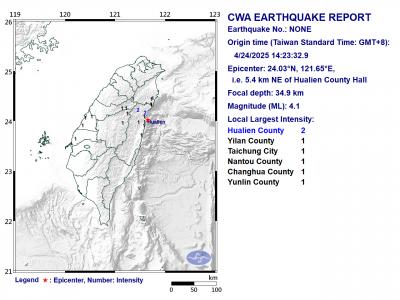
A magnitude 4.1 earthquake struck eastern Taiwan's Hualien County at 2:23pm today, according to the Central Weather Administration (CWA). The epicenter of the temblor was 5.4 kilometers northeast of Hualien County Hall, at a depth of 34.9 km, according to the CWA. The earthquake's intensity, which gauges the actual effect of a temblor, was the highest in Hualien County, where it measured 2 on Taiwan's 7-tier intensity scale. The quake also measured an intensity of 1 in Yilan county, Taichung, Nantou County, Changhua County and Yunlin County, the CWA said. There were no immediate reports of damage or injuries.
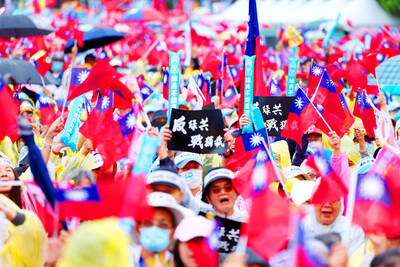
‘WORSE THAN COMMUNISTS’: President William Lai has cracked down on his political enemies and has attempted to exterminate all opposition forces, the chairman said The legislature would motion for a presidential recall after May 20, Chinese Nationalist Party (KMT) Chairman Eric Chu (朱立倫) said yesterday at a protest themed “against green communists and dictatorship” in Taipei. Taiwan is supposed to be a peaceful homeland where people are united, but President William Lai (賴清德) has been polarizing and tearing apart society since his inauguration, Chu said. Lai must show his commitment to his job, otherwise a referendum could be initiated to recall him, he said. Democracy means the rule of the people, not the rule of the Democratic Progressive Party (DPP), but Lai has failed to fulfill his

OFF-TARGET: More than 30,000 participants were expected to take part in the Games next month, but only 6,550 foreign and 19,400 Taiwanese athletes have registered Taipei city councilors yesterday blasted the organizers of next month’s World Masters Games over sudden timetable and venue changes, which they said have caused thousands of participants to back out of the international sporting event, among other organizational issues. They also cited visa delays and political interference by China as reasons many foreign athletes are requesting refunds for the event, to be held from May 17 to 30. Jointly organized by the Taipei and New Taipei City governments, the games have been rocked by numerous controversies since preparations began in 2020. Taipei City Councilor Lin Yen-feng (林延鳳) said yesterday that new measures by


 RSS
RSS