


The Citizen Congress Watch (CCW) criticized the Chinese Nationalist Party (KMT) yesterday for failing to fulfill its promise of legislative reform, citing the high number of KMT absences at the legislature and the stalled sunshine bills.
Statistics released by the CCW at a press conference held outside the Legislative Yuan showed KMT Legislator Chang Chia-chun (張嘉郡) topping the list with 18 absences during the legislative session from February to May. KMT legislators Liu Chuan-chung (劉銓忠) and Tsao Erh-chung (曹爾忠) ranked second with 16 absences each and Lii Ming-shing (李明星) placed third with 15 absences.
Democratic Progressive Party (DPP) Legislator Chen Chi-yu (陳啟昱) and Non-Partisan Solidarity Union Legislator Yen Chin-piao (顏清標) also ranked second.

PHOTO: CNA
“Since the legislative session began, the legislature’s efficiency has been really disappointing,” CCW chairman Ku Chung-hwa (顧忠華) said.
“The KMT leadership, including [President] Ma Ying-jeou [馬英九], [KMT chairman] Wu Poh-hsiung [吳伯雄] and [Legislative Speaker] Wang Jin-pyng [王金平] repeatedly told the public that the KMT, with the majority in the legislature and the governing party, will make legislative efficiency and self-discipline its priority” Ku said.
“They also said they would push for legislative reform and pass the sunshine bills — but what do we see now?” Ku said.
Ku urged lawmakers to strive to “achieve perfect attendance records and work harder to have the sunshine bills passed.”
Approached for comment, Chang said a legislator’s performance should not be judged solely on his or her record of attendance.
“I was helping to take care of the fertilizer [shortage] problem and flooding because of heavy rains in Yunlin County,” she said. “Although I wasn’t at legislative meetings, I was helping the farmers in my constituency.”
Liu said he was busy attending the funeral of farmers who died because of the heat, while Tsao said he was unable to return to Taipei from his constituency in Matsu because of heavy fog.
Liu said that he was out of the country on official business.
Chen said he was busy running for local chapter chairman, but promised that he would spend more time at the legislature as the local party chief election was over.
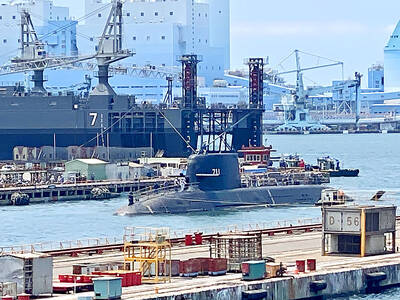
AGING: While Japan has 22 submarines, Taiwan only operates four, two of which were commissioned by the US in 1945 and 1946, and transferred to Taiwan in 1973 Taiwan would need at least 12 submarines to reach modern fleet capabilities, CSBC Corp, Taiwan chairman Chen Cheng-hung (陳政宏) said in an interview broadcast on Friday, citing a US assessment. CSBC is testing the nation’s first indigenous defense submarine, the Hai Kun (海鯤, Narwhal), which is scheduled to be delivered to the navy next month or in July. The Hai Kun has completed torpedo-firing tests and is scheduled to undergo overnight sea trials, Chen said on an SET TV military affairs program. Taiwan would require at least 12 submarines to establish a modern submarine force after assessing the nation’s operational environment and defense

A white king snake that frightened passengers and caused a stir on a Taipei MRT train on Friday evening has been claimed by its owner, who would be fined, Taipei Rapid Transit Corp (TRTC) said yesterday. A person on Threads posted that he thought he was lucky to find an empty row of seats on Friday after boarding a train on the Bannan (Blue) Line, only to spot a white snake with black stripes after sitting down. Startled, he jumped up, he wrote, describing the encounter as “terrifying.” “Taipei’s rat control plan: Release snakes on the metro,” one person wrote in reply, referring
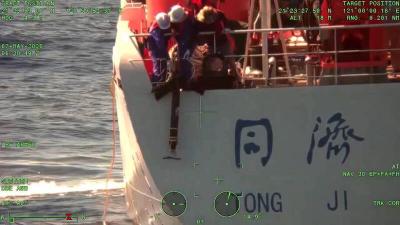
The coast guard today said that it had disrupted "illegal" operations by a Chinese research ship in waters close to the nation and driven it away, part of what Taipei sees a provocative pattern of China's stepped up maritime activities. The coast guard said that it on Thursday last week detected the Chinese ship Tongji (同濟號), which was commissioned only last year, 29 nautical miles (54km) southeast of the southern tip of Taiwan, although just outside restricted waters. The ship was observed lowering ropes into the water, suspected to be the deployment of scientific instruments for "illegal" survey operations, and the coast

Yangmingshan National Park authorities yesterday urged visitors to respect public spaces and obey the law after a couple was caught on a camera livestream having sex at the park’s Qingtiangang (擎天崗) earlier in the day. The Shilin Police Precinct in Taipei said it has identified a suspect and his vehicle registration number, and would summon him for questioning. The case would be handled in accordance with public indecency charges, it added. The couple entered the park at about 11pm on Thursday and began fooling around by 1am yesterday, the police said, adding that the two were unaware of the park’s all-day live


 RSS
RSS