


President-elect Ma Ying-jeou (馬英九) promised technology tycoons yesterday he would relax the cap on investment in China as a priority after his inauguration on May 20.
The removal of the cap, usually 40 percent of a company’s net value, would help Taiwanese businesses compete with multinationals in China, boost the nation’s competitiveness globally and encourage businesses to keep their roots in Taiwan, Ma said.
Ma also promised to revise the regulations regarding income tax, inheritance tax and donation tax to create a friendlier investment environment.
“Our goal is to push for low taxes and simple tax policies and to give local businesses enough incentive so that they will continue investing in Taiwan,” Ma said after meeting seven business tycoons in Taipei’s Neihu District (內湖).
Ma visited heads of leading technology businesses including Lite-On Group (光寶集團) chairman Song Kung-yuan (宋恭源), Acer chairman Wang Jen-tang (王振堂) and Asustek (華碩電腦) chairman Jonney Shih (施崇堂).
After the two-hour closed door meeting, Ma said that he had often consulted local businesses as Taipei mayor and promised to keep up regular communication with the technology industry after his inauguration.
Song lauded Ma for his sincerity in listening to the opinions of industry leaders and urged him to remove the cap on investment in the Chinese market as soon as possible.
The business leaders also urged Ma to relax regulations for hiring foreign talent, especially from China, and to implement cross-strait direct links soon.
Accompanying Ma to meet the businessmen, economic affairs minister-designate Yiin Chii-ming (尹啟銘) promised to prioritize the removal of the investment cap after he is sworn in.
He also pledged to add a sunset clause to the Statute for Upgrading Industries (促進產業升級條例) by next year that would stipulate when and in what situations tax breaks would be revoked.
Under existing regulations, China-bound investment may not exceed 20 percent of a company’s net assets if those exceed NT$10 billion (US$323.5 million); 30 percent when net assets are between NT$5 billion and NT$10 billion; and 40 percent when net assets are less than NT$5 billion.

REASONS FOR TRAVEL: An assistant professor said that proposed amendments to penalize drivers if they used drugs overseas would not deter people from traveling People who operate a motor vehicle under the influence of marijuana would have their driver’s license revoked, even if they used the substance while overseas, the Ministry of Transportation and Communications said yesterday, citing proposed amendments to the Road Traffic Management and Penalty Act (道路交通管理處罰條例). The amendments would also authorize the government to revoke the licenses of people determined to have used Category 1 or Category 2 narcotics, even if they were not operating a vehicle while under the influence of drugs, as well as ban them from taking the license test for three years, the ministry said. People aged 18 or

GLOBALGIVING: ‘ Caving to external pressure is not acceptable for an organization that has cultivated justice reform and human rights for 30 years,’ one NGO said A slew of non-government organizations (NGOs) have withdrawn from the GlobalGiving fundraising platform after it announced it would use “Chinese Taipei” instead of “Taiwan” from next month. The Taiwan Good Rice Association wrote on Facebook on Friday that it was informed on April 28 via a teleconference call of the change, which was made because the platform wanted to operate in China. Taiwan Good Rice is to terminate all cooperative relationships with GlobalGiving in response to the platform’s “unilateral and non-negotiable” decision to remove references to Taiwan, the NGO said. “Taiwan is in the official name of Taiwan Good Rice Association and the

HEAVY WEATHER: Typhoon Jangmi is due to crash straight into the Ryukyus as airlines look to shift flights to larger aircraft or cancel flights to Okinawa entirely Taiwan’s international air carriers announced flight adjustments over the weekend as Typhoon Jangmi is forecast to hit the Ryukyu Islands today and tomorrow. The Central Weather Administration (CWA) upgraded Jangmi from a tropical storm to a typhoon at 8am yesterday, with the eye located 580km south of Naha city. It was moving north at 19kph. Today, China Airlines’ CI-120, CI-121, CI-122 and CI-123 flights between Taoyuan and Naha, Okinawa, have been canceled as well as CI-132 and CI-133 between Kaohsiung and Naha. EVA Air’s BR-112, BR-113, BR-186 and BR-185 flights between Taoyuan and Naha are also canceled. Low-cost carrier Tigerair Taiwan canceled IT-230,
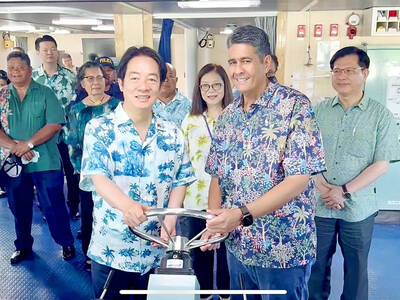
MULTIPRONGED APPROACH: China has sought to pressure Palau across a number of fronts, but the island nation has staunchly resisted overtures to ditch Taiwan Palau has been firm in backing Taiwan despite Chinese pressure that uses tourism economics, cyberattacks and criminal infiltration as tools to threaten the Pacific ally into renouncing its recognition of Taiwan as a sovereign state. The Presidential Office yesterday announced that Vice President Hsiao Bi-khim (蕭美琴) would visit Palau from Saturday to Wednesday next week at the invitation of Palauan President Surangel Whipps Jr. Whipps in April said in an interview that China had outspokenly asked Palau to “denounce Taiwan.” “And we have said: ‘We have no enemies, but nobody tells us who our friends are,’” he said. Whipps has told reporters multiple times


 RSS
RSS