


A Tainan university has developed a low-cost, compact wire inspection device that will revolutionize the way construction contractors and machine makers check their wiring assemblies, a local newspaper reported yesterday.
The Southern Taiwan University of Technology (STUT) has arranged to have a local manufacturer mass produce the device, which saves time and manpower by checking the status of a group of wires simultaneously rather than wire by wire as normally occurs at present.
Researchers at the university said the gadget, dubbed the “digital wiring inspector,” is comprised of a signal transmitting unit and a signal analyzing unit.
The transmitter, placed at one end of the wires, sends individual signals through each wire to the analyzer at the other end. The analyzer indicates which lines are functional and which are faulty by decoding the signals received.
“It’s like putting a yellow, a green and a red pellet into pipelines one, two and three,” said Wei Chao-huang, an assistant professor in the university’s Department of Electrical Engineering.
“If only the yellow and red pellets comes out through the other end, then it can be determined that pipeline two is broken,” he said.
The new device can be operated by a single person, a huge advantage in today’s market.
Wei said the most commonly used methods of wiring inspection require multiple workers at a site to check each wire individually, usually by using an additional common wire — a reference wire designated by inspectors — to short-circuit the wire being inspected.
“When the workload is only a cable or two, it’s not a problem using the conventional ways, “ Wei said, “but at a construction site, for example, where there might be tens of rooms with hundreds of electrical cables, one-by-one inspection would be extremely time-consuming.”
Researchers said the prototype device, awarded a gold medal at the 2008 Thailand International Invention Exhibition, cost less than NT$200 and estimated that the price of the commercial version would be no more than NT$99.

Former president Tsai Ing-wen (蔡英文) on Monday called for greater cooperation between Taiwan, Lithuania and the EU to counter threats to information security, including attacks on undersea cables and other critical infrastructure. In a speech at Vilnius University in the Lithuanian capital, Tsai highlighted recent incidents in which vital undersea cables — essential for cross-border data transmission — were severed in the Taiwan Strait and the Baltic Sea over the past year. Taiwanese authorities suspect Chinese sabotage in the incidents near Taiwan’s waters, while EU leaders have said Russia is the likely culprit behind similar breaches in the Baltic. “Taiwan and our European

The Taipei District Court sentenced babysitters Liu Tsai-hsuan (劉彩萱) and Liu Jou-lin (劉若琳) to life and 18 years in prison respectively today for causing the death of a one-year-old boy in December 2023. The Taipei District Prosecutors’ Office said that Liu Tsai-hsuan was entrusted with the care of a one-year-old boy, nicknamed Kai Kai (剴剴), in August 2023 by the Child Welfare League Foundation. From Sept. 1 to Dec. 23 that year, she and her sister Liu Jou-lin allegedly committed acts of abuse against the boy, who was rushed to the hospital with severe injuries on Dec. 24, 2023, but did not
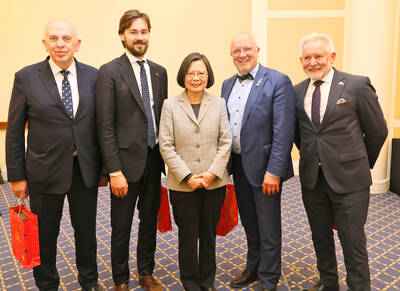
LIKE-MINDED COUNTRIES: Despite the threats from outside, Taiwan and Lithuania thrived and developed their economies, former president Tsai Ing-wen said Former president Tsai Ing-wen (蔡英文) on Saturday thanked Lithuania for its support of Taiwan, saying that both countries are united as partners in defending democracy. Speaking at a reception organized by the Lithuania-Taiwan Parliamentary Friendship Group welcoming her on her first visit to the Baltic state, Tsai said that while she was president from 2016 to last year, many Lithuanian “friends” visited Taiwan. “And I told myself I have to be here. I am very happy that I am here, a wonderful country and wonderful people,” Tsai said. Taiwan and Lithuania are in similar situations as both are neighbors to authoritarian countries, she

Former president Tsai Ing-wen (蔡英文) is to visit the UK during her ongoing European trip, which originally included only Lithuania and Denmark, her office said today. Tsai departed Taiwan for Europe on Friday night, with planned stops in Lithuania and Denmark, marking her second visit to the continent since her two-term presidency ended in May last year. Her office issued a statement today saying that Tsai would also visit the UK "for a few days," during which she is to meet with UK politicians and Taiwanese professionals, and visit academic and research institutions. Following Tsai's stop in Denmark, she is to visit the


 RSS
RSS