

With many women's rights activists watching, a monument to commemorate Taiwan's pioneer in modern dance, Tsai Jui-yueh (
"The erection of the monument is a tribute to Taiwan's history and women, as well as a reminder of the example that Tsai set for the coming generations," said Tchen Yu-chiou (陳郁秀), secretary-general of the National Cultural Association.
Tsai was born in 1921 during the Japanese colonial period. As a child, she showed her interest and talent in dance by creating a dance to accompany the Japanese children's song Momotaro-san when she was five years old.
At the age of 16, Tsai traveled to Japan to learn from modern dance master Ishi Baku, participating in hundreds of performances across Vietnam, Singapore, Malaysia, Myanmar and Japan during World War II.
AFTER WORLD WAR II
On her journey back to Taiwan from Japan after World War II, Tsai gave the first performance of the musical The Beautiful Island on the ferry.
However, when her husband was accused of spying for the Chinese Communist Party and expelled from Taiwan in 1949, Tsai was also arrested and imprisoned for three years on Green Island, where many other political prisoners were jailed.
After her release, Tsai continued her career by founding a school for modern dance and a dance troupe in Taipei in 1953, though the authoritarian Chinese Nationalist Party (KMT) regime often intervened.
In 1983, Tsai and her son moved to Australia to continue her career. She often traveled back and forth between Taiwan and Australia until her death in 2005.
"I admire [Tsai] for her insistence on what she loved, despite repressions and restrictions that the government put upon her during the White Terror," Minister of the Interior Lee Yi-yang (
Several of Tsai's former students performed dances and read poems in commemoration of their teacher.
COLORFUL STEEL
The monument is made with colorful steel boards that form the shape of a woman jumping with her head held up towards the sky.
"The colors symbolize the colorful creativity of Tsai, and the gesture represents her desire to search for perfection in art," T.T. Deh (
Deh was convicted in 1970 for a failed assassination attempt on late president Chiang Ching-kuo (

‘FRIENDSHIP FLEET’: A CGA official is scheduled to meet with the president of the Pacific nation, while one of the ships is to host a banquet and National Day event Two Coast Guard Administration (CGA) patrol vessels have docked at Malakal Harbor in Palau as part of an expedition exercise and diplomatic visit, during which a senior official is expected to meet with Palauan President Surangel Whipps Jr, the agency said yesterday. The two vessels, the 4,000-tonne-class Chiayi and the 1,000-tonne-class Penghu, set sail for Palau from Taiwan last week and arrived on Tuesday at Malakal Harbor, the CGA’s Fleet Branch said in a statement. The journey marks the second time the CGA has dispatched a “friendship fleet” to another country, after it sent its first-ever goodwill fleet, comprising the Hualien and
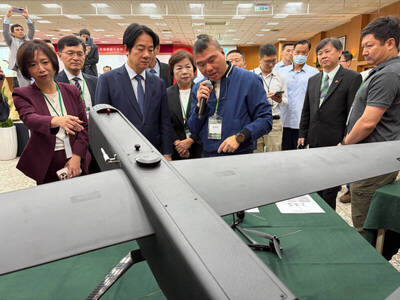
Two executives of drone supplier Jiin Ming Industry Co (錦明實業) have been detained and held incommunicado over the company's alleged use of prohibited China-made chips and camera lenses in drones supplied under recent military contracts, the Taoyuan District Prosecutors' Office said today. In a statement, prosecutors said they raided the offices of Jiin Ming — headquartered in Taoyuan — as well as those of its subsidiaries and its suppliers on Thursday last week. The raids followed a report that the company had breached its procurement contracts by putting the prohibited components into drones delivered to the military. During the raids, prosecutors summoned

South Korean boy band BigBang drew 120,000 fans to three concerts at Taipei Dome from Friday through yesterday, as the band thanked them for their support over their 20-year career. The Taipei Dome concerts were part of BigBang's "2026-2027 World Tour XX: Cosmos." Friday's concert was BigBang's first performance in Taiwan in 11 years. During the encore, group leader G-Dragon (GD) shouted "I love you" in Chinese and said he was especially happy to perform in Taiwan with bandmates Taeyang and Daesung. "Taipei, I'm very grateful to you all," GD said in Chinese, asking fans to wait for the band's return. Daesung thanked
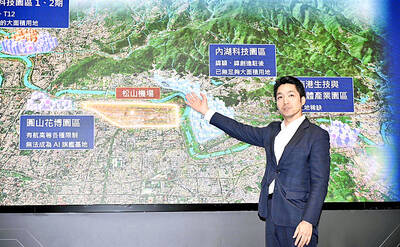
DETAILED PLAN NEEDED: Relocating the airport would affect not just travelers, but also undermine national defense and emergency medical services, a legislator said Taipei Mayor Chiang Wan-an (蔣萬安) yesterday proposed relocating Taipei International Airport (Songshan airport) and turning the site into an artificial intelligence (AI) park, drawing opposition from politicians across party lines. Chiang’s plan would turn the 300 hectares into an AI park featuring tech clusters, residential communities and green space. The industrial cluster would host 200 domestic enterprises, generate NT$12 trillion (US$376.47 billion) in output, and accommodate 65,000 jobs and 35,000 residents, he said. Cabinet spokeswoman Michelle Lee (李慧芝) said the Executive Yuan was surprised by the announcement, as the Taipei City Government did not discuss the proposal with the central government before making


 RSS
RSS