


In an attempt to promote the development of tourism in Kinmen and Matsu, the Executive Yuan yesterday gave a conditional green light to people living in Taiwan proper to make stopovers on the two islands before traveling on to China.
Currently, people in Taiwan proper must make time-consuming and costly stopovers in third territories such as Hong Kong and Macau when traveling to China.
However, the "small three links" route, opened in January 2001, allows limited direct transportation between Kinmen and Matsu islands and the southern Chinese port cities of Xiamen and Fuzhou.
Under the Cabinet's plan, a travel agency in Kinmen or Matsu would be granted a quota of Taiwanese tourists it could take to China, equal to the number of Chinese tourists it has traveling through the "links" to visit Penghu.
A condition is attached to the proposal, however: the Taiwanese tourists must spend at least one night in either Kinmen or Matsu.
"We hope to see an increase in tourism to Kinmen and Matsu to facilitate economic development and bring prosperity to people of those regions," Premier Chang Chun-hsiung (
The proposal will begin a six-month trial on April 1, with the number of tourists traveling from Taiwan to Kinmen set at 600 a day and Matsu limited to 80 a day because of the limited accommodation available on the islands.
According to figures from the Mainland Affairs Council (MAC), the average number of Chinese tourists visiting Kinmen was 73 per day last year, with just two per day visiting Matsu.
Chinese tourists are allowed to travel on to Penghu via Kinmen or Matsu, but not to Taiwan proper.
Including residents of Taiwan in the "small three links" framework would "give travel agencies in Kinmen and Matsu an incentive to draw more Chinese tourists," MAC Chairman Chen Ming-tong (
Currently, the route is only available for people with addresses registered in Kinmen and Matsu for at least six months, businesspeople with operations in China and their employees and family members, veterans originally from China and residents of Fujian Province married to Taiwanese.
The Cabinet also approved an amendment to ensure China-bound Taiwanese businesspeople who didn't register their Chinese investments with the government would not be investigated for possible tax evasion.
The amendment to the Statute Governing the Relations Between People of the Taiwan Area and the Mainland Area (
The avoidance of paying taxes is a major reason why businesspeople would choose to remit unregistered capital out of Taiwan via underground or illegal channels, Chang said.
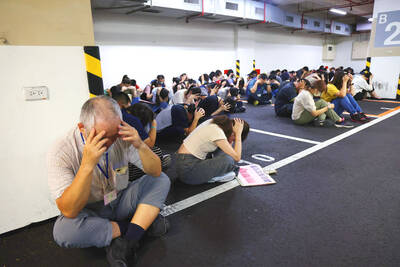
Taipei on Thursday held urban resilience air raid drills, with residents in one of the exercises’ three “key verification zones” reporting little to no difference compared with previous years, despite government pledges of stricter enforcement. Formerly known as the Wanan exercise, the air raid drills, which concluded yesterday, are now part of the “Urban Resilience Exercise,” which also incorporates the Minan disaster prevention and rescue exercise. In Taipei, the designated key verification zones — where the government said more stringent measures would be enforced — were Songshan (松山), Zhongshan (中山) and Zhongzheng (中正) districts. Air raid sirens sounded at 1:30pm, signaling the

The number of people who reported a same-sex spouse on their income tax increased 1.5-fold from 2020 to 2023, while the overall proportion of taxpayers reporting a spouse decreased by 4.4 percent from 2014 to 2023, Ministry of Finance data showed yesterday. The number of people reporting a spouse on their income tax trended upward from 2014 to 2019, the Department of Statistics said. However, the number decreased in 2020 and 2021, likely due to a drop in marriages during the COVID-19 pandemic and the income of some households falling below the taxable threshold, it said. The number of spousal tax filings rebounded

A saleswoman, surnamed Chen (陳), earlier this month was handed an 18-month prison term for embezzling more than 2,000 pairs of shoes while working at a department store in Tainan. The Tainan District Court convicted Chen of embezzlement in a ruling on July 7, sentencing her to prison for illegally profiting NT$7.32 million (US$248,929) at the expense of her employer. Chen was also given the opportunity to reach a financial settlement, but she declined. Chen was responsible for the sales counter of Nike shoes at Tainan’s Shinkong Mitsukoshi Zhongshan branch, where she had been employed since October 2019. She had previously worked

Labor rights groups yesterday called on the Ministry of Labor to protect migrant workers in Taiwan’s fishing industry, days after CNN reported alleged far-ranging abuses in the sector, including deaths and forced work. The ministry must enforce domestic labor protection laws on Taiwan-owned deep-sea fishing vessels, the Coalition for Human Rights for Migrant Fishers told a news conference outside the ministry in Taipei after presenting a petition to officials. CNN on Sunday reported that Taiwanese seafood giant FCF Co, the owners of the US-based Bumble Bee Foods, committed human rights abuses against migrant fishers, citing Indonesian migrant fishers. The alleged abuses included denying


 RSS
RSS