


Global warming could increase the prevalence of dengue fever, the Environmental Protection Administration (EPA) said yesterday, urging the public to begin their prevention work early as the warmer months approach.
The EPA has published a pamphlet illustrating strategies that worked well in previous years to teach the public how to stay healthy in the heat.
Dengue fever is an infectious disease spread by the Aedes aegypti mosquito in warm regions of the world including Asia and Africa.
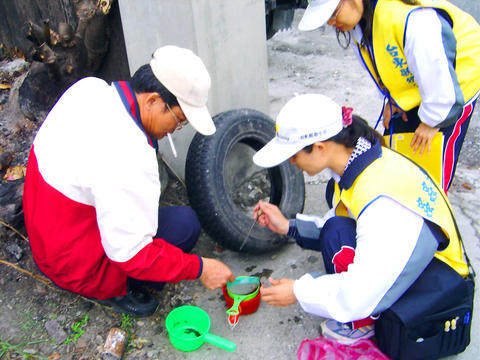
PHOTO: WANG HSIU-TING, TAIPEI TIMES
The disease is characterized by an acute onset of fever and typically lasts a week. Patients develop severe headaches, muscle pains and rashes that may cover the entire body in severe cases.
"In 1998 Taiwan was 1.43oC hotter than our historical average -- more than twice the global increase, which was 0.6oC," EPA Minister Winston Dang (
The increased temperature makes for more prolific breeding of the Aedes aegypti mosquito, Dang said, which could increase the prevalence of dengue in northern Taiwan.
The best way to eliminate dengue fever, the minister said, is to start with Aedes aegypti mosquito extermination.
"In addition to the work done by the EPA street cleaners, people can help improve our environment by eliminating standing pools of water [such as in old fish bowls or flowerpots]," Dang said.
The complete pamphlet can be downloaded from the EPA Web site at www.epa.gov.tw.
In related news, the EPA yesterday said that 1.44 percent -- or 122 out of 33,717 -- of sampled domestic pesticides failed to comply with regulations, with 111 violators selling expired products.
Among the 11 samples that violated the EPA's pesticide dosage allowances, Korean-made COMBAT Power Roach contained twice the allowed amount, said Yuan Shaw-ying (袁紹英), director-general of the EPA's department of environmental sanitation and toxic substance management.
Yuan assured consumers that all products unfit for sale had been pulled from shelves, but urged the public to maintain their environment by using pesticides sparingly and carefully cleaning surfaces after using them.

‘NON-RED’: Taiwan and Ireland should work together to foster a values-driven, democratic economic system, leveraging their complementary industries, Lai said President William Lai (賴清德) yesterday expressed hopes for closer ties between Taiwan and Ireland, and that both countries could collaborate to create a values-driven, democracy-centered economic system. He made the remarks while meeting with an Irish cross-party parliamentary delegation visiting Taiwan. The delegation, led by John McGuinness, deputy speaker of the Irish house of representatives, known as the Dail, includes Irish lawmakers Malcolm Byrne, Barry Ward, Ken O’Flynn and Teresa Costello. McGuinness, who chairs the Ireland-Taiwan Parliamentary Friendship Association, is a friend of Taiwan, and under his leadership, the association’s influence has grown over the past few years, Lai said. Ireland is

A saleswoman, surnamed Chen (陳), earlier this month was handed an 18-month prison term for embezzling more than 2,000 pairs of shoes while working at a department store in Tainan. The Tainan District Court convicted Chen of embezzlement in a ruling on July 7, sentencing her to prison for illegally profiting NT$7.32 million (US$248,929) at the expense of her employer. Chen was also given the opportunity to reach a financial settlement, but she declined. Chen was responsible for the sales counter of Nike shoes at Tainan’s Shinkong Mitsukoshi Zhongshan branch, where she had been employed since October 2019. She had previously worked
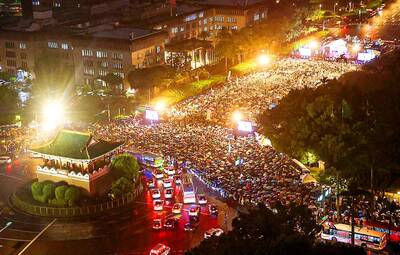
FINAL COUNTDOWN: About 50,000 attended a pro-recall rally yesterday, while the KMT and the TPP plan to rally against the recall votes today Democracy activists, together with arts and education representatives, yesterday organized a motorcade, while thousands gathered on Ketagalan Boulevard in Taipei in the evening in support of tomorrow’s recall votes. Recall votes for 24 Chinese Nationalist Party (KMT) lawmakers and suspended Hsinchu City mayor Ann Kao (高虹安) are to be held tomorrow, while recall votes for seven other KMT lawmakers are scheduled for Aug. 23. The afternoon motorcade was led by the Spring Breeze Culture and Arts Foundation, the Tyzen Hsiao Foundation and the Friends of Lee Teng-hui Association, and was joined by delegates from the Taiwan Statebuilding Party and the Taiwan Solidarity
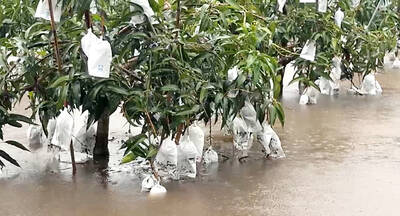
TRANSPORT DISRUPTION: More than 100 ferry services were suspended due to rough seas and strong winds, and eight domestic flights were canceled, the ministry said Tropical Storm Wipha intensified slightly yesterday as it passed closest to Taiwan, dumping more than 200mm of rain in Hualien and Taitung counties, the Central Weather Administration (CWA) said. As of 11am, Wipha was about 210km southwest of Cape Oluanpi (鵝鑾鼻) and was moving west-northwest at 27km per hour (kph). The storm carried maximum sustained winds of 101kph and gusts reaching 126kph, with a 150km radius of strong winds, CWA data showed. Wipha’s outer rainbands began sweeping across Taiwan early yesterday, delivering steady rainfall in the east and scattered showers in other regions, forecasters said. More heavy rain was expected, especially in the eastern


 RSS
RSS