

An international meeting on coral reef observatories held in southern Taiwan concluded on Friday that a global sensor network for monitoring coral reef ecosystems should be set up to better conserve ocean habitats threatened by global warming.
The Global Coral Reef Environmental Observatory Network (CREON) Integration Meeting was attended by some 60 scientists and engineers from Taiwan, the US, Australia, Japan, South Korea, Malaysia, Thailand and Costa Rica.
CREON, an association striving to design and build marine sensor networks, held the meeting with the Pacific Rim Applications and Grid Middleware Assembly, an internationally renowned grid community with rich expertise in resources, bioscience, telescience and geoscience.
High-tech sensor networks combine data and information collected through remote satellite measurement, early warning systems and monitoring stations in oceans, allowing researchers to review coral reef ecosystems in real time and in different dimensions such as 3D.
The meeting reviewed the performance of sensor networks deployed in coral reef areas in the Great Barrier Reef in Australia, Moorea in French Polynesia, and the Houbihu (
A sensor network was deployed in Kenting's coral reef area a few years ago by a research team of Kenting's National Museum of Marine Biology, with the help of CREON. The team has wide experience in coral reef conservation.
Kenting's coral reefs had an average coverage of 40 percent after last year's reef bleaching crisis. Other coral reef areas in Pacific and Indian oceans had coverage of only 20 percent on average after the bleaching crisis.
Other conclusions reached include designating the Houbihu area as a reference resource in conservation, and holding a meeting every year in Kenting to integrate data and information.
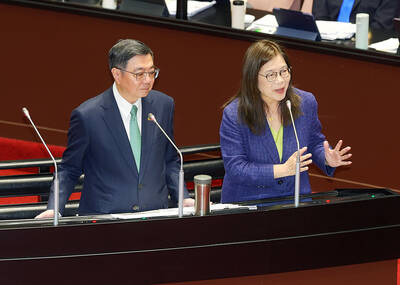
The donation of offshore patrol vessel Kinmen to the Philippines includes provisions that protect Taiwanese fishers and facilitate security cooperation across the First Island Chain, officials said yesterday. The comment was made during the Cabinet’s comprehensive administrative report at the legislature after Chinese Nationalist Party (KMT) Legislator Hsu Yu-chen (許宇甄) expressed concerns about the decision to give a ship to a country whose coast guard had in 2013 fired on a Taiwanese trawler and killed its captain without provocation. The Cabinet should lay out the safeguards that have been established to prevent the Philippine government from using the Kinmen to harass, expel
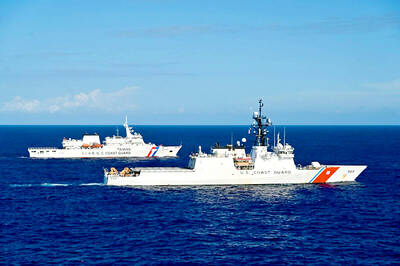
GROWING TIES: The CGA is planning a goodwill mission to the Philippines, in what would be the first time since 1975 a Taiwanese paramilitary vessel has visited the country The Coast Guard Administration (CGA) plans to significantly expand its participation in international security cooperative frameworks and its operational capabilities, a budget proposal for next year showed. The budget indicates a transformation of the CGA from a maritime law enforcement arm into a national defense and intelligence gathering entity capable of tackling larger regional security matters. The proposal showed that personnel from the coast guard’s Intelligence Division and Special Action Support Center are to participate in high-level national security talks with the US. As the CGA has dealt with China’s rising “gray zone” threats around Taiwan, it has become a valuable asset to
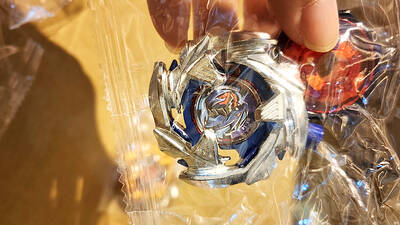
The National Police Agency’s Third Special Police Corps yesterday said that from May to July, it intercepted five smuggling operations from China, seizing more than 70,000 counterfeit Beyblades with an estimated infringement value of NT$34.45 million (US$1.08 million). It added that any bootleg unit that reached the local market could present hidden health hazards to players. Beyblades, a line of spinning toy tops used in competitive gaming and developed in Japan by toy company Takara Tomy, have become popular in Taiwan, making them a target for fraudsters. The Third Special Police Corps, dedicated to safeguarding maritime borders and trade lines,
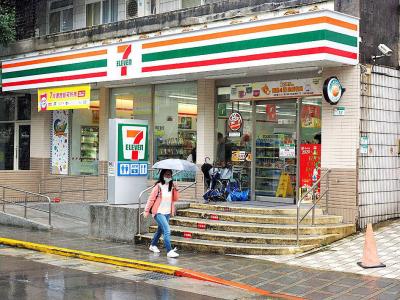
Five customers who made purchases at 7-Eleven stores across Taiwan won the top NT$10 million (US$313,716) special prize in the July-August uniform invoice lottery, including one who spent just NT$27 on photocopying, the convenience store chain said today. The five special prize winners made their purchases at stores in Taoyuan, Taipei, Taichung and Kaohsiung, 7-Eleven operator President Chain Store Corp said. The five winning purchases included NT$29 spent on snacks at a store in Taoyuan's Zhongli District (中壢), NT$27 on photocopying at a store in Taipei's Zhongzheng District (中正), NT$139 on City Cafe coffee and daily necessities at a store in Taipei's


 RSS
RSS