

The legal system will determine whether a controversial Chinese-language weekly newspaper is illegally undermining the campaign of Chinese Nationalist Party (KMT) presidential candidate Ma Ying-jeou (馬英九), Premier Chang Chun-hsiung (張俊雄) said yesterday.
"The Executive Yuan is in favor of handling the matter in accordance with the law, but respects the prosecutor's decision and action in the legal proceedings," Chang said on the legislative floor.
KMT Legislator Wu Yu-sheng (吳育昇) had asked the government to confiscate copies of Taiwan Weekly, which has published a series of unsubstantiated accusations against leading KMT figures and their family members, and probe the newspaper's publisher.
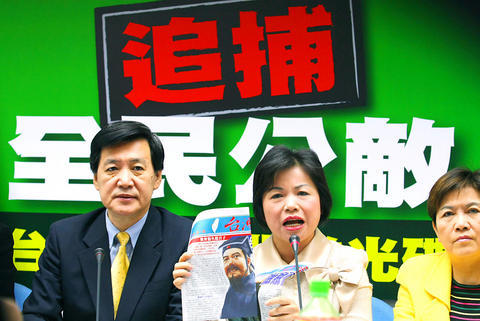
PHOTO: CNA
Wu accused the publishers of violating Article 104 of the Public Officials Election and Recall Act (公職人員選舉罷免法), which states that people who spread inaccurate information to undermine candidates may be sentenced to a maximum of five years in prison, Wu said.
Copy in the latest edition of the publication states that more than 150,000 free copies have been distributed since it was launched on Feb. 29.
In its first issue, the weekly claimed that KMT vice presidential candidate Vincent Siew (
Both Siew and Chow have denied the charges and taken legal action.
Minister of Justice Morley Shih (施茂林) said yesterday he would refer the case to the state public prosecutor-general.
Nevertheless, KMT Legislator Chang Hsien-yao (張顯耀) criticized the Government Information Office (GIO) for failing to record and verify the identity and address of Taiwan Weekly's publisher.
In response, a GIO official who wished to remain anonymous said that, since the Publication Act (出版法) was abolished in 1999, people are free to issue a publication without registering with the office.
The KMT caucus also accused Central News Agency (CNA), the state-sponsored news agency, of being involved in the production of Taiwan Weekly because the publication carried photos provided by CNA.
Later yesterday, CNA issued a statement saying that the photos, 13 in total, were purchased by a group named "Tai-wen Magazine Club" for NT$15,120.
Meanwhile, in a statement issued late on Wednesday night, Ma accused his Democratic Progressive Party (DPP) rival, Frank Hsieh (謝長廷), of planning to attack his late father.
"My rival's campaign team has attacked my wife and my daughters recently, and I've heard that my late father will be the next target of their smear campaign," Ma said in the statement.
"As a son, I am asking my rival to allow my late father to rest in peace. I urge Hsieh's campaign team to focus on public policies because these issues are what the public care about," it said,
Ma said in the statement that his late father was not a perfect person, but his past should be buried with his ashes, rather than being dug up, distorted and exaggerated by his rival or the media.
Ma's father Ma Ho-ling (
Ma spokesman Luo Chih-chiang (
Hsieh spokesman Chao Tien-lin (
"How does Ma Ying-jeou know what the newspaper is going to publish? Are he or his aides present at editorial meetings with the newspaper's staff?" Chao asked.
At a separate setting yesterday, Hsieh said he was occupied with criticizing his rival's "one China" market proposal and saw no need to change the focus of his attack.
"It is [my] opponent who wishes to change the subject, so it is obvious who is benefitting from the Taiwan Weekly controversy," Hsieh said.
ADDITIONAL REPORTING BY STAFF WRITER
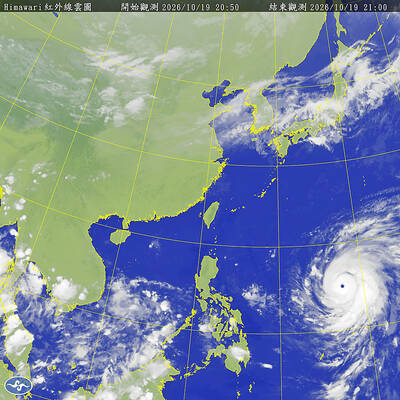
Typhoon Champi is forecast to turn northward earlier than previously expected, sparing Taiwan a direct hit but still bringing heavy rain to the north of the country on Friday and Saturday, the Central Weather Administration (CWA) said yesterday. Typhoon Champi had strengthened and increased in size over the past 12 hours, and as of yesterday afternoon, was packing sustained winds of 198kph near its center, CWA forecaster Cheng Chieh-jen (鄭傑仁) said. However, due to the weakening of a Pacific high-pressure system the storm is now expected to turn northward earlier than initially forecast, likely around Japan’s Ishigaki Island, Cheng said. As Champi brushes
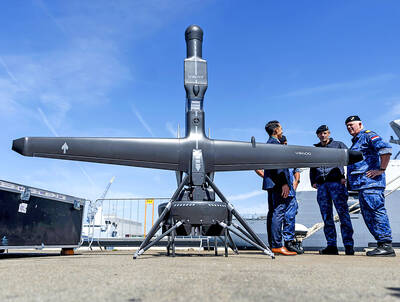
DEFENSE PROCUREMENT: Taiwan could become the largest operator of V-BAT drones outside the US once they are delivered, the Ministry of National Defense said The navy and the coast guard are acquiring 292 units of MQ-35A V-BAT vertical takeoff and landing (VTOL) surveillance drones manufactured by US-based defense technology company Shield AI, making Taiwan one of the largest buyers of the drone. The Coast Guard Administration budgeted NT$1.2 billion (US$37.1 million) to buy 12 drones, which have been delivered, Shield AI said in a report on Oct 13. The navy is planning to spend NT$36 billion under a four-year program code-named Project Yuan Xiao (遠鴞) to acquire 280 V-BAT drones, the Ministry of National Defense’s fiscal 2027 report showed. The combined procurement is expected

MAYORAL RACE: Su Chiao-hui made gains by persuading undecided voters and winning over voters in KMT-leaning districts, a pollster said Legislator Su Chiao-hui (蘇巧慧), the Democratic Progressive Party’s (DPP) candidate for New Taipei City mayor, has a 13.1 percentage point lead over her Chinese Nationalist Party (KMT) rival Lee Shu-chuan (李四川), a poll released yesterday showed. The poll, commissioned by the Taipei Trust in Democracy Association, showed that 43.1 percent of respondents said they would vote for Su, up 7.9 percentage points from a poll conducted in late August, while support for Lee was at 30 percent, down 4.7 percentage points. It showed that 48.6 percent of respondents thought Su would make a suitable mayor, compared with 35.9 percent for Lee. Independent candidate
A Chinese People's Liberation Army (PLA) Navy aircraft carrier group was being monitored after entering the western Pacific, the Ministry of National Defense said today, after Beijing yesterday criticized Taiwan for using a water cannon against a Chinese fishing boat near the Pratas Islands (Dongsha Islands, 東沙群島). A Chinese naval task group led by the aircraft carrier Liaoning (遼寧) yesterday sailed to the western Pacific for training, Chinese state-run Xinhua news agency quoted the PLA Navy as saying. “The drill is part of the annual routine training plan aimed at testing and improving the troops’ combat readiness and enhancing their ability to


 RSS
RSS