


The Cabinet yesterday approved a draft statute on streamlining the Cabinet, cutting the number of agencies under it from 36 to 26.
Premier Chang Chun-hsiung (
Although a number of Cabinet members had questioned the need for instituting a ministry to deal with veterans' affairs, Cabinet spokesman Shieh Jhy-wey (謝志偉) told a news conference after the meeting that Taiwan's move toward a volunteer military service would still necessitate the creation of a ministry to care for veterans.
Chang said that the draft bill, along with amendments to the Organic Standard Law of Central Government Agencies (
With the new legislative session scheduled to start on Friday, the Cabinet will seek to actively cooperate with the legislature to speed up the restructuring of the executive branch of the government, the premier said.
Under the draft bill, six new ministries would be established under the Executive Yuan to add to the eight ministries mandated by the Organic Law of the Executive Yuan.
The 14 ministries would cover interior and homeland security, foreign and overseas affairs, defense, finance, education and sports, justice, economic affairs, transportation and construction, labor and human resources, agriculture, public health and social welfare, environmental resources, tourism and culture, and veterans' affairs.
The seven commissions would cover a new technology commission, a new maritime council, a new commission on gender equality, a new national development commission, the Hakka Council, the Council of Indigenous Peoples and the Mainland Affairs Council.
The five independent institutions are the Central Bank of China, the Central Election Commission, the Fair Trade Commission, the Financial Supervisory Commission and the National Communication Commission.
The restructured Executive Yuan will also add two deputy secretary generals, one of which will help the secretary general with administrative affairs and the other to act as the body's spokesman.
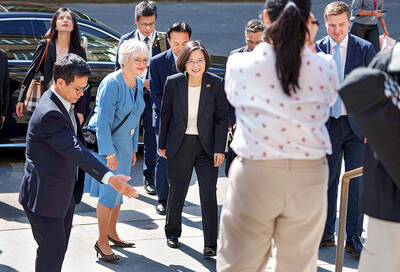
Former president Tsai Ing-wen (蔡英文) on Monday called for greater cooperation between Taiwan, Lithuania and the EU to counter threats to information security, including attacks on undersea cables and other critical infrastructure. In a speech at Vilnius University in the Lithuanian capital, Tsai highlighted recent incidents in which vital undersea cables — essential for cross-border data transmission — were severed in the Taiwan Strait and the Baltic Sea over the past year. Taiwanese authorities suspect Chinese sabotage in the incidents near Taiwan’s waters, while EU leaders have said Russia is the likely culprit behind similar breaches in the Baltic. “Taiwan and our European

The Taipei District Court sentenced babysitters Liu Tsai-hsuan (劉彩萱) and Liu Jou-lin (劉若琳) to life and 18 years in prison respectively today for causing the death of a one-year-old boy in December 2023. The Taipei District Prosecutors’ Office said that Liu Tsai-hsuan was entrusted with the care of a one-year-old boy, nicknamed Kai Kai (剴剴), in August 2023 by the Child Welfare League Foundation. From Sept. 1 to Dec. 23 that year, she and her sister Liu Jou-lin allegedly committed acts of abuse against the boy, who was rushed to the hospital with severe injuries on Dec. 24, 2023, but did not
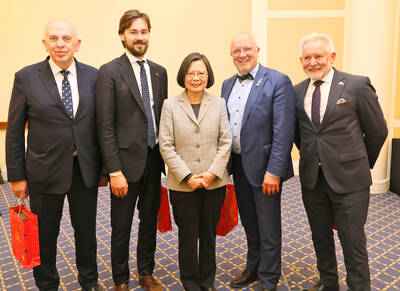
LIKE-MINDED COUNTRIES: Despite the threats from outside, Taiwan and Lithuania thrived and developed their economies, former president Tsai Ing-wen said Former president Tsai Ing-wen (蔡英文) on Saturday thanked Lithuania for its support of Taiwan, saying that both countries are united as partners in defending democracy. Speaking at a reception organized by the Lithuania-Taiwan Parliamentary Friendship Group welcoming her on her first visit to the Baltic state, Tsai said that while she was president from 2016 to last year, many Lithuanian “friends” visited Taiwan. “And I told myself I have to be here. I am very happy that I am here, a wonderful country and wonderful people,” Tsai said. Taiwan and Lithuania are in similar situations as both are neighbors to authoritarian countries, she

Former president Tsai Ing-wen (蔡英文) is to visit the UK during her ongoing European trip, which originally included only Lithuania and Denmark, her office said today. Tsai departed Taiwan for Europe on Friday night, with planned stops in Lithuania and Denmark, marking her second visit to the continent since her two-term presidency ended in May last year. Her office issued a statement today saying that Tsai would also visit the UK "for a few days," during which she is to meet with UK politicians and Taiwanese professionals, and visit academic and research institutions. Following Tsai's stop in Denmark, she is to visit the


 RSS
RSS