


"It was cold and chilly and like now it was close to the Lunar New Year," said retired professor Wu Yi-man (吳漪曼), remembering Jan. 27, 1949, when she and her cousin stood at Keelung Harbor, waiting for her father who was coming to Taiwan on the cross-strait steamer the Taiping (太平輪).
Fifty-nine years have passed, and like Wu the family members of passengers again stood near the same harbor on the same day of the year, in the same sprinkling rain. But this time, they were holding a minute of silence in front of a monument.
"In memory of those passengers who died in the Taiping sinking," the characters on the monument read.
In January 1949, when the Chinese Communist Party clearly had the upper hand in the Chinese Civil War against the Chinese Nationalist Party (KMT) regime, waves of Mainlanders were anxious to escape their war-torn hometowns and head for safety, with Taiwan being the most popular destination.
Two million mainlanders are estimated to have migrated to Taiwan, which at the time had a population of just 6 million.
Among the migrants were more than 1,500 people who crowded onto the Taiping on the eve of Jan. 27 -- although only 508 tickets were sold for the journey.
"Because it was so chaotic in [China] at the time, my father was coming to Taiwan to see if it was possible to move the National Conservatory of Music in Nanjing to here," Wu Yi-man said.
Wu Yi-man's father, Wu Poh-chao (吳伯超), was the president of the conservatory, while she was 17 and studying music at National Taiwan Normal University (NTNU) in Taipei. Wu Yi-man later became a music professor at several universities, including NTNU.
"My cousin and I went to Keelung to wait for my father, while my mother stayed in Taipei preparing a big dinner -- it was `Little Lunar New Year's Eve' that night," Wu Yi-man said.
"Little Lunar New Year's Eve" is a festive night that falls on the day before the official Lunar New Year's Eve.
"It was odd that no one was at the harbor when we arrived, so we asked and found out that the Taiping had sunk," Wu Yi-man said.
"My father was our family's only source of income, we -- my mother and I -- both suffered a great deal after his death," she said.
According to Searching for the Taiping (
Although the steamer was sailing at night, the lights were all out because of a curfew.
Not long before midnight, a smaller cargo boat, the Chienyuan (建元輪), ran into the practically invisible Taiping near the Zhoushan Archipelago (舟山群島) off the coast of China's Zhejiang Province and quickly sank.
Wang Shu-liang (
"My brother was on the boat, watching some new friends he met on board playing poker, and all of a sudden, they heard a big bang," Wang said. "So the others asked my brother to go see what had happened."
Water started flowing in soon after Wang Kuo-fu started walking toward the source of the noise, "and he was never seen again," Wang Shu-liang said, adding that the story was told to her by one of the survivors.
The fate of the Wang family was changed forever.
Wang Kuo-fu was planning to get married after the Lunar New Year; their younger sister, who was also engaged, ended up falling ill after hearing the bad news and eventually died, Wang Shu-liang said.
"We never dared tell my parents about my brother's death, so they believed he was alive until their own deaths," she said.
As the monument is now located within the perimeter of a naval base with restricted access, victims' family members hoped that it could be moved to a public place so that everyone can learn about the tragedy.
"It bears an important historical meaning and should be seen by more people," Wu Yi-man said. "It's really inconveniently located within the naval base."

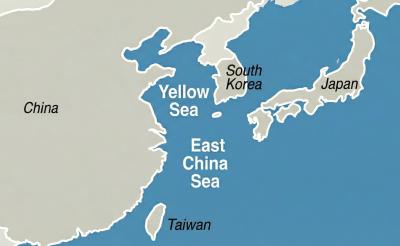
China has reserved offshore airspace in the Yellow Sea and East China Sea from March 27 to May 6, issuing alerts usually used to warn of military exercises, although no such exercises have been announced, the Wall Street Journal (WSJ) reported yesterday. Reserving such a large area for 40 days without explanation is an “unusual step,” as military exercises normally only last a few days, the paper said. These alerts, known as Notice to Air Missions (Notams), “are intended to inform pilots and aviation authorities of temporary airspace hazards or restrictions,” the article said. The airspace reserved in the alert is

NAMING SPAT: The foreign ministry called on Denmark to propose an acceptable solution to the erroneous nationality used for Taiwanese on residence permits Taiwan has revoked some privileges for Danish diplomatic staff over a Danish permit that lists “Taiwan” as “China,” Eric Huang (黃鈞耀), head of the Ministry of Foreign Affairs’ Department of European Affairs, told a news conference in Taipei yesterday. Reporters asked Huang whether the Danish government had responded to the ministry’s request that it correct the nationality on Danish residence permits of Taiwanese, which has been listed as “China” since 2024. Taiwan’s representative office in Denmark continues to communicate with the Danish government, and the ministry has revoked some privileges previously granted to Danish representatives in Taiwan and would continue to review
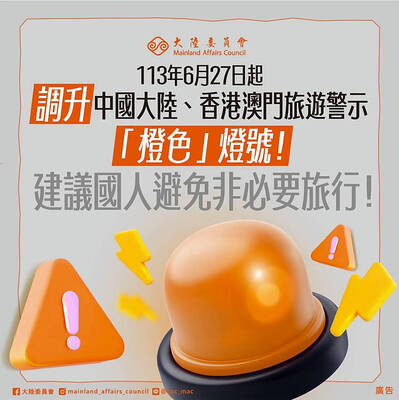
More than 6,000 Taiwanese students have participated in exchange programs in China over the past two years, despite the Mainland Affairs Council’s (MAC) “orange light” travel advisory, government records showed. The MAC’s publicly available registry showed that Taiwanese college and university students who went on exchange programs across the Strait numbered 3,592 and 2,966 people respectively. The National Immigration Agency data revealed that 2,296 and 2,551 Chinese students visited Taiwan for study in the same two years. A review of the Web sites of publicly-run universities and colleges showed that Taiwanese higher education institutions continued to recruit students for Chinese educational programs without
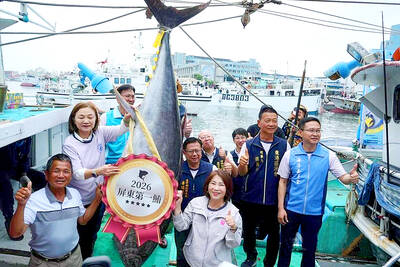
The first bluefin tuna of the season, brought to shore in Pingtung County and weighing 190kg, was yesterday auctioned for NT$10,600 (US$333.5) per kilogram, setting a record high for the local market. The auction was held at the fish market in Donggang Fishing Harbor, where the Siaoliouciou Island-registered fishing vessel Fu Yu Ching No. 2 delivered the “Pingtung First Tuna” it had caught for bidding. Bidding was intense, and the tuna was ultimately jointly purchased by a local restaurant and a local company for NT$10,600 per kilogram — NT$300 ,more than last year — for a total of NT$2.014 million. The 67-year-old skipper


 RSS
RSS