


Chinese Nationalist Party (KMT) caucus whip Kuo Su-chun (
Kuo made the remarks after the Central News Agency on Thusday quoted an anonymous legislator who attended a luncheon with People First Party (PFP) Chairman James Soong (
Kuo said the KMT was not against referendums, but opposes holding plebiscites in conjunction with the legislative and presidential polls.
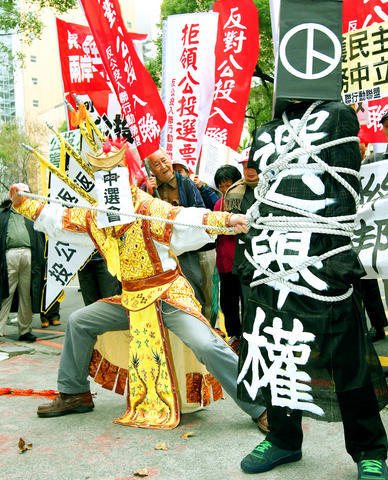
PHOTO: CNA
The nation has been plagued for months by the dispute over whether referendums should be scheduled on the same days as the elections, she said.
"It would be a good thing if we could draw up clear rules of the game in this matter," she said.
At a separate setting, Presidential Office Deputy Secretary-General Chen Chi-mai (
"No conclusion was reached on his suggestion during the meeting," Chen Chi-mai said.
Chen Chi-mai said the president had not yet decided whether to launch a third referendum to be put to a vote in conjunction with the other UN referendums.
He was referring to Democratic Progressive Party (DPP) presidential candidate Frank Hsieh's (謝長廷) suggestion earlier this week to hold a referendum on joining the UN that is phrased such that both political camps approve, to prevent the referendums from failing and giving the international community the impression that the Taiwanese do not want to join the global body.
Since there is not enough time before the referendum date for members of the public to initiate a third plebiscite, the DPP suggested either the legislature or the president initiate the referendum application.
Article 17 of the Referendum Law states: "When the nation is exposed to an external threat that may affect its sovereignty, the president may, following a resolution by the Executive Yuan, place national security matters before the public for decision in a referendum," known as a "defensive referendum."
The legislature is also authorized to initiate referendums.
However, the Central Election Commission (CEC) is required to announce the content of a referendum 28 days before the vote. The legislature would have to present the application for a third UN referendum to the CEC by Feb. 23.
Although the DPP said it was willing to cooperate with the KMT on a referendum concerning UN membership, the DPP is opposed to the KMT caucus' proposal to pass a binding resolution that requires the government to "return to" or "join" the UN using the national title "Republic of China [ROC]" once the new legislature convenes.
The KMT said on Thursday this would resolve the UN referendum dispute.
According to a a senior KMT official, who spoke on condition of anonymity, such a resolution, if ratified by the new legislature, would reflect the public's willingness to join the international body, while making it unnecessary for the government to hold any referendum on UN membership.
DPP Department of Information and Culture Deputy Director Hsieh Hsin-ni (
Voting in referendums is a way for the public to express their "Taiwanese consciousness," she said. Dropping the referendums and passing a resolution would be an insult to the public, she said.

PRAISE: Japanese visitor Takashi Kubota said the Taiwanese temple architecture images showcased in the AI Art Gallery were the most impressive displays he saw Taiwan does not have an official pavilion at the World Expo in Osaka, Japan, because of its diplomatic predicament, but the government-backed Tech World pavilion is drawing interest with its unique recreations of works by Taiwanese artists. The pavilion features an artificial intelligence (AI)-based art gallery showcasing works of famous Taiwanese artists from the Japanese colonial period using innovative technologies. Among its main simulated displays are Eastern gouache paintings by Chen Chin (陳進), Lin Yu-shan (林玉山) and Kuo Hsueh-hu (郭雪湖), who were the three young Taiwanese painters selected for the East Asian Painting exhibition in 1927. Gouache is a water-based
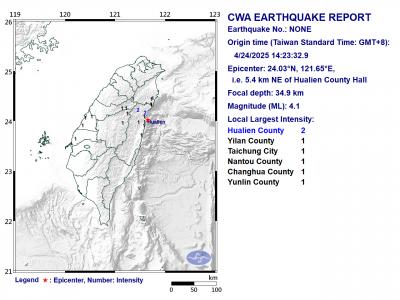
A magnitude 4.1 earthquake struck eastern Taiwan's Hualien County at 2:23pm today, according to the Central Weather Administration (CWA). The epicenter of the temblor was 5.4 kilometers northeast of Hualien County Hall, at a depth of 34.9 km, according to the CWA. The earthquake's intensity, which gauges the actual effect of a temblor, was the highest in Hualien County, where it measured 2 on Taiwan's 7-tier intensity scale. The quake also measured an intensity of 1 in Yilan county, Taichung, Nantou County, Changhua County and Yunlin County, the CWA said. There were no immediate reports of damage or injuries.
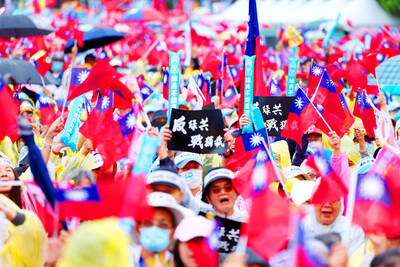
‘WORSE THAN COMMUNISTS’: President William Lai has cracked down on his political enemies and has attempted to exterminate all opposition forces, the chairman said The legislature would motion for a presidential recall after May 20, Chinese Nationalist Party (KMT) Chairman Eric Chu (朱立倫) said yesterday at a protest themed “against green communists and dictatorship” in Taipei. Taiwan is supposed to be a peaceful homeland where people are united, but President William Lai (賴清德) has been polarizing and tearing apart society since his inauguration, Chu said. Lai must show his commitment to his job, otherwise a referendum could be initiated to recall him, he said. Democracy means the rule of the people, not the rule of the Democratic Progressive Party (DPP), but Lai has failed to fulfill his

OFF-TARGET: More than 30,000 participants were expected to take part in the Games next month, but only 6,550 foreign and 19,400 Taiwanese athletes have registered Taipei city councilors yesterday blasted the organizers of next month’s World Masters Games over sudden timetable and venue changes, which they said have caused thousands of participants to back out of the international sporting event, among other organizational issues. They also cited visa delays and political interference by China as reasons many foreign athletes are requesting refunds for the event, to be held from May 17 to 30. Jointly organized by the Taipei and New Taipei City governments, the games have been rocked by numerous controversies since preparations began in 2020. Taipei City Councilor Lin Yen-feng (林延鳳) said yesterday that new measures by


 RSS
RSS