


Following its landslide victory in the legislative elections yesterday, the Chinese Nationalist Party (KMT) strengthened its power as the majority party in the legislature by sweeping 81 of 113 legislative seats.
The party won 57 of the 73 district seats and 20 of the 34 legislator-at-large seats. Together with the seats won by Non-Partisan Solidarity Union, the pan-blue camp occupied more than three fourths of the legislative seats.
Gathering on the podium at KMT headquarters at 9pm, KMT heavyweights including party chairman Wu Poh-hsiung (吳伯雄), KMT presidential candidate Ma Ying-jeou (馬英九), Legislative Speaker Wang Jin-pyng (王金平) and former KMT chairman Lien Chan (連戰) thanked supporters for trusting the party with such a heavy responsibility and vowed to take advantage of the majority to improve the effectiveness of the legislature and drive society forward.
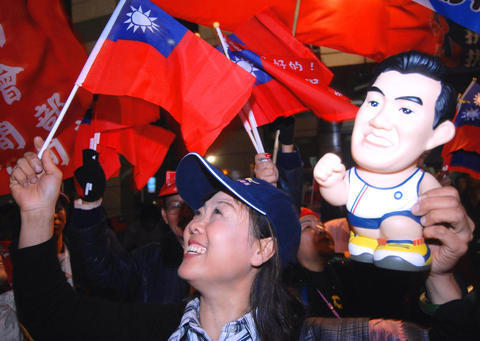
PHOTO: SAM YEH, AFP
"We will not abuse the power as the majority in the legislature. The KMT will take the advantage as the majority party to improve the effectiveness of the legislature. In the meantime, we will respect the minority," Wu said.
While stressing that the party would take a "very cautious and humble attitude" in embracing its victory, Ma said the KMT's landslide victory reflected the people's yearning for change, pledging to push for national policies that would stabilize society.
"This is the first time since 1993 that the KMT has had so much power. People in Taiwan are asking for change and we must put the people above the party, fulfilling our duty with humility and meeting their expectations," Ma said.
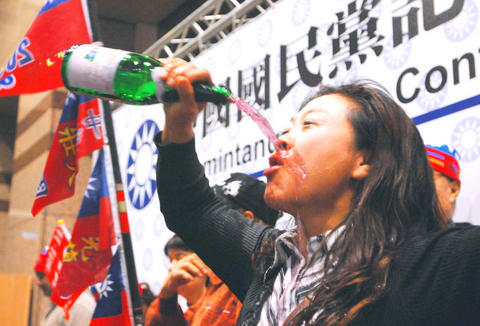
PHOTO: CNANWARNING: EXCESSIVE CONSUMPTION OF ALCOHOL CAN DAMAGE
Asked whether the Democratic Progressive Party (DPP) defeat would rally pan-green supporters during the presidential election in March, Ma said the KMT would seek to "take advantage of this win to achieve another win in March."
Long before the KMT responded to the party victory, hundreds of supporters already cramped the headquarters shouting "Go, go, Ma Ying-jeou! Go, go, KMT!"
Watching the vote-counting updates on-screen at headquarters, the supporters shouted and clapped hands as the KMT continued to grab seats, waving national flags, popping up champagne and letting off firecrackers to express their excitement.
Wang said yesterday he expected the party to continue pushing for more bills in the legislature, while declining to confirm whether he would seek re-election as legislative speaker.
Wu said the party had reached a consensus on promoting Wang as the new legislative speaker.
"As to the vice speaker, we will come up with a democratic mechanism to choose the candidate among promising hopefuls. I will not tolerate any party members causing a split in order to get the position," Wu said.
Wu also denied the party would seek to impeach the president with its majority in the new legislature and pledged not to push for the constitutional reform in the next two years.
"We thank voters for giving us a chance and we cherish this opportunity very much. I promise you that we will not use the majority power recklessly," he said.
In response to President Chen Shui-bian's (
New Party Chairman Yok Mu-ming (郁慕明) yesterday expressed regret over the party's failure to pass the 5 percent threshold to qualify for representation in the legislature and urged the parties to examine the single-district, two-vote mechanism.
The party nominated 10 legislator-at-large candidates, including KMT Legislator Joanna Lei (
Yok said the 5 percent threshold was too high for small parties and called on all parties not to ignore the voice of small parties.
"The total of 12 percent of the ballots small parties received showed that about 1 million voters wanted change. The voice should not remain unheard," Yok said.
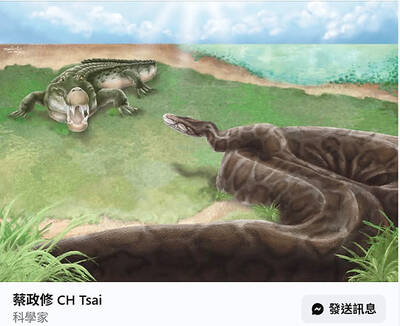
Taiwanese paleontologists have discovered fossil evidence that pythons up to 4m long inhabited Taiwan during the Pleistocene epoch, reporting their findings in the international scientific journal Historical Biology. National Taiwan University (NTU) Institute of Ecology and Evolutionary Biology associate professor Tsai Cheng-hsiu (蔡政修) led the team that discovered the largest snake fossil ever found in Taiwan. The single trunk vertebra was discovered in Tainan at the Chiting Formation, dated to between 400,000 and 800,000 years ago in the Middle Pleistocene, the paper said. The area also produced Taiwan’s first avian fossil, as well as crocodile, mammoth, saber-toothed cat and rhinoceros fossils, it said. Discoveries

Taiwanese paleontologists have discovered fossil evidence that pythons up to 4m long inhabited Taiwan during the Pleistocene epoch, reporting their findings in the international scientific journal Historical Biology. National Taiwan University (NTU) Institute of Ecology and Evolutionary Biology associate professor Tsai Cheng-hsiu (蔡政修) led the team that discovered the largest snake fossil ever found in Taiwan. A single trunk vertebra was discovered in Tainan at the Chiting Formation, dated to between 800,000 to 400,000 years ago in the Middle Pleistocene, the paper said. The area also produced Taiwan’s first avian fossil, as well as crocodile, mammoth, sabre-toothed cat and rhinoceros fossils, it said. Discoveries
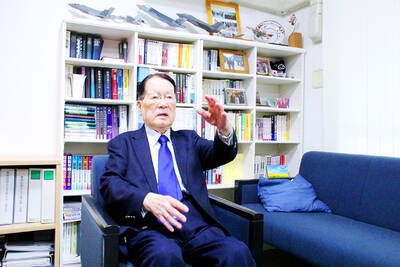
Whether Japan would help defend Taiwan in case of a cross-strait conflict would depend on the US and the extent to which Japan would be allowed to act under the US-Japan Security Treaty, former Japanese minister of defense Satoshi Morimoto said. As China has not given up on the idea of invading Taiwan by force, to what extent Japan could support US military action would hinge on Washington’s intention and its negotiation with Tokyo, Morimoto said in an interview with the Liberty Times (sister paper of the Taipei Times) yesterday. There has to be sufficient mutual recognition of how Japan could provide
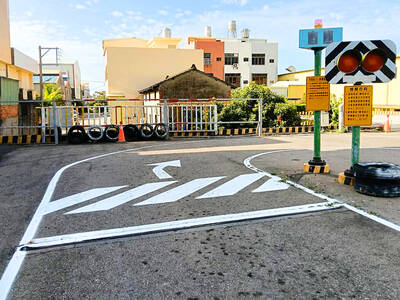
UPDATED TEST: The new rules aim to assess drivers’ awareness of risky behaviors and how they respond under certain circumstances, the Highway Bureau said Driver’s license applicants who fail to yield to pedestrians at intersections or to check blind spots, or omit pointing-and-calling procedures would fail the driving test, the Highway Bureau said yesterday. The change is set to be implemented at the end of the month, and is part of the bureau’s reform of the driving portion of the test, which has been criticized for failing to assess whether drivers can operate vehicles safely. Sedan drivers would be tested regarding yielding to pedestrians and turning their heads to check blind spots, while drivers of large vehicles would be tested on their familiarity with pointing-and-calling


 RSS
RSS