


Contrary to their Democratic Progressive Party (DPP) and the Chinese Nationalist Party (KMT) counterparts, which have budgets from electoral campaigns, legislator hopefuls running under the banner of smaller parties rely mostly on donations from supporters to run their campaign activities.
Given their limited financial resources, small parties candidates often opt for more "economical" ways, such as e-mail campaigns and blogs, to promote their candidacies, as opposed to their resourceful counterparts, who hold big campaign rallies, run TV spots and print copious campaign brochures.
"The traditional campaign style resorts to passion, whereas most of our Green Party Taiwan supporter are considered more of idealists," said Pan Han-shen (潘翰聲), a Green Party legislative candidate. "[We] rely mostly on small donations [from our supporters], we even bring our own water bottles when we are out on the streets."
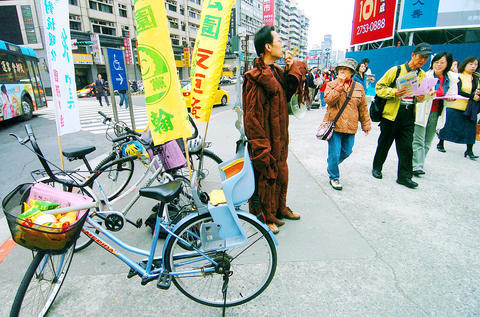
PHOTO: CHIEN JUNG-FONG, TAIPEI TIMES
Legislative hopefuls from The Third Society Party do not have their own individual campaign offices.
Third Society Party founder and legislative candidate Jou Yi-cheng (
"We do not have a lot of money for campaign events, so it's impossible for us to waste any of our money," he said.
With their seemingly bottomless resources, KMT legislative candidates, on the other hand, are often the envy of smaller parties.
With the support from the party's affluent party assets, each KMT legislative candidate receives an aggregate budget of NT$5 million (US$156,000) from the party in subsidies for campaign spending.
KMT Taipei City Headquarters head Pan Chia-sen (潘家森) said the money is wired to special campaign accounts set up by the candidates.
"This is legal political donation for campaign activities. Whoever receives this money must report it to the tax bureau as political donations," he said.
Given that most KMT candidates are current lawmakers, their better-known names also give them an advantage when soliciting donations, he said.
Although the DPP does not subsidize its legislative candidates, being the governing party has helped candidates receive donations.
DPP campaign aides said that party candidates receive donations from high-ranking party officials, with the amounts varying on an individual basis.
The bus advertisement industry, meanwhile, said that compared with previous elections, there had been a decline this time around in requests from legislative candidates to place ads on buses.
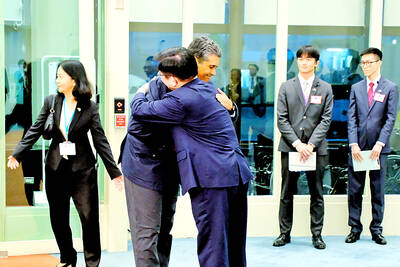
Palauan President Surangel Whipps Jr arrived in Taiwan last night to kick off his first visit to the country since beginning his second term earlier this year. After arriving at Taoyuan International Airport at around 6:30 pm, Whipps and his delegation were welcomed by Minister of Foreign Affairs Lin Chia-lung (林佳龍). Speaking to gathered media, the Palauan leader said he was excited and honored to be back in Taiwan on his first state visit to Taiwan since he was sworn in this January. Among those traveling with Whipps is Minister of State Gustav N. Aitaro, Public Infrastructure
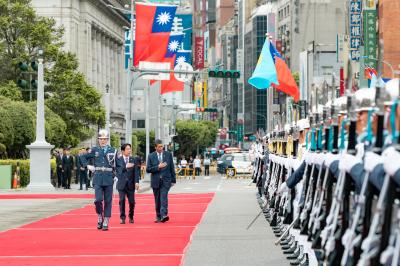
President William Lai (賴清德) yesterday thanked Palau for its continued support of Taiwan's international participation, as Taipei was once again excluded from the World Health Assembly (WHA) currently taking place in Switzerland. "Palau has never stopped voicing support for Taiwan" in the UN General Assembly, the WHO and other UN-affiliated agencies, Lai said during a bilateral meeting with visiting Palau President Surangel Whipps Jr. "We have been profoundly touched by these endorsements," Lai said, praising the Pacific island nation's firm support as "courageous." Lai's remarks came as Taiwan was excluded for the ninth consecutive year from the WHA, which is being held in
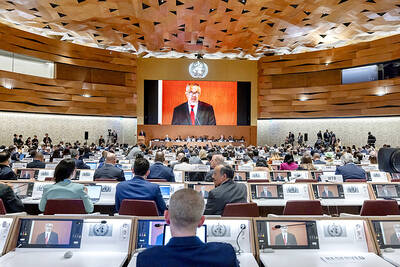
RESOLUTIONS DEBATE: Taiwan’s allies said that UN and WHA resolutions cited by China and other nations ‘do not determine Taiwan’s participation in WHO activities’ A proposal to invite Taiwan to this year’s World Health Assembly (WHA) was rejected on Monday, resulting in Taipei’s absence from the annual meeting for a ninth consecutive year, although partners spoke up for Taiwan’s participation at the first day of the meeting. The first agenda item after the opening was a “two-on-two debate” on a proposal to invite Taiwan to participate at the WHA as an observer. Similar to previous years, two countries made statements in favor of the proposal, while two others expressed their opposition. Philippine Secretary of Health Teodoro Herbosa, president of the 78th WHA, accepted the WHA General Committee’s
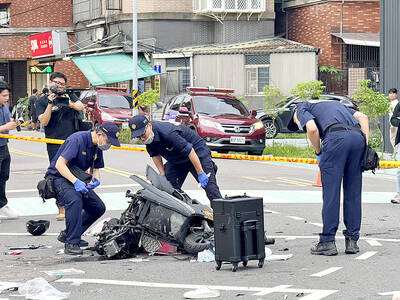
At least three people died and more than a dozen were injured yesterday afternoon when a vehicle struck a group of pedestrians in New Taipei City’s Sansia District (三峽). The incident happened at about 4pm when a car rammed into pedestrians at an intersection near Bei Da Elementary School. Witnesses said the sedan, being driven at a high speed, ran a red light, knocking scooters out of the way and hitting students crossing the road before careening into a median near the intersection of Guocheng and Guoguang streets. The incident resulted in three deaths and 13 injuries, including the driver, a 78-year-old man


 RSS
RSS