


US Congressman Tom Lantos, the powerful chairman of the House Foreign Affairs Committee who has regularly stood up for Taiwan over the years, on Wednesday announced his plans to retire at the end of this year, after learning that he had contracted cancer of the esophagus.
Lantos, 79, is a Holocaust survivor and lifelong champion of human rights. His childhood persecution as a victim of Nazism and anti-Semitism and his experience as a fighter against communism naturally brought him to the defense of Taiwan's democracy and freedom.
A regular visitor to Taiwan, Lantos is a long-time acquaintance of President Chen Shui-bian (陳水扁) and chairman of the Congressional Human Rights Caucus.
He convinced the caucus to give Chen its annual human rights award in 2005.
Nevertheless, Lantos has not been shy to criticize Chen when he felt the president had erred, but such criticism has always been delivered against a backdrop of his concern for Taiwan's greater good.
Lantos' planned retirement makes him the third leading Taiwan supporter in Congress to announce his retirement in recent months.
Former Senate majority leader Trent Lott announced last month that he would retire at the end of last year, and Colorado Congressman Tom Tancredo said he would retire this year.
Lantos assumed the chairmanship of the foreign affairs panel this year after the Democratic Party swept to power in last year's legislative elections. In the largely bipartisan panel, he succeeded the late Henry Hyde, another staunch backer of Taiwan, to the chairmanship.
PUNDITS
Washington pundits immediately began to circulate supposed heirs to Lantos' committee chairmanship. If the Democrats win again this year, they say, there are two leading possibilities: One is Gary Ackerman of New York and the other is Howard Berman of California, both of whom have been among a number of congressmen who have regularly come to Taiwan's defense as political issues concerning Taiwan have emerged over the years.
If the Republicans were to regain control of the House, the ranking member, Ileana Ros-Lehtinen, will likely take over. Like Lantos, Ros-Lehtinen is a firm champion of Taiwan. In any event, the committee's bipartisan affinity for Taiwan is unlikely to change, whoever takes over.
Under Lantos' chairmanship, the House Foreign Affairs Committee took some significant steps to back Taiwan last year.
In July, the House unanimously approved a resolution, which Lantos propelled through the Foreign Affairs Committee, urging the Bush administration to allow Chen and other senior Taiwan officials to visit Washington freely, which they have been barred from doing since Washington granted Beijing diplomatic recognition at the end of 1978.
In September, the committee and House rushed through a bill to press the administration to allow Taiwan to purchase 66 advanced F16 C/D fighter aircraft in the face of a funding deadline that appeared to imperil the sale. In rare legislative speed, Lantos and his Republican counterpart on the committee, Ros-Lehtinen, introduced the bill one day, the committee approved it the next day and the House approved it by voice vote the following week.
But Lantos' support for Taiwan and for Chen goes much deeper than his elevation to the committee chairmanship.
LOOPHOLE
Long a proponent of the idea that Chen and other Taiwanese leaders should be allowed to travel to Washington, which is still forbidden by the State Department, Lantos sidestepped the prohibition in September 2005 when, as human rights caucus chairman, he arranged a teleconference hookup with Chen during a transit stop in Miami, despite State Department rules against Chen conducting "public" activities during his transit.
From a sound studio in the basement of the Capitol, Lantos awarded Chen the caucus' annual human rights award for the president's efforts to promote human rights and political freedom in Taiwan and throughout Asia. Chen replied via closed circuit television from his hotel room, and a Taiwanese envoy later delivered the award to Florida.
In May 2001, when Chen made his historic three-day visit to New York to become the first sitting Taiwanese president to make the trip, Lantos was among 20 House members who took a charter jet to New York to have dinner with him.
During the dinner, Lantos mooted the idea of having the House invite Chen to visit Congress in Washington the following year.
In September 2002, Lantos was one of three congressmen sponsoring a resolution approved unanimously by the House extending Congress' "warmest welcome" to first lady Wu Shu-jen (吳淑珍) in advance of her historic visit to the capital.
The following September, Lantos spoke on the House floor in support of a resolution welcoming Chen on his second New York visit, bemoaning Chen's inability to visit Washington.
"If Taiwan were any other nation, President Chen would be welcomed to a [White House] Rose Garden ceremony, a state dinner and the opportunity to address a joint session of Congress," Lantos said.
DEMOCRACY
Whenever Taiwanese leaders did visit Washington, Lantos was always a prominent attendee at the traditional Congressional receptions held in Capitol ceremonial rooms.
At a reception for Democratic Progressive Party presidential candidate Frank Hsieh (
This past February, when the Congressional Taiwan Caucus celebrated its fifth anniversary in the Capitol, Lantos exclaimed, "What a joy it is to celebrate yet again the friendship between the United States and Taiwan."
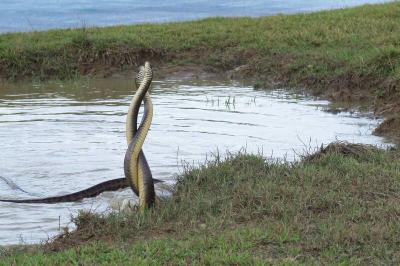
Kenting National Park service technician Yang Jien-fon (楊政峰) won a silver award in World Grand Prix Photography Awards Spring Season for his photograph of two male rat snakes intertwined in combat. Yang’s colleagues at Kenting National Park said he is a master of nature photography who has been held back by his job in civil service. The awards accept entries in all four seasons across six categories: architectural and urban photography, black-and-white and fine art photography, commercial and fashion photography, documentary and people photography, nature and experimental photography, and mobile photography. Awards are ranked according to scores and divided into platinum, gold and

The Chinese Nationalist Party (KMT) caucus yesterday said it opposes the introduction of migrant workers from India until a mechanism is in place to prevent workers from absconding. Minister of Labor Hung Sun-han (洪申翰) on Thursday told the Legislative Yuan that the first group of migrant workers from India could be introduced as early as this year, as part of a government program. The caucus’ opposition to the policy is based on the assessment that “the risk is too high,” KMT caucus secretary-general Lin Pei-hsiang (林沛祥) said. Taiwan has a serious and long-standing problem of migrant workers absconding from their contracts, indicating that

SPACE VETERAN: Kjell N. Lindgren, who helps lead NASA’s human spaceflight missions, has been on two expeditions on the ISS and has spent 311 days in space Taiwan-born US astronaut Kjell N. Lindgren is to visit Taiwan to promote technological partnerships through one of the programs organized by the US for its 250th national anniversary. Lindgren would be in Taiwan from Tuesday to Saturday next week as part of the US Bureau of Educational and Cultural Affairs’ US Speaker Program, organized to celebrate the 250th anniversary of the signing of the Declaration of Independence, the American Institute in Taiwan (AIT) said in a statement yesterday. Lindgren plans to engage with key leaders across the nation “to advance cutting-edge technological partnerships and inspire the next generation of scientists and engineers,”

TRADE-OFF: Beijing seeks to trade a bowl of tempura for a Chinese delicacy, an official said, while another said its promises were attempts to interfere in the polls The government must carefully consider the national security implications of building a bridge connecting Kinmen County and Xiamen, China, the Public Construction Commission (PCC) said yesterday. PCC Commissioner Derek Chen (陳金德), who is also a minister without portfolio, made the remarks in a meeting of the legislature’s Transportation Committee, after Democratic Progressive Party Legislator Hsu Fu-kuei (徐富癸) asked about China’s proposal of new infrastructure projects to further connect Kinmen and Lienchiang (Matsu) counties with Xiamen. China unveiled the bridge plan, along with nine other policies for Taiwan, on Sunday, the last day of Chinese Nationalist Party (KMT) Chairwoman Cheng Li-wun’s (鄭麗文) visit


 RSS
RSS