


The great-grandson of dictator Chiang Kai-shek (
Dressed casually in jeans and a T-shirt, Demos Chiang (蔣友柏) made the comments at a press conference to announce the launch of his blog, baimu yiyan (白木怡言), a play on one of the characters in his Chinese name.
The young Chiang said that when he first heard of the "de-Chiang" movement, he felt a tinge of sadness, but the feeling quickly subsided once he was able to see the bigger picture.
"I discovered that no one from the pan-green camp was talking about getting rid of Chiang, but the terms were both tossed around by the pan-blues. Both the DPP and the Chinese Nationalist Party [KMT] are not used to employing positive tactics to win elections," he was quoted as saying in a Central News Agency report yesterday.
In his view, neither party is equipped to bring hope to the public. Instead, politicians from both sides are skilled in manipulating the "fear" factor to drum up support by "scaring" voters.
The product designer also threw his weight behind the government's decision to replace the inscription on the former Chiang Kai-Shek Memorial Hall, saying getting rid of the inscription and that changing the name to National Taiwan Democracy Memorial Hall would leave the DPP "one less target" to attack his family.
"The DPP obviously used the hall controversy as one its major election strategies, but somehow the KMT linked the issue with fear," the CNA report quoted him as saying. "In this whole mess, the posterity of Chiang Kai-shek became the biggest casualty."
He did not spare the pan-blue or some of his family members in his criticism.
"The KMT has lost its ability to self-regulate," he said. "It feels the need to be immersed in self-approval and has a difficult time pulling itself out of it. It doesn't dare and isn't willing to let go of the concepts that were deeply ingrained in it."
"The KMT wants to preserve the hall in order to keep the past glory alive. It could also use the issue to mobilize the pan-blue voters by making them think their spiritual leader is being sabotaged. This is an effective and economic efficient way to boost its popularity," he said.
Chiang also said it would be in the DPP's interest to leave the hall and his great-grandfather's statue alone so "it could use it to solidify the pan-green voters" in every election.
He said he had advised his mother to remain neutral on the issue. Without naming any names, he said those members of the Chiang family who chose to sit on one side of the fence did so out of "self-serving political interests."
Commenting on the recent debate on the relocation of his great-grandfather and grandfather's mausoleums, he said whether the two men were recognized as the ex-presidents of the Republic of China or Taiwan, it was an undeniable fact that they are an integral part of the nation's history.
"In that case, we should follow the precedent set by the late president Yen Chia-kan [
He said he never wanted and would never join the KMT, but he was obligated to comment on the party's conduct because it "has done many things that affect my family and the generations that follow."
From now on, he said, his blog would be his only conduit to express his political views and he would decline all interviews related to politics.
Additional reporting by Jenny W. Hsu
Also See: EDITORIAL: Chiang Kai-shek's party favor
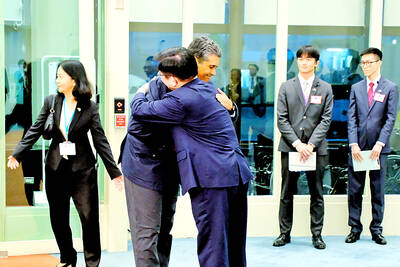
Palauan President Surangel Whipps Jr arrived in Taiwan last night to kick off his first visit to the country since beginning his second term earlier this year. After arriving at Taoyuan International Airport at around 6:30 pm, Whipps and his delegation were welcomed by Minister of Foreign Affairs Lin Chia-lung (林佳龍). Speaking to gathered media, the Palauan leader said he was excited and honored to be back in Taiwan on his first state visit to Taiwan since he was sworn in this January. Among those traveling with Whipps is Minister of State Gustav N. Aitaro, Public Infrastructure
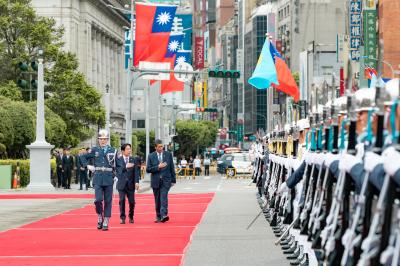
President William Lai (賴清德) yesterday thanked Palau for its continued support of Taiwan's international participation, as Taipei was once again excluded from the World Health Assembly (WHA) currently taking place in Switzerland. "Palau has never stopped voicing support for Taiwan" in the UN General Assembly, the WHO and other UN-affiliated agencies, Lai said during a bilateral meeting with visiting Palau President Surangel Whipps Jr. "We have been profoundly touched by these endorsements," Lai said, praising the Pacific island nation's firm support as "courageous." Lai's remarks came as Taiwan was excluded for the ninth consecutive year from the WHA, which is being held in
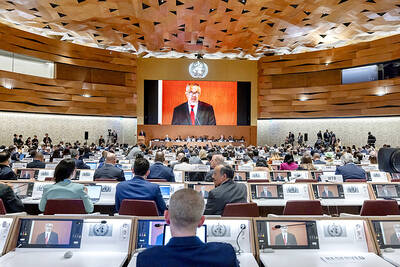
RESOLUTIONS DEBATE: Taiwan’s allies said that UN and WHA resolutions cited by China and other nations ‘do not determine Taiwan’s participation in WHO activities’ A proposal to invite Taiwan to this year’s World Health Assembly (WHA) was rejected on Monday, resulting in Taipei’s absence from the annual meeting for a ninth consecutive year, although partners spoke up for Taiwan’s participation at the first day of the meeting. The first agenda item after the opening was a “two-on-two debate” on a proposal to invite Taiwan to participate at the WHA as an observer. Similar to previous years, two countries made statements in favor of the proposal, while two others expressed their opposition. Philippine Secretary of Health Teodoro Herbosa, president of the 78th WHA, accepted the WHA General Committee’s
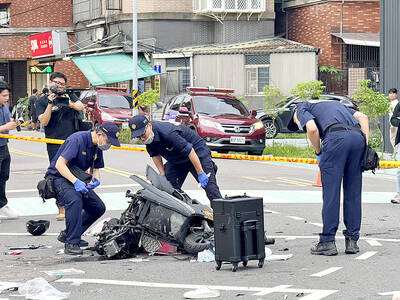
At least three people died and more than a dozen were injured yesterday afternoon when a vehicle struck a group of pedestrians in New Taipei City’s Sansia District (三峽). The incident happened at about 4pm when a car rammed into pedestrians at an intersection near Bei Da Elementary School. Witnesses said the sedan, being driven at a high speed, ran a red light, knocking scooters out of the way and hitting students crossing the road before careening into a median near the intersection of Guocheng and Guoguang streets. The incident resulted in three deaths and 13 injuries, including the driver, a 78-year-old man


 RSS
RSS