


National Security Bureau (NSB) chief Shi Hwei-yow (許惠祐) said yesterday that national security officials had not illegally monitored the opposition parties.
"Illegal monitoring violates criminal law and can lead to a maximum of five years in prison. I do not believe a government official would take such a risk," Shi told reporters at the legislature yesterday.
The Chinese Nationalist Party (KMT) has accused the Democratic Progressive Party (DPP) of misusing the nation's security resources to secure intelligence about a secret meeting between KMT vice presidential candidate Vincent Siew (
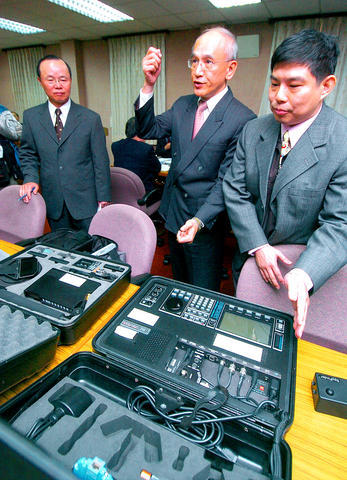
PHOTO: WANG MIN-WEI, TAIPEI TIMES
Shi said the accusations were groundless.
Siew allegedly warned Burghardt that the DPP was planning to destabilize the elections.
The meeting was not known about until last Friday when DPP Legislator Sandy Yen (莊和子) told local reporters that Siew and Burghardt had met for an hour on Dec. 8.
Chief of the Ministry of Justice's Investigation Bureau, Yeh Sheng-mao (
He told reporters at the legislature that his bureau did not illegally monitor opposition parties or their politicians.
He said the bureau only conducts monitoring related to criminal investigations and in cases were permission was granted by a judge.
Despite the NSB's denial, the pan-blue camp continued with the accusations. When approached by reporters, KMT Legislator Hung Hsiu-chu (
"Only the government authorities could conduct large-scale wiretapping using high-tech equipment," she said.
Calling the leak an example of "green terror," Hung said she felt horrified by the leak.
KMT Legislator Chiu Yi (
"It is a setback for democracy if [the government] did resort to wiretapping, stalking and manipulation of the opposition," he said.
When asked for comment, Legislative Speaker Wang Jin-pyng (王金平), a KMT member, said it was "possible" that the nation's intelligence agencies had resorted to phone tapping the KMT.
"We cannot say for sure because we are unable to identify the specific process [of the tapping], but wiretapping is really abused in Taiwan," Wang said. "If the accusation proves to be true, this would be a serious political incident."
Meanwhile, Ma's campaign office dismissed media speculation that the leak was an inside job.
"Leaks of internal documents have occurred before and we still do not know how ... we will continue to enhance our information security," spokesman Lo Chih-chiang (羅智強) said.
Premier Chang Chun-hsiung (
"You know, I personally have never done such a thing [eavesdropping]," he said.
Meanwhile, Chang was evasive about whether the administration would take legal action against the KMT in order to reclaim its stolen assets. He emphasized that the related government agencies were planning to take the necessary steps to deal with the matter, saying that he expected them to formulate an appropriate plan.
Chang said the DPP had encountered many difficulties regarding the recovery of the KMT's stolen assets, including several failed attempts to enact a law forcing the KMT to return its improperly acquired party assets to the nation's treasury.
Additional reporting by Ko Shu-ling

Costa Rica sent a group of intelligence officials to Taiwan for a short-term training program, the first time the Central American country has done so since the countries ended official diplomatic relations in 2007, a Costa Rican media outlet reported last week. Five officials from the Costa Rican Directorate of Intelligence and Security last month spent 23 days in Taipei undergoing a series of training sessions focused on national security, La Nacion reported on Friday, quoting unnamed sources. The Costa Rican government has not confirmed the report. The Chinese embassy in Costa Rica protested the news, saying in a statement issued the same

Taiwan’s Liu Ming-i, right, who also goes by the name Ray Liu, poses with a Chinese Taipei flag after winning the gold medal in the men’s physique 170cm competition at the International Fitness and Bodybuilding Federation Asian Championship in Ajman, United Arab Emirates, yesterday.
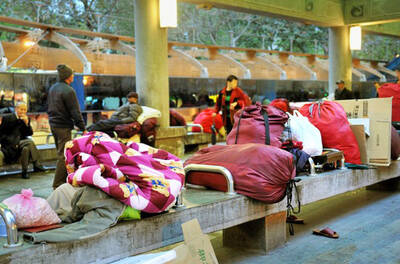
A year-long renovation of Taipei’s Bangka Park (艋舺公園) began yesterday, as city workers fenced off the site and cleared out belongings left by homeless residents who had been living there. Despite protests from displaced residents, a city official defended the government’s relocation efforts, saying transitional housing has been offered. The renovation of the park in Taipei’s Wanhua District (萬華), near Longshan Temple (龍山寺), began at 9am yesterday, as about 20 homeless people packed their belongings and left after being asked to move by city personnel. Among them was a 90-year-old woman surnamed Wang (王), who last week said that she had no plans
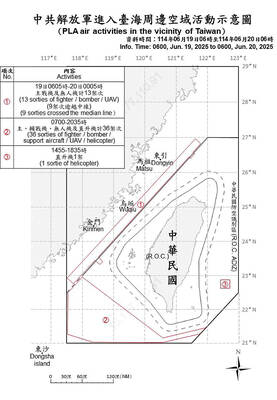
‘SPEY’ REACTION: Beijing said its Eastern Theater Command ‘organized troops to monitor and guard the entire process’ of a Taiwan Strait transit China sent 74 warplanes toward Taiwan between late Thursday and early yesterday, 61 of which crossed the median line in the Taiwan Strait. It was not clear why so many planes were scrambled, said the Ministry of National Defense, which tabulated the flights. The aircraft were sent in two separate tranches, the ministry said. The Ministry of Foreign Affairs on Thursday “confirmed and welcomed” a transit by the British Royal Navy’s HMS Spey, a River-class offshore patrol vessel, through the Taiwan Strait a day earlier. The ship’s transit “once again [reaffirmed the Strait’s] status as international waters,” the foreign ministry said. “Such transits by


 RSS
RSS