


The Cabinet yesterday upset Democratic Progressive Party (DPP) lawmakers pushing for a change in the way the vehicle fuel tax is imposed to encourage the use of public transportation.
A proposal by DPP Legislator Wang To-far (王塗發) and several colleagues to amend Article No. 27 of the Highway Law (公路法) passed its preliminary review in the legislature's Transportation Committee last week.
The fee is now levied on cars according to their exhaust volume. The amendment would change the gauge to the vehicle's fuel consumption rate.
"The government is supportive of the amendment, but we should also consider the impact the new measure might have before carrying it out," Cabinet Spokesman Shieh Jhy-wey (謝志偉) said after the Cabinet meeting.
He said the government needs to assess the level of influence the measure would have on the economy and commodity prices.
Premier Chang Chun-hsiung (張俊雄) delayed a decision on the proposed amendment until an overall assessment is finished, Shieh said.
Upon hearing the Cabinet's decision, Wang said, "It's so disappointing that the government resisted the reform for fear of losing revenue."
Wang said the Ministry of Transportation and Communications earns around NT$40 billion (US$1.23 billion) a year from the fuel tax, which he said was about twice what it is should obtain from vehicle owners.
Wang said the system penalizes vehicle owners who do not drive very often, while changing to a fuel-consumption basis would help reduce energy consumption.
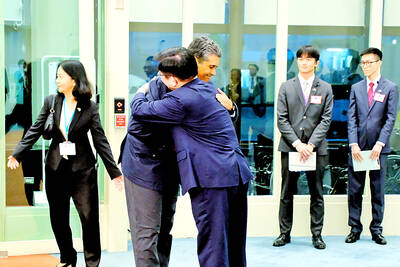
Palauan President Surangel Whipps Jr arrived in Taiwan last night to kick off his first visit to the country since beginning his second term earlier this year. After arriving at Taoyuan International Airport at around 6:30 pm, Whipps and his delegation were welcomed by Minister of Foreign Affairs Lin Chia-lung (林佳龍). Speaking to gathered media, the Palauan leader said he was excited and honored to be back in Taiwan on his first state visit to Taiwan since he was sworn in this January. Among those traveling with Whipps is Minister of State Gustav N. Aitaro, Public Infrastructure
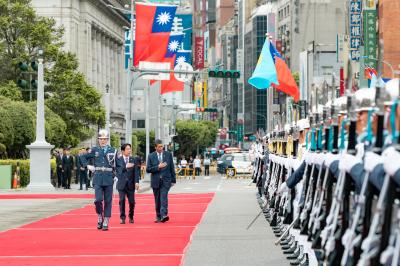
President William Lai (賴清德) yesterday thanked Palau for its continued support of Taiwan's international participation, as Taipei was once again excluded from the World Health Assembly (WHA) currently taking place in Switzerland. "Palau has never stopped voicing support for Taiwan" in the UN General Assembly, the WHO and other UN-affiliated agencies, Lai said during a bilateral meeting with visiting Palau President Surangel Whipps Jr. "We have been profoundly touched by these endorsements," Lai said, praising the Pacific island nation's firm support as "courageous." Lai's remarks came as Taiwan was excluded for the ninth consecutive year from the WHA, which is being held in
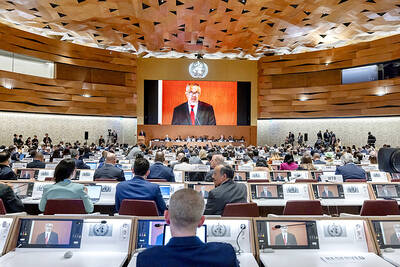
RESOLUTIONS DEBATE: Taiwan’s allies said that UN and WHA resolutions cited by China and other nations ‘do not determine Taiwan’s participation in WHO activities’ A proposal to invite Taiwan to this year’s World Health Assembly (WHA) was rejected on Monday, resulting in Taipei’s absence from the annual meeting for a ninth consecutive year, although partners spoke up for Taiwan’s participation at the first day of the meeting. The first agenda item after the opening was a “two-on-two debate” on a proposal to invite Taiwan to participate at the WHA as an observer. Similar to previous years, two countries made statements in favor of the proposal, while two others expressed their opposition. Philippine Secretary of Health Teodoro Herbosa, president of the 78th WHA, accepted the WHA General Committee’s
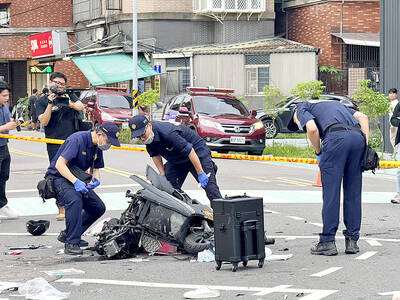
At least three people died and more than a dozen were injured yesterday afternoon when a vehicle struck a group of pedestrians in New Taipei City’s Sansia District (三峽). The incident happened at about 4pm when a car rammed into pedestrians at an intersection near Bei Da Elementary School. Witnesses said the sedan, being driven at a high speed, ran a red light, knocking scooters out of the way and hitting students crossing the road before careening into a median near the intersection of Guocheng and Guoguang streets. The incident resulted in three deaths and 13 injuries, including the driver, a 78-year-old man


 RSS
RSS