

The commander of US forces in the Pacific, Admiral Timothy Keating, hit out at China on Tuesday for refusing to allow the Kitty Hawk aircraft carrier group to visit Hong Kong for a Thanksgiving port call last week, a move that some have linked to US arms sales to Taiwan. Keating called the decision "perplexing" and "troublesome."
"This is perplexing. It's not helpful. It is not, in our view, conduct that is indicative of a country who understands its obligations [as] a responsible nation," Keating said during a press teleconference from Hawaii beamed to the Pentagon press briefing room.
In view of the recent visit to Beijing by US Secretary of Defense Robert Gates, which was intended to improve bilateral military relations, the Chinese action "came as a surprise and it's of some concern to us," Keating said.
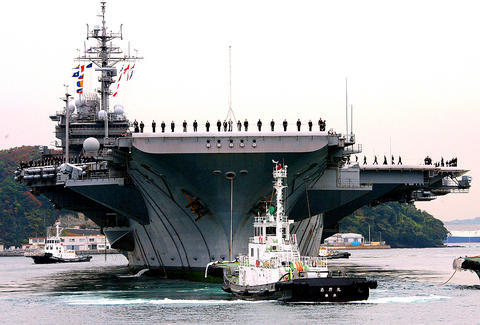
PHOTO: AFP
Keating's remarks indicated that Beijing's decision to block the carrier group could be a major irritant in efforts by Gates to improve and expand military relationships between Beijing and Washington.
However, Keating said that despite the Kitty Hawk snub, the US wants to expand so-called "mil-mil" (military-to-military) relations with China.
Nevertheless, he made it clear that the US was upset about the incident and wanted a clearer explanation from Beijing.
Keating will visit China in January, his second trip there since assuming the top US Pacific military post. He said one of the issues he would raise would be Hong Kong port calls and the flap over the Kitty Hawk visit.
Keating also took China to task for denying safe harbor in Hong Kong for two US minesweepers caught in a tropical storm just before the Kitty Hawk incident.
The ships, the Patriot and the Guardian, were operating in international waters near Hong Kong and were caught in a sudden storm. They sought shelter in Hong Kong but were turned back by the Chinese.
Keating said this incident was even more egregious than the Kitty Hawk incident, because it violated basic principles of maritime rescue.
China's refusal was "behavior that we do not consider consonant with a nation who advocates a peaceful rise and harmonious relations," Keating said.
While it remains unclear why Beijing rejected the Kitty Hawk port call, some press reports say it is was in retaliation over two US actions.
One was US President George W. Bush's decision to welcome the Dalai Lama to Washington and stand with him publicly while the Tibetan religious leader received a congressional medal.
The other was an announcement this month that the US planned to sell Taiwan up to US$939 million in upgraded ground equipment for its Patriot II anti-missile batteries, a sale that came just two months after the US agreed to a US$1.96 billion sale of 12 P-3C submarine-hunting aircraft.
Another explanation was offered by the Hong Kong-based Ming Pao daily, which said the Chinese snub was connected to a large-scale military exercise recently conducted by the Chinese Navy's Eastern and Southern Fleet in an area of the Pacific Ocean east of Taiwan and north of the Philippines.
The exercise was a drill for blockading Taiwan, it said.
"Sources ... said that during the exercise some Chinese ships ran into the Kitty Hawk's battle group in international waters sailing toward Hong Kong," an online version of the Ming Pao article said.
By refusing to allow the Kitty Hawk into Hong Kong, China "wanted to hide the details of their naval exercises and combat capability" to blockade the Taiwan Strait as part of a military attack on Taiwan, the newspaper said.
Admiral Gary Roughead, the chief of naval operations, said: "As someone who has been going to sea all my life, if there is one tenet that we observe, it's when somebody is in need, you provide -- and you sort it out later."
The two minesweepers were refueled by a US tanker and suffered no damage from the storm, Roughead said.
Additional reporting by NY Times News Service

The donation of offshore patrol vessel Kinmen to the Philippines includes provisions that protect Taiwanese fishers and facilitate security cooperation across the First Island Chain, officials said yesterday. The comment was made during the Cabinet’s comprehensive administrative report at the legislature after Chinese Nationalist Party (KMT) Legislator Hsu Yu-chen (許宇甄) expressed concerns about the decision to give a ship to a country whose coast guard had in 2013 fired on a Taiwanese trawler and killed its captain without provocation. The Cabinet should lay out the safeguards that have been established to prevent the Philippine government from using the Kinmen to harass, expel
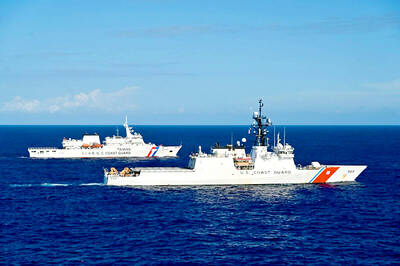
GROWING TIES: The CGA is planning a goodwill mission to the Philippines, in what would be the first time since 1975 a Taiwanese paramilitary vessel has visited the country The Coast Guard Administration (CGA) plans to significantly expand its participation in international security cooperative frameworks and its operational capabilities, a budget proposal for next year showed. The budget indicates a transformation of the CGA from a maritime law enforcement arm into a national defense and intelligence gathering entity capable of tackling larger regional security matters. The proposal showed that personnel from the coast guard’s Intelligence Division and Special Action Support Center are to participate in high-level national security talks with the US. As the CGA has dealt with China’s rising “gray zone” threats around Taiwan, it has become a valuable asset to
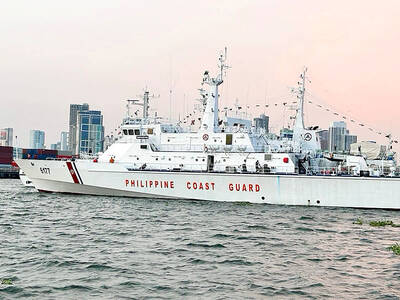
A patrol vessel donated by the Coast Guard Administration (CGA) to the Philippines was commissioned into the Philippine Coast Guard (PCG) on Friday, a Philippine non-governmental organization said. The CGA on Sept. 16 confirmed media reports that Taiwan had donated a retired 500-tonne patrol vessel to the Philippines. The Manila-based We Protect Our Seas (WPS) foundation, which served as an intermediary in the transfer, said that the vessel was formerly the CGA’s 500-tonne petrol vessel Kinmen (CG123). The WPS, in a statement issued on Friday, said the vessel, renamed as the BRP Sarangani, had been commissioned into the PCG the
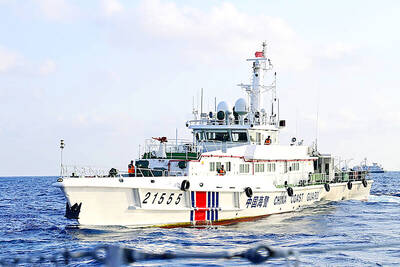
‘GRAY ZONE’ TACTICS: Beijing sent two China Coast Guard vessels to escort a ‘supposedly private research ship,’ a Philippine Coast Guard spokesman said The Coast Guard Administration (CGA) yesterday confirmed that it had recently deployed three patrol vessels to waters in Taiwan’s overlapping exclusive economic zone with the Philippines to monitor three Chinese vessels. CGA Deputy Director-General Hsieh Ching-chin (謝慶欽) said the agency regularly monitors Chinese vessels around Taiwan, and that the deployment south of Oluanpi (鵝鑾鼻), Taiwan proper’s southernmost point, was carried out in accordance with standard procedures. He added that the waters fall within the overlapping exclusive economic zones of Taiwan and the Philippines, which extend 200 nautical miles (370km) from their coastlines. Hsieh made the comments when asked about a


 RSS
RSS