

Chinese Nationalist Party (KMT) presidential candidate Ma Ying-jeou (
When asked by a Japanese reporter which channel would be used to communicate with China, Ma said that the technical details could be worked out later. The point, he said, was that leaders from both sides are willing to act.
"It is important that leaders of both sides are willing to improve the relationship," Ma said.
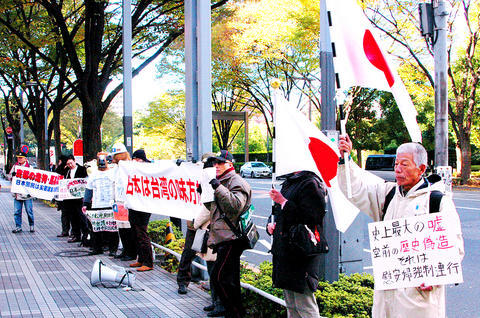
PHOTO: CNA
Ma said, however, that he has no plans to visit China.
He also said that although Koo Chen-fu (
Ma said he was confident that the SEF and ARATS would continue to function as the intermediary bodies for cross-strait exchanges.
Asked whether he supported the idea of convening a meeting of the major powers on the cross-strait issue, similar to the six-party talks on North Korea, Ma said it would be more appropriate for the two sides to solve their problems themselves. However, he said he would welcome any advice offered by foreign countries.
agreements
Ma said that the SEF and ARATS had conducted 24 rounds of cross-strait negotiations before 2000 and that four agreements were reached during the first Koo-Wang meeting in Singapore in April 1993. The four agreements indicate that both sides are willing and able to resolve their problems, he said.
defense
Ma said upon his arrival in Japan on Wednesday that, if elected, he would increase Taiwan's military budget to 3 percent of the country's GDP.
"This would be to show our resolve to defend ourselves," Ma said.
Given this, a journalist asked why the KMT has been at loggerheads with the Democratic Progressive Party (DPP) over defense spending.
Ma answered that although the US government had approved the sale of a package of arms, including submarines, Patriot missiles and anti-submarine aircraft, to Taiwan in 2001, the DPP administration had not submitted a budget bill for the procurement until three years later, in June 2004.
Noting that that proposal was rejected at one point by the legislature on the grounds that details of the proposal were too sketchy and prices were about twice as high as the fair market value, Ma said the purchase of Patriot missiles was later nixed by the Taiwanese public in a nationwide referendum in 2004 initiated by the DPP administration.
He said the purchase of P-3 Orion anti-submarine aircraft had already been passed by the legislature and the purchase of submarines was still under assessment.
Ma, who was confronted by protesters on Thursday angered by Taiwan's claim to the disputed Diaoyutai Islands (
The Diaoyutais, a group of uninhabited islands northwest of Taiwan that are controlled by Japan, are also claimed by China.
Ma was to return from this three-day visit to Japan later yesterday.
hsieh says no
In Taichung, Democratic Progressive Party presidential candidate Frank Hsieh (謝長廷) said yesterday he would not visit China if elected next year, a Central News Agency (CNA) report said.
Hsieh said he learned from his visit to China in 1993 that the media were not allowed unrestricted access to his activities.
"I don't think I will visit China as the media are not allowed to cover my activities throughout the journey, which would make it difficult for me to explain my whereabouts, even if just for an hour," Hsieh said.

The donation of offshore patrol vessel Kinmen to the Philippines includes provisions that protect Taiwanese fishers and facilitate security cooperation across the First Island Chain, officials said yesterday. The comment was made during the Cabinet’s comprehensive administrative report at the legislature after Chinese Nationalist Party (KMT) Legislator Hsu Yu-chen (許宇甄) expressed concerns about the decision to give a ship to a country whose coast guard had in 2013 fired on a Taiwanese trawler and killed its captain without provocation. The Cabinet should lay out the safeguards that have been established to prevent the Philippine government from using the Kinmen to harass, expel
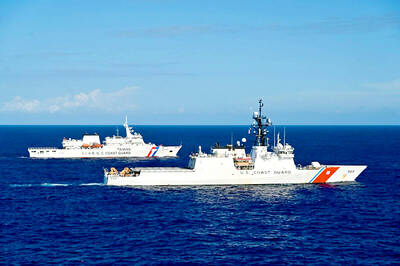
GROWING TIES: The CGA is planning a goodwill mission to the Philippines, in what would be the first time since 1975 a Taiwanese paramilitary vessel has visited the country The Coast Guard Administration (CGA) plans to significantly expand its participation in international security cooperative frameworks and its operational capabilities, a budget proposal for next year showed. The budget indicates a transformation of the CGA from a maritime law enforcement arm into a national defense and intelligence gathering entity capable of tackling larger regional security matters. The proposal showed that personnel from the coast guard’s Intelligence Division and Special Action Support Center are to participate in high-level national security talks with the US. As the CGA has dealt with China’s rising “gray zone” threats around Taiwan, it has become a valuable asset to
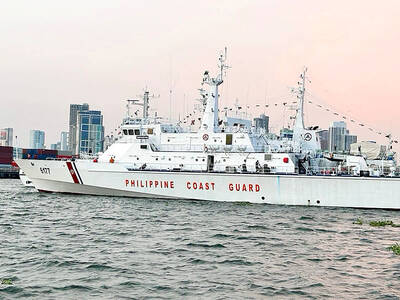
A patrol vessel donated by the Coast Guard Administration (CGA) to the Philippines was commissioned into the Philippine Coast Guard (PCG) on Friday, a Philippine non-governmental organization said. The CGA on Sept. 16 confirmed media reports that Taiwan had donated a retired 500-tonne patrol vessel to the Philippines. The Manila-based We Protect Our Seas (WPS) foundation, which served as an intermediary in the transfer, said that the vessel was formerly the CGA’s 500-tonne petrol vessel Kinmen (CG123). The WPS, in a statement issued on Friday, said the vessel, renamed as the BRP Sarangani, had been commissioned into the PCG the
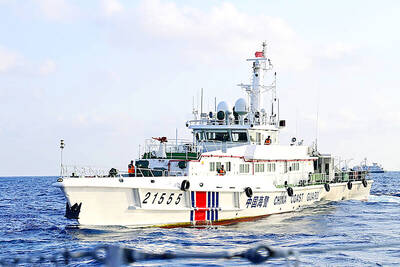
‘GRAY ZONE’ TACTICS: Beijing sent two China Coast Guard vessels to escort a ‘supposedly private research ship,’ a Philippine Coast Guard spokesman said The Coast Guard Administration (CGA) yesterday confirmed that it had recently deployed three patrol vessels to waters in Taiwan’s overlapping exclusive economic zone with the Philippines to monitor three Chinese vessels. CGA Deputy Director-General Hsieh Ching-chin (謝慶欽) said the agency regularly monitors Chinese vessels around Taiwan, and that the deployment south of Oluanpi (鵝鑾鼻), Taiwan proper’s southernmost point, was carried out in accordance with standard procedures. He added that the waters fall within the overlapping exclusive economic zones of Taiwan and the Philippines, which extend 200 nautical miles (370km) from their coastlines. Hsieh made the comments when asked about a


 RSS
RSS