


The National Science Council (NSC) yesterday presented a patented and innovative process for making polyhydroxybutyrate-valerate (PHBV), a biodegradable plastic made from the bacterial fermentation of starch.
"In a time when fossil fuels are increasingly scarce and expensive, our breakthrough allows us to cost-efficiently mass produce greener [more environmentally friendly] plastics," research coordinator Don Trong-ming (
"Not only can PHBV be made into consumer products, its bio-compatibility allows for the production of biomedical products such as sutures and bone plates," he said.
The six-year research project was an interdisciplinary effort involving six universities, NSC Deputy Minister Yang Hung-duen (
PHBV is a type of polyhydroxyalkanoate (PHA), a substance produced by microorganisms as a nutrient-conserving mechanism when nitrogen, phosphorus and sulfur are scarce, Don said.
"Basically, PHA plastics are made by microorganisms and microorganisms can degrade them," Don said, adding that in compost PHA can completely biodegenerate into water and carbon dioxide in just three months.
"PHA was named by Forbes magazine in 2003 as one of the five molecules that will change the world; molecules that can incur substantial profits on their advances on the molecular level," he said.
The most common type of PHA is poly-beta-hydroxybutyrate (PHB), a compound similar to polypropylene but stiffer and more brittle, Don said, adding that PHB is also limited in application because of its cost and small temperature window for molding.
"The goal of our project was therefore to combat the limitations and produce a cheap, stretchy and easily moldable plastic," Don said.
"We decided to use Haloferax mediterranei, a bacteria found in the ocean, because it economically feeds on starch [rice bran and soy milk] and lives in highly saturated saltwater where most other bacteria cannot survive, so the probability of contamination is low," Don said.
The team set about making the bacteria produce PHBV, a PHB copolymer that has a valerate component attached to the PHB compound, which makes the plastic more stretchy, said Simon Lai (
"The breakthrough came when we developed a two-staged fermentation process to force the bacteria to produces PHBV in the second stage, instead of PHB, because of a diet change," Don said.
"Our PHBV yield of 55.6 percent is much higher than market standards," said Will Chen, (
"In the future we aim to make the plastic even greener by utilizing food waste as feedstock," Don said.
Talks with businesses for market production have been initiated, Don said, adding that, "we hope the mass production of this green plastic will help alleviate the environmental burden that traditional plastic brings."
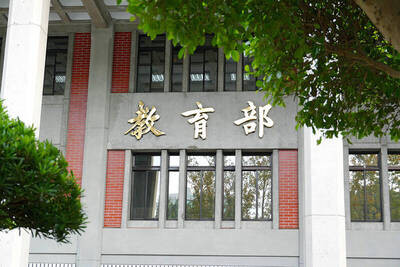
The Ministry of Education (MOE) is to launch a new program to encourage international students to stay in Taiwan and explore job opportunities here after graduation, Deputy Minister of Education Yeh Ping-cheng (葉丙成) said on Friday. The government would provide full scholarships for international students to further their studies for two years in Taiwan, so those who want to pursue a master’s degree can consider applying for the program, he said. The fields included are science, technology, engineering, mathematics, semiconductors and finance, Yeh added. The program, called “Intense 2+2,” would also assist international students who completed the two years of further studies in

Former president Tsai Ing-wen (蔡英文) departed for Europe on Friday night, with planned stops in Lithuania and Denmark. Tsai arrived at Taiwan Taoyuan International Airport on Friday night, but did not speak to reporters before departing. Tsai wrote on social media later that the purpose of the trip was to reaffirm the commitment of Taiwanese to working with democratic allies to promote regional security and stability, upholding freedom and democracy, and defending their homeland. She also expressed hope that through joint efforts, Taiwan and Europe would continue to be partners building up economic resilience on the global stage. The former president was to first
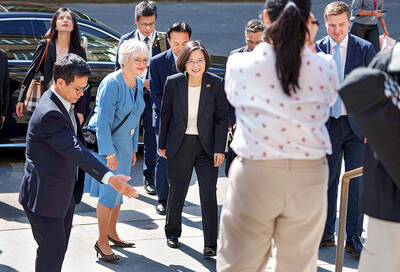
Former president Tsai Ing-wen (蔡英文) on Monday called for greater cooperation between Taiwan, Lithuania and the EU to counter threats to information security, including attacks on undersea cables and other critical infrastructure. In a speech at Vilnius University in the Lithuanian capital, Tsai highlighted recent incidents in which vital undersea cables — essential for cross-border data transmission — were severed in the Taiwan Strait and the Baltic Sea over the past year. Taiwanese authorities suspect Chinese sabotage in the incidents near Taiwan’s waters, while EU leaders have said Russia is the likely culprit behind similar breaches in the Baltic. “Taiwan and our European

The Taipei District Court sentenced babysitters Liu Tsai-hsuan (劉彩萱) and Liu Jou-lin (劉若琳) to life and 18 years in prison respectively today for causing the death of a one-year-old boy in December 2023. The Taipei District Prosecutors’ Office said that Liu Tsai-hsuan was entrusted with the care of a one-year-old boy, nicknamed Kai Kai (剴剴), in August 2023 by the Child Welfare League Foundation. From Sept. 1 to Dec. 23 that year, she and her sister Liu Jou-lin allegedly committed acts of abuse against the boy, who was rushed to the hospital with severe injuries on Dec. 24, 2023, but did not


 RSS
RSS