


The deaths of two experienced swimmers in last week's Sun Moon Lake Swimming Carnival has raised questions as to whether this annual sports event should continue after 25 years.
The deaths of Yang Chao-wan (
Wang Han (王瀚), a Taiwanese swimmer who has succeeded in swimming across 12 channels around the world in the past 20 years, said it was inappropriate for an event of this magnitude to take place in the fall.
The event's organizer said this year's carnival attracted about 20,000 swimmers -- including participants from Japan, the US and European countries.
"The normal body temperature is about 36.5oC, but the average temperature of the lake water during fall is about 20oC," he said. "Swimming in a lake with such cold water is very risky."
For the human body to get used to swimming in such low temperatures, a competitor must undergo cold-water training for at least six months before the event, Wang said, adding that the person must also prove that he or she has neither chronic disease nor clogged arteries.
Wang also criticized the organizers for not strictly screening swimmers.
He said the swimmers he had chosen to swim across the Taiwan Strait with him in August, for example, had to be between 20 and 40 years of age. He only made exceptions for two swimmers -- one aged 15 and the other 51 -- as both had shown that they were physically capable of handling such a challenging task.
The Sun Moon Lake swim organizer, however, allowed the participation of senior and handicapped swimmers and even let them swim first, he said.
Wang termed the organizer's attitude in ensuring the swimmers' safety as "reckless."
"In the past, many had applied to swim across the Taiwan Strait, but they were rejected by the Mainland Affairs Council, which insisted that each swimmer be accompanied by one emergency boat," he said.
"Having more than 10,000 swim-mers collectively engage in a long-distance swimming contest is unheard of in other countries," he said.
While critics like Wang questioned the safety of the event, others said that any sport involves risk of injury and illness and swimming is no exception.
"Sudden death happens from time to time -- to professional athletes and amateurs alike," said Sandy Hsieh (謝伸裕), a physical education professor at National Taiwan Normal University. "There's little you can do to prevent it."
Hsieh said that swimmers do not need special cold-water training before participating in the Sun Moon Lake swim if they have developed the habit of swimming early in the morning when the water is often cold. He added that participants must do a physical check to determine if they are fit enough to participate in a potentially grueling race.
Having participated in the Sun Moon Lake Swimming Carnival a couple of years ago, Hsieh said that other factors might explain the deaths this year.
"Most of the swimmers arrived the night before the event. Some were probably still tired after having driven more than four to six hours to Puli (
Safety was not the only controversy that dogged the event.
In a news report published by the Chinese-language Liberty Times (the Taipei Times' sister newspaper) last Wednesday, Yuchih Township (魚池) authorities estimated that the event added another two tonnes to the daily garbage.
The water quality at the lake is under scrutiny as well, since the lake serves as the source of water for residents of 12 villages in Yuchih Township. Many feared the swimming carnival might further worsen the water quality.
Faced with the public criticism, the event organizer -- Puli Swimming Association -- said that participants were required to sign affidavits stating that they would be responsible for their own safety.
Association chairman Chen Guei-san (

Fast food chain McDonald's is to raise prices by up to NT$5 on some products at its restaurants across Taiwan, starting on Wednesday next week, the company announced today. The prices of all extra value meals and sharing boxes are to increase by NT$5, while breakfast combos and creamy corn soup would go up by NT$3, the company said in a statement. The price of the main items of those meals, if ordered individually, would remain the same. Meanwhile, the price of a medium-sized lemon iced tea and hot cappuccino would rise by NT$3, extra dipping sauces for chicken nuggets would go up
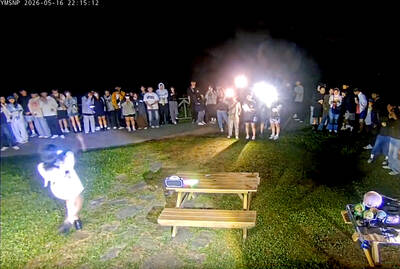
Yangmingshan National Park’s Qingtiangang (擎天崗) nature area has gone viral after a park livestream camera observed a couple in the throes of intimate congress, which was broadcast live on YouTube, drawing large late-night crowds and sparking a backlash over noise, bright lights and disruption to wildlife habitat. The area’s livestream footage appeared to show a couple engaging in sexual activity on a picnic table in the park on Friday last week, with the uncensored footage streamed publicly online. The footage quickly spread across social media, prompting a tide of visitors to travel to the site to “check in” and recreate the

Minister of Digital Affairs Lin Yi-ching (林宜敬) yesterday cited regulatory issues and national security concerns as an expert said that Taiwan is among the few Asian regions without Starlink. Lin made the remarks on Facebook after funP Innovation Group chief executive officer Nathan Chiu (邱繼弘) on Friday said Taiwan and four other countries in Asia — China, North Korea, Afghanistan and Syria — have no access to Starlink. Starlink has become available in 166 countries worldwide, including Ukraine, Malaysia, the Philippines and Vietnam, in the six years since it became commercial, he said. While China and North Korea block Starlink, Syria is not
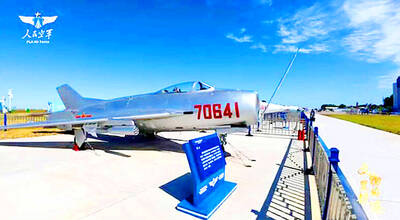
GROUNDED: A KMT lawmaker proposed eliminating drone development programs and freezing funding for counterdrone systems, despite China’s adoption of the technology China has deployed attack drones at air bases near the Taiwan Strait in a strategy aimed at overwhelming Taiwan’s air defense systems through saturation attacks, the Mainland Affairs Council (MAC) said. The council’s latest quarterly report on China said that satellite imagery and open-source intelligence indicate that the Chinese People’s Liberation Army (PLA) had converted retired J-6 fighter jets into J-6W drones, which the PLA has stationed at six air bases near Taiwan, five in China’s Fujian Province and one in Guangdong Province. The report cited J. Michael Dahm, a senior fellow at the US-based Mitchell Institute, as saying that China has


 RSS
RSS