


Academics exchanged views on ethnicity and nationalism in democratic development during the second day of a Taiwan Thinktank forum yesterday.
The Taipei forum was titled "After the Third Wave," referring to a theory that democratization has occurred in three major waves, the third of which began in the 1970s. The first wave of democratization followed World War I and the second came after World War II.
The term "third wave" of democracy was coined by Harvard University political scientist Samuel Huntington, who argued that the most recent wave began in Southern Europe and spread to Latin America before reaching the former communist regimes of Central and Eastern Europe.
Mark Beissinger, professor of politics at Princeton University, examined the ways in which nationalism and ethnic lines played roles in both undermining and consolidating democratization in 15 former Soviet states.
Beissinger challenged the argument that strong ethnic identities are an enemy of democracy, saying that the role of ethnic nationalism in supporting democratization had been overlooked.
In the former Soviet states, Beissinger said, strong ethnic identities did not drive democratization alone, but ethnicity fueled democratization in combination with other factors.
The developments in this region have shown that strong ethnic identities can form the basis for a mobilizing action toward democracy when ethnic nationalism is directed against foreign occupation rather than against other indigenous ethnicities, Beissinger said.
"Ethnic nationalism is not necessarily incompatible with the democracy, but rather depends on the types of objects against which ethnic groups mobilize," he said.
Stephen Ndegwa, the World Bank's head public sector specialist, discussed the continuing challenges posed by identity politics in almost two decades of shaky democracy in Africa.
As an African, Ndegwa said that he took the problem of ethnic nationalism in Africa as a "given" that must be solved, as it has plagued the continent.
He said that Africa has produced a veritable "laboratory of democratic innovations," especially in dealing with ethnicity.
Ndegwa discussed three strategies to deal with ethnic politics in African countries, highlighting two recent debates in Africa on constitutional reform that focused on the division and restriction of political power.
"The debates relate to the questions echoed broadly within each transition of local determination of critical issues in the public arena, of balancing ethnic interests and of localizing power," he said.
Ndegwa said that some countries were debating their constitutions, an important indication of progress.
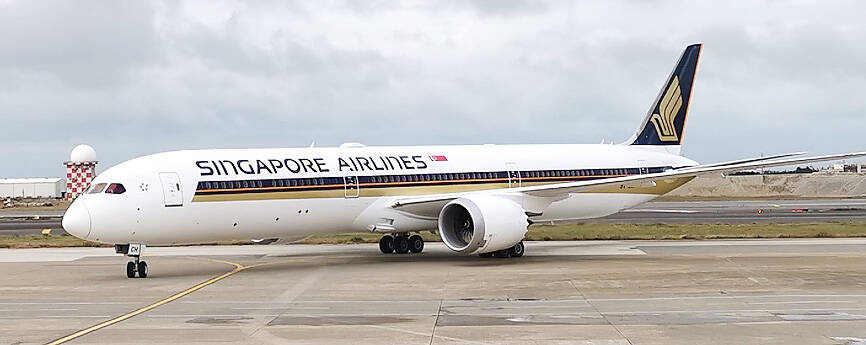
INCREASED CAPACITY: The flights on Mondays, Wednesdays, Fridays and Sundays would leave Singapore in the morning and Taipei in the afternoon Singapore Airlines is adding four supplementary flights to Taipei per week until May to meet increased tourist and business travel demand, the carrier said on Friday. The addition would raise the number of weekly flights it operates to Taipei to 18, Singapore Airlines Taiwan general manager Timothy Ouyang (歐陽漢源) said. The airline has recorded a steady rise in tourist and business travel to and from Taipei, and aims to provide more flexible travel arrangements for passengers, said Ouyang, who assumed the post in July last year. From now until Saturday next week, four additional flights would depart from Singapore on Monday, Wednesday, Friday
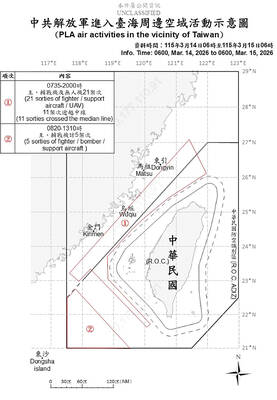
The Ministry of National Defense yesterday reported the return of large-scale Chinese air force activities after their unexplained absence for more than two weeks, which had prompted speculation regarding Beijing’s motives. China usually sends fighter jets, drones and other military aircraft around the nation on a daily basis. Interruptions to such routine are generally caused by bad weather. The Ministry of National Defense said it had detected 26 Chinese military aircraft in the Taiwan Strait over the previous 24 hours. It last reported that many aircraft on Feb. 25, when it spotted 30 aircraft, saying Beijing was carrying out another “joint combat

Taiwan’s three major international carriers are increasing booking fees, with EVA Airways having already increased the charge to US$28 per flight segment from US$25, while China Airlines (CAL) and Starlux Airlines are set to follow suit. Booking fees are charged by airlines through a global distribution system (GDS) and passed on to passengers. Carriers that apply the fees include CAL, EVA, Starlux and Tigerair Taiwan. A GDS is a computerized network operated by a company that connects airlines with travel agents and ticketing platforms, allowing reservations to be made and processed in real time. Major players include Amadeus, Sabre and Travelport. EVA Air began

Taiwan successfully defended its women’s 540 kilogram title and won its first-ever men’s 640 kg title at the 2026 World Indoor Tug of War Championships in Taipei yesterday. In the women’s event, Taiwan’s eight-person squad reached the final following a round-robin preliminary round and semifinals featuring teams from Ukraine, Japan, Thailand, Vietnam, the Basque Country and South Korea. In the finals, they swept the Basque team 2-0, giving the team composed mainly of National Taiwan Normal University students and graduates its second championship in a row, and its fourth in five years. Team captain


 RSS
RSS