


The Taiwan Railway Administration (TRA) yesterday unveiled its new Electric Multiple Unit (EMU) 700-model trains, which will be used to carry commuters and short-distance travelers.
The purchase was part of the TRA's efforts to reinforce its advantage as a short-distance train operator to cope with the impact of the Taiwan High Speed Rail.
The body of the EMU700-model train is decorated using three different colors: blue, white and orange. It has an interior design similar to the one used by the Taipei MRT System. The passenger seats, however, are covered with velvet.
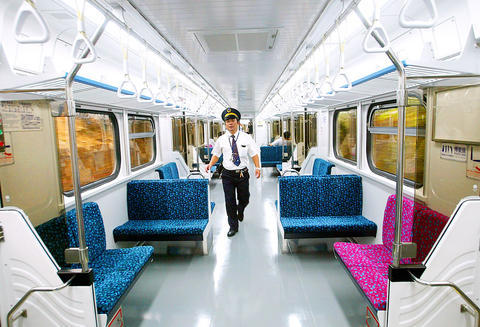
PHOTO: CNA
Each train car can hold 300 passengers and has six passenger exits. Above each exit an LED panel will display the stops on the route and other relevant passenger information in both Chinese and English.
The train can reach an operational speed of 110kph, coming to full stop from maximum speed within 580m.
The train is also being touted for its energy-saving design. When the train switches from high speed to low speed, the motor will then become a power generator and transmit excess electricity back to the wires.
If the train's air-conditioning system breaks down, an emergency ventilation system to maintain air circulation inside the train will be activated.
TRA secretary general Chang Ying-huei (張應輝) said yesterday that the administration has ordered a total of 160 EMU700-model train cars. Twelve were made by Nippon Sharyo Co, which is also the original designer of the EMU series. The other 148 cars were produced by the Taiwan Rolling Stock Co (TRSC), a local contractor who formed a technical partnership with Nippon Sharyo.
The contract states that TRSC must provide another 112 cars by the end of the year.
Chang said so far, only eight cars have passed the testing requirements. These cars will form the first train set that will begin operation this month.
Chang added that the administration hopes the operation of EMU trains will replace Chukuang Express (
TRSC vice president C.M. Chiou (
The train's motors, for example, were partially made by Tatung Co. A large percentage of the bogies, on the other hand, were manufactured by the China Steel Corp, he said.

FUKUOKA SITUATION: Japanese media reported that the pathogen is expected to be identified by the summer, while the CDC downplayed the idea that it was hMPV A “mysterious cold-like illness” reported in Japan’s Fukuoka Prefecture does not seem to be a new disease, but Japanese authorities have been asked about the situation, the Centers for Disease Control (CDC) said yesterday. The Fukuoka Prefectural Medical Association on Wednesday told a news conference that a “mystery cold” that has become a hot topic on social media is “highly likely to be caused by some kind of viral infection,” Japan’s KBC News reported. “Many people are experiencing symptoms starting with a sore throat, followed by a runny nose, phlegm and a severe cough,” KBC News reported, citing association officials. Health authorities are

Nvidia Corp CEO Jensen Huang (黃仁勳) arrived in Taiwan yesterday ahead of upcoming AI and technology events, saying he plans to meet with clients and Taiwan Semiconductor Manufacturing Co Chairman C.C. Wei (魏哲家) during his visit. After landing at Taipei Songshan Airport, Huang posed for photos with fans and handed out Yakult drinks to reporters and supporters waiting at the scene, saying he has “a lot to do” during the trip. Asked about reports that Nvidia’s planned headquarters site in Taipei’s Beitou Shilin Technology Park could break ground on May 27, Huang said that if the company holds an event, he would

The Ministry of Finance this afternoon announced the winning numbers for the March-April uniform invoice lottery. The winning number for the NT$10 million (US$318,060) special prize is 19531471, and the winning number for the NT$2 million grand prize is 85941329. Three numbers were drawn for the NT$200,000 first prize: 07225810, 20231230 and 83518781. Those with receipts matching the last seven digits of any of the first-prize numbers will win the NT$40,000 second prize, while those matching the last six digits will win the NT$10,000 third prize. Those whose receipts match the last five digits of the first-prize numbers can claim the NT$4,000 fourth prize,
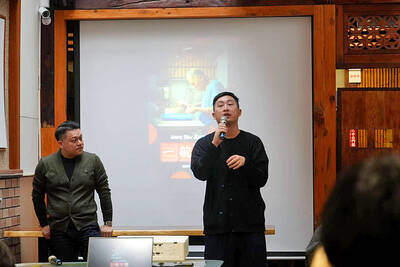
Taiwan Travelogue (臺灣漫遊錄), which earlier this week became the first Taiwanese novel to win the International Booker Prize, is to be adapted into a television series through a Taiwan-Japan coproduction, producer Chang Chen-yu (張辰漁) said yesterday. Chang, a producer at World Softest Production Film Co, wrote on Facebook that the company had been searching for projects with international appeal that retain a strong Taiwanese identity after colleagues and Japanese partners strongly recommended the novel. After reading the book, Chang said he immediately decided to pursue the screen rights. “A great story has the power to transcend time and borders, and connect countless people,”


 RSS
RSS