


■ CRIME
Police smash extortion ring
Police have nabbed the alleged ringleader of a group of Philippine officials and naval officers who have been extorting money from seized Taiwanese fishing trawlers, the Chinese-language Liberty Times (the Taipei Times' sister newspaper) reported yesterday. Hsu Chih-yi (許志宜), a Taiwanese, was arrested upon arrival at Taiwan Taoyuan International Airport on Thursday. In April last year, several tuna boats were intercepted by two Philippine warships in the waters between Taiwan and the Philippines. Their captains were taken into custody and accused of trespassing in Philippine waters. The captains paid thousands of dollars to have their vessels released. Through telephone taps, the Bureau of Criminal Investigation learned that Hsu and several Philippine officials and navy officers had masterminded the seizure of the ships. Hsu, who lives in southern Taiwan, used his connections to a Philippine naval officer to "assist" the captains by telling them how to deposit cash to an account in the Philippines to secure the release of their boats.
■ TRANSPORTATION
THSRC adds more trains
Taiwan High Speed Rail Corp (THSRC) increased the number of southbound and northbound daily train runs yesterday from 31 to 37. Officials also said that ticket sales would be extended by a half-hour, until 10:30pm, to accommodate passengers on the last train of the day, while ticket vending machines at the Taipei station would remain open until 11pm. This is the third increase in train runs in less than four months.
■ EDUCATION
System to add another year
Minister of Education Tu Cheng-sheng (杜正勝) said yesterday that the ministry was planning to extend the nine-year compulsory education system by one year to include kindergarten. Speaking during a visit to Tung Ho Elementary School, Tu said that with myriad issues needing to be tackled before the compulsory education system is formally extended, the ministry has decided that the first step will be to offer subsidies to low-income families to help them cover the costs of sending their children to kindergarten. Providing a year of free kindergarten is expected to cost the government around NT$25 billion (US$762 million) per year, Tu said. He said more qualified teachers will have to be recruited and the quality of private kindergartens upgraded as part of the ministry's reform plans. The subsidy program may be implemented as early as this September, he said.
■ SCIENCE
Cloned pigs give birth
Three female cloned pigs raised at the Animal Technology Institute Taiwan (ATIT) in Miaoli have given birth to 19 piglets in recent months, indicating a breakthrough in cloning technology, institute researchers reported on Thursday. The researchers cloned five "spotty mini pigs" from a female Lanyu small-ear pig last year, they said. Three of the five became pregnant early this year through natural insemination and one gave birth to six piglets in late May, while the others delivered six and seven youngsters earlier this month. Six of the piglets died because of insufficient milk, but the rest are doing well. The researchers said ATIT produced its first generation of cloned pigs in 2002, although those pigs could not reproduce. The fact that some of the second-generation clones have given birth to piglets with no genetic abnormalities was evidence of the improvement in the institute's cloning technology, the researchers said.

LOUD AND PROUD Taiwan might have taken a drubbing against Australia and Japan, but you might not know it from the enthusiasm and numbers of the fans Taiwan might not be expected to win the World Baseball Classic (WBC) but their fans are making their presence felt in Tokyo, with tens of thousands decked out in the team’s blue, blowing horns and singing songs. Taiwanese fans have packed out the Tokyo Dome for all three of their games so far and even threatened to drown out home team supporters when their team played Japan on Friday. They blew trumpets, chanted for their favorite players and had their own cheerleading squad who dance on a stage during the game. The team struggled to match that exuberance on the field, with
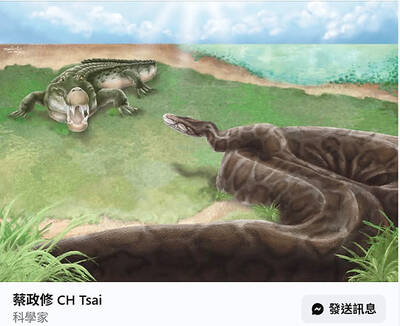
Taiwanese paleontologists have discovered fossil evidence that pythons up to 4m long inhabited Taiwan during the Pleistocene epoch, reporting their findings in the international scientific journal Historical Biology. National Taiwan University (NTU) Institute of Ecology and Evolutionary Biology associate professor Tsai Cheng-hsiu (蔡政修) led the team that discovered the largest snake fossil ever found in Taiwan. The single trunk vertebra was discovered in Tainan at the Chiting Formation, dated to between 400,000 and 800,000 years ago in the Middle Pleistocene, the paper said. The area also produced Taiwan’s first avian fossil, as well as crocodile, mammoth, saber-toothed cat and rhinoceros fossils, it said. Discoveries

Taiwanese paleontologists have discovered fossil evidence that pythons up to 4m long inhabited Taiwan during the Pleistocene epoch, reporting their findings in the international scientific journal Historical Biology. National Taiwan University (NTU) Institute of Ecology and Evolutionary Biology associate professor Tsai Cheng-hsiu (蔡政修) led the team that discovered the largest snake fossil ever found in Taiwan. A single trunk vertebra was discovered in Tainan at the Chiting Formation, dated to between 800,000 to 400,000 years ago in the Middle Pleistocene, the paper said. The area also produced Taiwan’s first avian fossil, as well as crocodile, mammoth, sabre-toothed cat and rhinoceros fossils, it said. Discoveries

Whether Japan would help defend Taiwan in case of a cross-strait conflict would depend on the US and the extent to which Japan would be allowed to act under the US-Japan Security Treaty, former Japanese minister of defense Satoshi Morimoto said. As China has not given up on the idea of invading Taiwan by force, to what extent Japan could support US military action would hinge on Washington’s intention and its negotiation with Tokyo, Morimoto said in an interview with the Liberty Times (sister paper of the Taipei Times) yesterday. There has to be sufficient mutual recognition of how Japan could provide


 RSS
RSS