


Lawmakers set the agenda for the special legislative session yesterday, putting a couple of controversial election-related bills on the list.
The extra session opens today and will review 19 bills backed by the pan-blue alliance, which is composed of the Chinese Nationalist Party (KMT), the People First Party and the Non-Partisan Solidarity Union.
The agenda was set after the pan-green camp failed to push through their request of a review of 18 bills during the two-week session. There was a clear difference in bills to be reviewed between the pan-blue and pan-green agendas, although there were six items in common.
Among the most controversial of the pan-blue proposals was a bill designed to eliminate the corruption allegations against KMT presidential candidate Ma Ying-jeou (
Ma is on trial for wiring half of his monthly mayoral special allowance as mayor of Taipei to the bank accounts of himself and his wife. A proposed amendment to the Audit Law (審計法) would redefine the special mayoral allowance as a "substantial subsidy."
Another disputed bill backed by the KMT calls for an absentee voting system. It wants people who handle electoral administration, military personnel and police who are on duty on election days, and people who study or work in counties or cities outside their registered residences to be able to apply for absentee ballots.
The DPP have said that the bill would allow the approximately 1 million Taiwanese businesspeople living and working in China to cast absentee votes and provide an opportunity for the Chinese authorities to manipulate the elections.
Another long-standing debate about revising the 28th, 29th and 30th clauses of the Statute Governing the Relations Between the Peoples of the Taiwan Area and the Mainland Area (台灣地區與大陸地區人民關係條例) was also placed on the agenda.
The amendment would allow Taiwanese ships and aircraft to sail or fly directly to China within three months of the bill being passed by the legislature.
The pan-green camp's request for a review of a bill on retrieving the KMT's stolen assets, a proposed amendment to toughen regulations on political contributions and draft legislation calling for a level playing filed for political parties were all rejected by pan-blue lawmakers.
The pan-blues did include two long-delayed budget bills for the current fiscal year on the agenda -- one for the NT$3.07 trillion (US$100 billion) budget for state-owned enterprises and the NT$1.15 trillion budget for governmental non-profit funds and the second for the NT$77.3 billion special budget for public construction projects.
But Legislative Speaker Wang Jin-pyng (王金平) said that whether the two camps could break their deadlock on a proposed amendment to the Organic Law of the Central Election Commission (中央選舉委員會組織法) would determine the passage of the two budget bills.
The pan-blue camp agreed to list the budget bill for state-owned enterprises and governmental non-profit funds as the first item to be reviewed and place the commission amendment second.
The KMT-backed amendment to the commission's organic law would create a pan-blue majority in the body by stipulating that its members are chosen according to the parties' number of legislative seats instead of being appointed by the premier.
KMT caucus whip Tseng Yung-chuan (曾永權) said his party has showed its sincerity in taking care of issues concerning the economy and people's livelihood during the extra session by moving the budget bill ahead of the CEC bill.
The legislature, however, is expected to stay deadlocked unless lawmakers make progress in talks on the budget bill for state-owned enterprises and governmental non-profit funds scheduled for 3pm today and another session on the commission bill at 11am tomorrow.
Democratic Progressive Party (DPP) Chairman Yu Shyi-kun urged the KMT to give more weight to bills concerning public welfare rather than on elections.
The KMT was "obviously trying to block the DPP's referendum proposals on recovering the KMT's stolen assets from being held with next year's legislative or presidential election," Yu said.
He said the KMT was trying to ensure Ma would win next year.
DPP Secretary-General Lin Chia-lung (
Additional reporting by Flora Wang

The military has spotted two Chinese warships operating in waters near Penghu County in the Taiwan Strait and sent its own naval and air forces to monitor the vessels, the Ministry of National Defense (MND) said. Beijing sends warships and warplanes into the waters and skies around Taiwan on an almost daily basis, drawing condemnation from Taipei. While the ministry offers daily updates on the locations of Chinese military aircraft, it only rarely gives details of where Chinese warships are operating, generally only when it detects aircraft carriers, as happened last week. A Chinese destroyer and a frigate entered waters to the southwest
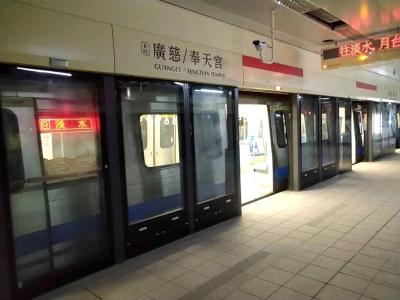
The eastern extension of the Taipei MRT Red Line could begin operations as early as late June, the Taipei Department of Rapid Transit Systems said yesterday. Taipei Rapid Transit Corp said it is considering offering one month of free rides on the new section to mark its opening. Construction progress on the 1.4km extension, which is to run from the current terminal Xiangshan Station to a new eastern terminal, Guangci/Fengtian Temple Station, was 90.6 percent complete by the end of last month, the department said in a report to the Taipei City Council's Transportation Committee. While construction began in October 2016 with an
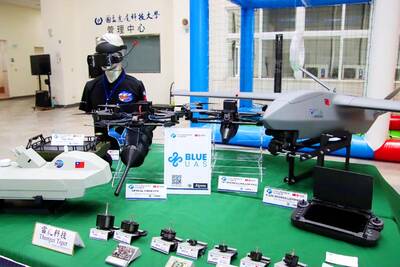
NON-RED SUPPLY: Boosting the nation’s drone industry is becoming increasingly urgent as China’s UAV dominance could become an issue in a crisis, an analyst said Taiwan’s drone exports to Europe grew 41.7-fold from 2024 to last year, with demand from Ukraine’s fight against Russian aggression the most likely driver of growth, a study showed. The Institute for Democracy, Society and Emerging Technology (DSET) in a statement on Wednesday said it found that many of Taiwan’s uncrewed aerial vehicle (UAV) sales were from Poland and the Czech Republic. These countries likely transferred the drones to Ukraine to aid it in its fight against the Russian invasion that started in 2022, it said. Despite the gains, Taiwan is not the dominant drone exporter to these markets, ranking second and fourth

Japanese Prime Minister Sanae Takaichi’s comment last year on Tokyo’s potential reaction to a Taiwan-China conflict has forced Beijing to rewrite its invasion plans, a retired Japanese general said. Takaichi told the Diet on Nov. 7 last year that a Chinese naval blockade or military attack on Taiwan could constitute a “survival-threatening situation” for Japan, potentially allowing Tokyo to exercise its right to collective self-defense. Former Japan Ground Self-Defense Force general Kiyofumi Ogawa said in a recent speech that the remark has been interpreted as meaning Japan could intervene in the early stages of a Taiwan Strait conflict, undermining China’s previous assumptions


 RSS
RSS