

President Chen Shui-bian (陳水扁) expressed concern over the US' commitment to the "six assurances" in a meeting with a high-ranking US official yesterday, saying he hoped Washington would reiterate its pledges.
"I'm very concerned whether the US government has changed its `six assurances' or even abandoned them," Chen said. "If not, I hope the US government will reiterate its pledge at an appropriate time."
Chen made the remarks in a meeting with Raymond Burghardt, chairman of the Board of Trustees of the American Institute in Taiwan (AIT), at the Presidential Office yesterday afternoon.
The "six assurances" refer to the pledge made in 1982 by former US president Ronald Reagan in which he promised that the US will not: Set a date for termination of arms sales to Taiwan; alter the terms of the Taiwan Relations Act [TRA]; consult with China in advance before making decisions about US arms sales to Taiwan; mediate between Taiwan and China; alter its position about the sovereignty of Taiwan, which was that the question was one to be decided peacefully by the people of Taiwan themselves, or pressure Taiwan to enter into negotiations with China; or formally recognize Chinese sovereignty over Taiwan.
The assurances were formulated in response to the 1982 communique signed between Washington and Beijing, in which Reagan pledged that the US would reduce arms sales to Taiwan.
Burghardt did not respond to Chen's call on the "six assurances," but said the US government would be particularly glad to see the government budget, especially some items relating to the US' security commitment to Taiwan, pass the legislature today.
Chen reiterated that the "four nos" pledge he made in 2000 and 2004 would remain unchanged for the remainder of his term. Chen said the pledge has helped maintain peace and stability in the Asia-Pacific region and cement the hard-earned friendship between Taipei and Washington.
Chen also said he hoped the US would voice its support for the country's plan to join the UN Convention to Eliminate All Forms of Discrimination against Women.
He said UN Secretary-General Ban Ki-moon had rejected the country's application, citing UN Resolution 2758 and claiming that the resolution stated Taiwan was part of the People's Republic of China (PRC).
"His argument does not tally with the fact because the resolution never makes such a statement," he said. "We support the US government's `one China' policy, which is defined by the TRA of 1979 and the `six assurances' of 1982. Neither of them recognize Taiwan as part of PRC."
Chen also took aim at Chinese Nationalist Party (KMT) presidential candidate Ma Ying-jeou (馬
Ma on Wednesday said that the KMT supports the idea of each side of the Strait having its own interpretation of "one China."
Taiwan has never denied PRC is a sovereign state, Chen said.
"It is the PRC that refuses to recognize Taiwan as a sovereignty," he said. "To expect China to respect and recognize Taiwan as a country is like seeking fish on a tree. The person must be not only naive but also ignorant if he advocates this `mutual non-denial.'"
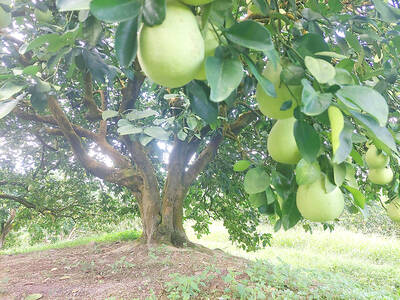
A Hualien pomelo farmer refused to sell to China after the country announced it would permit more Taiwanese pomelo imports, prompting widespread support from Taiwanese consumers, who rallied to buy his fruit. China’s Taiwan Affairs Office last month said that China’s General Administration of Customs registered an additional 79 Taiwanese pomelo orchards and packing facilities in Hualien County, allowing more Taiwanese producers to export pomelos to China. “I am a Hualien fruit farmer and I refuse to sell to China,” Liu Tzu-hao (劉子豪) from Ruisui Township (瑞穗) said in an online post. Liu is a well-known farmer in the community and has served
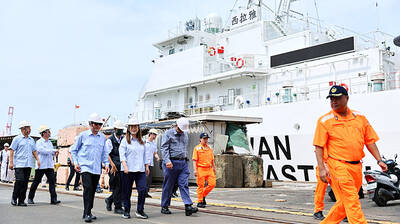
Ocean Affairs Council (OAC) Minister Kuan Bi-ling (管碧玲) on Wednesday said decommissioned coast guard vessels were given to the Philippines to enhance regional rescue capacity and would not affect Taiwanese fishers’ rights and benefits. Kuan made the remarks after confirmation on Tuesday that a 500-tonne Coast Guard Administration (CGA) patrol and rescue vessel would be given to the Philippine Coast Guard. The donation ceremony was reportedly done in Manila, but whether the vessel — previously numbered “CG123” and named Kinmen (金門) — has been handed over has yet to be confirmed. China’s Taiwan Affairs Office (TAO) on Wednesday criticized the donation for “taking
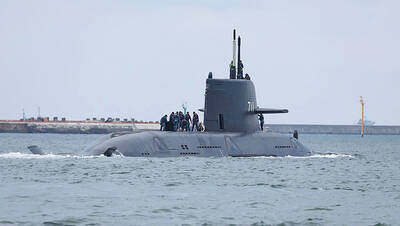
UPDATE: The submarine would need to undergo combined systems testing and crew training for navy personnel before it is ready for mission, an expert said Taiwan’s first domestically built submarine, the Hai Kun (Narwhal, 海鯤), could be delivered to the navy as early as next month, military expert and Taiwan Association for Security and Development chairman Chi Tung-yun (紀東昀) said yesterday. The submarine was yesterday morning observed departing for its 21st sea trial and its 15th submerged test. The vessel missed the initial delivery deadline of November last year due to “testing delays,” its primary contractor, shipbuilder CSBC Corp, Taiwan, said in June. The contractor also cited “political pressure from China” in procuring critical equipment. All testing operations are in the final stages, with the

OCT. 31: The antiviral drugs Tamiflu and Eraflu have been distributed to about 4,000 medical facilities nationwide for people in seven groups who develop flu-like symptoms As the domestic influenza epidemic enters its peak season and continues to escalate, the Centers for Disease Control (CDC) yesterday announced that publicly funded influenza antiviral drugs for seven eligible groups have been extended to Oct. 31, allowing those who develop flu-like symptoms to receive the medication without undergoing a rapid influenza test. The CDC has extended the expanded use of flu antiviral drugs to seven groups: healthcare and influenza-prevention personnel; residents and staff at nursing homes, long-term care facilities and similar institutions; kindergarten and daycare workers and home-based caregivers; students from kindergarten through high school, vocational high school and the


 RSS
RSS