


While praising a US academic's suggestion to designate Oct. 25 as "national independence day," President Chen Shui-bian (
"To declare Oct. 25 as Taiwan's independence day is to declare Taiwan's independence," Chen said. "It is a serious matter and requires careful discussion."
He made the remarks while meeting two representatives of Pepperdine University: Michael Warder, vice chancellor of the California school, and Bruce Herschensohn, a professor of public policy who served in the administrations of US presidents Richard Nixon and Ronald Reagan.
Herschensohn said Taiwan's bid to join the UN under the name "Taiwan" was futile, therefore Chen should take a historic step in the last year of his second term and make Oct. 25 a national holiday.
Oct. 25 is the day the Republic of China withdrew from the UN in 1971.
"Over the years, you have done everything in the world to try to accommodate the international community," Herschensohn said. "You can't win. Take exactly the opposite course."
He said the people of the US are less impressed with the UN. If he were giving a speech and said the US should get out of the UN and the UN should get out of the US, he could guarantee there would be applause.
"Therefore, if you made [Oct. 25] a national holiday, from that day forward you wouldn't have to sit in the same room with some significant governments that are murderers, hostage-takers, rapists and terrorists," he said.
"So you celebrate Oct. 25. That becomes your day of independence without declaring it, as we have July 4," he said.
Describing the proposal as an "innovative" idea, Chen said the country would continue its efforts to enter the UN and WHO and that he hoped to see a referendum on joining the UN under the name "Taiwan" held in tandem with either the year-end legislative elections or next year's presidential election.
The president drew a round of laughter when he asked his guests if his "four noes" pledge would become "three noes" if he declared independence.
The "four noes" are the pledges Chen made in his inaugural speech in 2000, when he promised that as long as China did not use military force against Taiwan, he would not declare independence, change the national title, enshrine the "state-to-state" model of cross-strait relations in the Constitution or back an independence referendum.
Chen said Taiwan has no intention of competing with China in the UN, but the People's Republic of China cannot represent Taiwan and its 23 million people.
Herschensohn said that while the US government embraces a "one China" policy, it calls for a two-state resolution of the Israel-Palestinian issue.
"Does the Palestinian Authority deserve independence, but Taiwan not?" he said.
"Taiwan has no desires on taking over China, but the Palestinian Authority has admitted desires to take over Israel. Taiwan is a friend of the United States. The Palestinian Authority is not a friend," Herschensohn said.
US President George W. Bush has praised the people of Iraq for going to the polls to vote on a referendum on a new constitution, Herschensohn said, so Taiwan could make a case for a similar referendum because the US believes in democracy and independence more than anything else.
Chen said he wished American Institute in Taiwan (AIT) Director Stephen Young were there to hear Herschensohn's comments.
Herschensohn said that he met Young on Monday but had not discussed his ideas with the envoy.
Young represents the US State Department and he represents himself, Herschensohn said.

FUKUOKA SITUATION: Japanese media reported that the pathogen is expected to be identified by the summer, while the CDC downplayed the idea that it was hMPV A “mysterious cold-like illness” reported in Japan’s Fukuoka Prefecture does not seem to be a new disease, but Japanese authorities have been asked about the situation, the Centers for Disease Control (CDC) said yesterday. The Fukuoka Prefectural Medical Association on Wednesday told a news conference that a “mystery cold” that has become a hot topic on social media is “highly likely to be caused by some kind of viral infection,” Japan’s KBC News reported. “Many people are experiencing symptoms starting with a sore throat, followed by a runny nose, phlegm and a severe cough,” KBC News reported, citing association officials. Health authorities are

Nvidia Corp CEO Jensen Huang (黃仁勳) arrived in Taiwan yesterday ahead of upcoming AI and technology events, saying he plans to meet with clients and Taiwan Semiconductor Manufacturing Co Chairman C.C. Wei (魏哲家) during his visit. After landing at Taipei Songshan Airport, Huang posed for photos with fans and handed out Yakult drinks to reporters and supporters waiting at the scene, saying he has “a lot to do” during the trip. Asked about reports that Nvidia’s planned headquarters site in Taipei’s Beitou Shilin Technology Park could break ground on May 27, Huang said that if the company holds an event, he would

Carrefour Taiwan is to begin using a new name from the start of July, but it cannot divulge the name until then, the chairman of the supermarket chain's parent company said today. President Chain Store Co chairman Lo Chih-hsien (羅智先) was asked by reporters after a shareholders' meeting to confirm whether the company has settled on a new name for the supermarket brand. In March, the government-registered name of two Carrefour Taiwan branches was quietly changed to "Le Chia Kang" (樂家康) in Chinese, raising speculation that has been selected as the name. Lo said that because of local regulations and contractual obligations, the
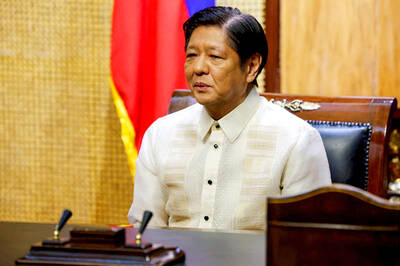
The Philippines would likely be involved in any conflict over Taiwan due to its proximity to the democracy claimed by China, President Ferdinand Marcos Jr said, reiterating a stance that risks angering Beijing. “In the Philippines, we do not have a choice because Taiwan is so close to the Philippines and we have almost 200,000 Filipino nationals living and working in Taiwan,” Marcos said in an interview with Japanese media in Manila on Monday. The Philippine leader’s comments come ahead of a state visit to Japan next week, where he is to meet with Japanese Prime Minister Sanae Takaichi to discuss security


 RSS
RSS