

President Chen Shui-bian's (陳水扁) long-time mentor and loyal follower Chang Chun-hsiung (張俊雄) has played the role of "firefighter" whenever the Chen administration faced political crises. There is nothing different with his new appointment as premier.
With the Democratic Progressive Party's (DPP) presidential primary just completed, the urgency of mending the fractures caused by keen competition and to ready the troops to win next year's presidential election will be a critical task for the party.
Premier Su Tseng-chang (蘇貞昌), who lost to his rival Frank Hsieh (謝長廷), resigned from his post on Saturday.
Su's move allowed Chang, the legislative and cross-strait affairs veteran, to return to the political stage.
Chang, 69, is one of the most respected DPP members because of his extensive political experience and seniority. He was one of the founders of the DPP in 1986 and had served as legislator for 15 years, starting in 1983. Whenever a candidate was needed for a significant official position -- such as Kaohsiung City mayor, Examination Yuan chief, DPP chairman or legislative speaker -- Chang's name always emerged.
Both members of the defunct Welfare State Alliance (福利國連線), Chang and Chen have developed a deep friendship over two decades. Having served as the general campaign manager for Chen in 2000 and secretary-general of the Presidential Office after Chen was elected, Chang has unwaveringly been Chen's mentor and helpful friend.
But Chen also encountered one of the most violent storms of his political career at a time when Chang headed the Cabinet. After his predecessor, Tang Fei (
At that time, the DPP still had a minority of seats in the legislature. But under Chen's guidance, Chang's Cabinet abruptly announced a freeze in the construction of the Fourth Nuclear Power Plant, a move that caused great consternation within the Chinese Nationalist Party (KMT), which had just lost power. The KMT threatened to recall Chen and the Council of Grand Justices ruled that it was unconstitutional for the Cabinet to scrap the nuclear plant project.
Stopping the construction of the Fourth Nuclear Power Plant had been one of Chen's campaign promises in the 2000 presidential election, but it became a factor in Chang's resignation from the premiership and constituted the first shot in the political confrontation between the governing and opposition parties. Before heading the Straits Exchange Foundation (SEF), Chang served as DPP secretary-general and legislator-at-large.
Chang will be the sixth person to become premier in the past seven years and will likely be the last premier in Chen's tenure.
Although SEF Secretary-General You Ying-lung (游盈隆) yesterday said he believed that thanks to his experiences at the SEF Chang would bring a new vision for cross-strait relations, political commentators did not expect much change in cross-strait relations.
"Chang's appointment shows that Chen still dominates cross-strait policies," political analyst Hsu Yung-ming (徐永明) said, adding that on some occasions Chang has been considered an executor of Chen's dictates.
The shake-up showed Chen's intention to retain control over the remainder of his term and the campaign strategy of next year's presidential election, said Shih Cheng-feng (施正鋒), a professor of public administration at Tamkang University.
"I think Chang's appointment is a compromise, since I heard that Hsieh actually wanted some other person to be the premier," Shih said.
Shih was also pessimistic about any new progress being made on cross-strait policies.
"China will wait and see how things go before Taiwan's new president is elected in 2008," he said.
Described as "good old man" by many people, Chang has a unique style. The dramatic cadence in his voice and feisty gestures when making speeches have made him the object of many a political mimic. Old singer Kao Ling-feng (高凌風), who is famous for his Chang impression, said Chang's return on the political scene had revived his career.
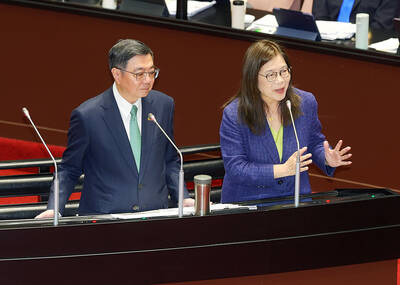
The donation of offshore patrol vessel Kinmen to the Philippines includes provisions that protect Taiwanese fishers and facilitate security cooperation across the First Island Chain, officials said yesterday. The comment was made during the Cabinet’s comprehensive administrative report at the legislature after Chinese Nationalist Party (KMT) Legislator Hsu Yu-chen (許宇甄) expressed concerns about the decision to give a ship to a country whose coast guard had in 2013 fired on a Taiwanese trawler and killed its captain without provocation. The Cabinet should lay out the safeguards that have been established to prevent the Philippine government from using the Kinmen to harass, expel
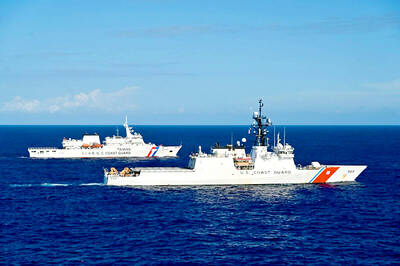
GROWING TIES: The CGA is planning a goodwill mission to the Philippines, in what would be the first time since 1975 a Taiwanese paramilitary vessel has visited the country The Coast Guard Administration (CGA) plans to significantly expand its participation in international security cooperative frameworks and its operational capabilities, a budget proposal for next year showed. The budget indicates a transformation of the CGA from a maritime law enforcement arm into a national defense and intelligence gathering entity capable of tackling larger regional security matters. The proposal showed that personnel from the coast guard’s Intelligence Division and Special Action Support Center are to participate in high-level national security talks with the US. As the CGA has dealt with China’s rising “gray zone” threats around Taiwan, it has become a valuable asset to
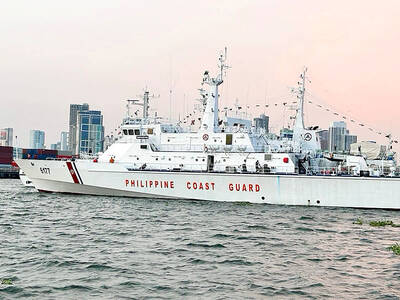
A patrol vessel donated by the Coast Guard Administration (CGA) to the Philippines was commissioned into the Philippine Coast Guard (PCG) on Friday, a Philippine non-governmental organization said. The CGA on Sept. 16 confirmed media reports that Taiwan had donated a retired 500-tonne patrol vessel to the Philippines. The Manila-based We Protect Our Seas (WPS) foundation, which served as an intermediary in the transfer, said that the vessel was formerly the CGA’s 500-tonne petrol vessel Kinmen (CG123). The WPS, in a statement issued on Friday, said the vessel, renamed as the BRP Sarangani, had been commissioned into the PCG the
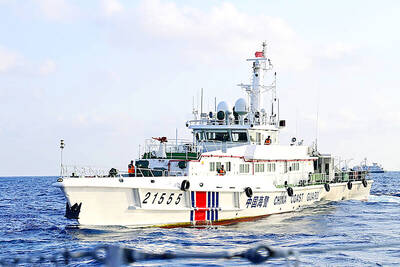
‘GRAY ZONE’ TACTICS: Beijing sent two China Coast Guard vessels to escort a ‘supposedly private research ship,’ a Philippine Coast Guard spokesman said The Coast Guard Administration (CGA) yesterday confirmed that it had recently deployed three patrol vessels to waters in Taiwan’s overlapping exclusive economic zone with the Philippines to monitor three Chinese vessels. CGA Deputy Director-General Hsieh Ching-chin (謝慶欽) said the agency regularly monitors Chinese vessels around Taiwan, and that the deployment south of Oluanpi (鵝鑾鼻), Taiwan proper’s southernmost point, was carried out in accordance with standard procedures. He added that the waters fall within the overlapping exclusive economic zones of Taiwan and the Philippines, which extend 200 nautical miles (370km) from their coastlines. Hsieh made the comments when asked about a


 RSS
RSS