


The Ministry of Education is taking "localization" too far as high school students nationwide fall behind in their Chinese-language ability, the Alliance to Save the National Language said yesterday.
Composed of academics, the alliance yesterday attacked the education ministry's curricula planning for high schools nationwide, saying that its latest plan, which alliance spokeswoman Lee Su-chen (
Promulgated by the education ministry in 2005, the last curriculum plan for high schools dramatically slashed the number of classical Chinese-related courses while adding more "vernacular" language classes, the alliance said.
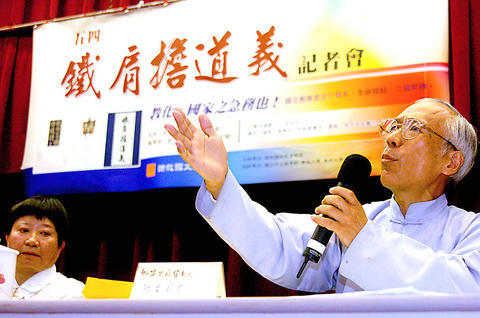
PHOTO: SEAN CHAO, TAIPEI TIMES
The ratio of vernacular to classical courses is now skewed in favor of the former by up to 20 percent, leaving students in the dark as to crucial elements of the Chinese language and culture, it said.
"The localization of education is getting out of hand," said alliance member Tu Chung-kao (
Alliance members and Chinese Nationalist Party (KMT) Legislator Diane Lee (
"The ratio looks unchanged," Lee Su-chen said, "but actually, the education ministry has canceled a lot of classical courses and expanded others [within the space allotted for classical education in curricula]."
The result of such cut-backs on classical education, Diane Lee said, is a whole generation of high school students whose command of the Chinese language is faulty or shallow. More than 90 percent of middle school teachers lament their students' poor grasp of the finer points of Chinese, she added.
In a phone interview last night, Chen Yi-hsing (陳益興), who oversees high school curricula planning as the ministry's director of secondary education, said that before 1998, secondary students attended six days of school, allowing for more in-depth study of all subjects.
Since two days of rest per week for students became mandatory nearly a decade ago, coursework in all subjects, not just Chinese, has been reduced, he said.
"That's when the cut-back on classical Chinese education began," he said.
As for the current division of coursework between vernacular and classical classes, Chen said that Taiwan's ratio was still higher than high schools in China.
"I don't have the statistics on hand now, but we're still emphasizing classical education more than the Chinese," he said
"We place great emphasis on the study of classical Chinese, and we look forward to the alliance's feedback and participation in further planning [of future high school curricula]," he said.
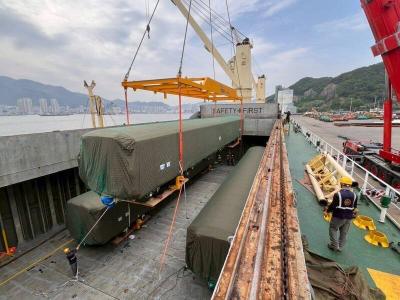
The first of 10 new high-capacity trains purchased from South Korea’s Hyundai Rotem arrived at the Port of Taipei yesterday to meet the demands of an expanding metro network, Taipei Rapid Transit Corp (TRTC) said yesterday. The train completed a three-day, 1,200km voyage from the Port of Masan in South Korea, the company said. Costing NT$590 million (US$18.79 million) each, the new six-carriage trains feature a redesigned interior based on "human-centric" transportation concepts, TRTC said. The design utilizes continuous longitudinal seating to widen the aisles and optimize passenger flow, while also upgrading passenger information displays and driving control systems for a more comfortable
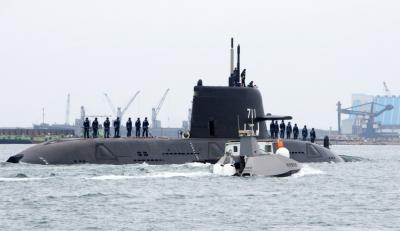
Taiwan's first indigenous defense submarine, the SS-711 Hai Kun (海鯤, or Narwhal), departed for its 13th sea trial at 7am today, marking its seventh submerged test, with delivery to the navy scheduled for July. The outing also marked its first sea deployment since President William Lai (賴清德) boarded the submarine for an inspection on March 19, drawing a crowd of military enthusiasts who gathered to show support. The submarine this morning departed port accompanied by CSBC Corp’s Endeavor Manta (奮進魔鬼魚號) uncrewed surface vessel and a navy M109 assault boat. Amid public interest in key milestones such as torpedo-launching operations and overnight submerged trials,
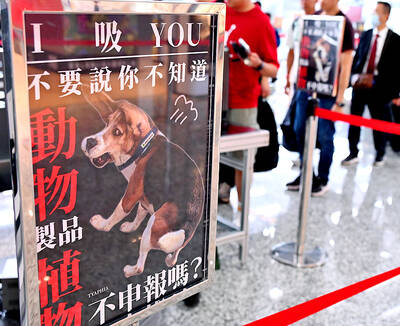
Quarantine awareness posters at Taiwan Taoyuan International Airport have gone viral for their use of wordplay. Issued by the airport branch of the Animal and Plant Health Inspection Agency, the posters feature sniffer dogs making a range of facial expressions, paired with advisory messages built around homophones. “We update the messages for holidays and campaign needs, periodically refreshing materials to attract people’s attention,” quarantine officials said. “The aim is to use the dogs’ appeal to draw focus to quarantine regulations.” A Japanese traveler visiting Taiwan has posted a photo on X of a poster showing a quarantine dog with a

SECURITY RISK: A university student sent a general alarm signal to THSRC’s control center on April 5, causing four operating trains to temporarily halt services The Ministry of Transportation and Communications yesterday pledged to submit a report on ways to harden the communication security of railway systems after a university student hacked into Taiwan High Speed Rail Corp’s (THSRC) radio communications system and disrupted operations of four high-speed rail trains last month. Investigation by the police and prosecutors found that the university student and radio enthusiast, surnamed Lin (林), first used a software-defined radio (SDR) filter to analyze THSRC signals, downloaded the data to a computer, cracked the parameters and then programmed the codes into his radio devices. Lin then sent a general alarm signal to


 RSS
RSS