


With her clear, rapid-fire lectures, Yu Dan (
Yesterday, Yu, a media expert and Beijing Normal University professor, released the Taiwanese version of her latest book -- a 200-page compilation of lectures she delivered on the Confucian Analects while appearing on China's Central Television last October.
The work has sold some 4 million copies in China, nearly double the number of JK Rowling's Harry Potter books, according to her Chinese publisher.

PHOTO: AP
With her soaring popularity, she is regarded by many as the modern day incarnation of China's most respected philosopher, whose observations developed into a complex social system that dominated Chinese thought until the communist victory in 1949.
Lin Tsai-chueh (
"She relates the analects to the day-to-day experience of ordinary Chinese and comforts their souls in the midst of China's big transition," Lin said.
With short, stylish hair with cranberry-colored highlights, the 42-year-old scholar told a packed Taipei auditorium that her main goal was to revive the classical Chinese teachings that as recently as 35 years ago had been anathema in her home country.
"We often think classics are too difficult, but as a Chinese, the classics are the origin of our being, works that comfort us in the midst of our bewilderment," Yu said. "In this complex world, we seek simplicity out of grandeur, the simple truths that we can find in the pithiness of Confucius' teachings."
Confucius' analects comprise responses the philosopher provided to 72 disciples who toured the countryside with him during the so-called "Warring States Period" -- a time of great political instability.
According to Yu, Confucius answered one disciple's question about the most essential quality a human being can have with a simple one-word answer: Forgiveness.
"Whatever attitude you adopt, you will receive the same quality of forgiveness from others you meet, and you will have a smooth life throughout," she said.
Appearing with Yu in Taipei was Chinese historian Yan Chongnian (閻崇年), who released two volumes of his own book Sixty years of Ming and Qing Dynasties, recounting the fall of the Ming Dynasty in the second quarter of the 17th century and the rise of the Qing Dynasty over the succeeding decades.
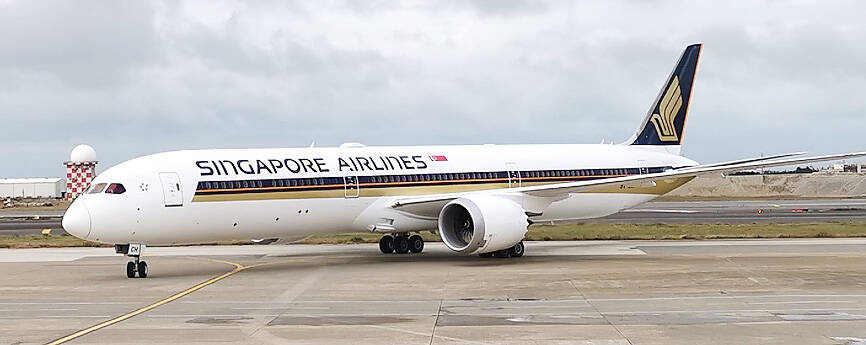
INCREASED CAPACITY: The flights on Mondays, Wednesdays, Fridays and Sundays would leave Singapore in the morning and Taipei in the afternoon Singapore Airlines is adding four supplementary flights to Taipei per week until May to meet increased tourist and business travel demand, the carrier said on Friday. The addition would raise the number of weekly flights it operates to Taipei to 18, Singapore Airlines Taiwan general manager Timothy Ouyang (歐陽漢源) said. The airline has recorded a steady rise in tourist and business travel to and from Taipei, and aims to provide more flexible travel arrangements for passengers, said Ouyang, who assumed the post in July last year. From now until Saturday next week, four additional flights would depart from Singapore on Monday, Wednesday, Friday
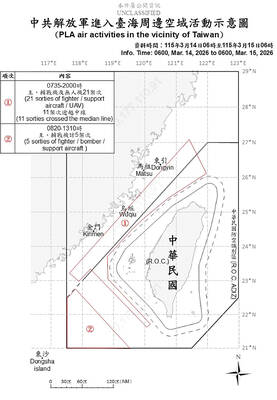
The Ministry of National Defense yesterday reported the return of large-scale Chinese air force activities after their unexplained absence for more than two weeks, which had prompted speculation regarding Beijing’s motives. China usually sends fighter jets, drones and other military aircraft around the nation on a daily basis. Interruptions to such routine are generally caused by bad weather. The Ministry of National Defense said it had detected 26 Chinese military aircraft in the Taiwan Strait over the previous 24 hours. It last reported that many aircraft on Feb. 25, when it spotted 30 aircraft, saying Beijing was carrying out another “joint combat

Taiwan’s three major international carriers are increasing booking fees, with EVA Airways having already increased the charge to US$28 per flight segment from US$25, while China Airlines (CAL) and Starlux Airlines are set to follow suit. Booking fees are charged by airlines through a global distribution system (GDS) and passed on to passengers. Carriers that apply the fees include CAL, EVA, Starlux and Tigerair Taiwan. A GDS is a computerized network operated by a company that connects airlines with travel agents and ticketing platforms, allowing reservations to be made and processed in real time. Major players include Amadeus, Sabre and Travelport. EVA Air began

Taiwan successfully defended its women’s 540 kilogram title and won its first-ever men’s 640 kg title at the 2026 World Indoor Tug of War Championships in Taipei yesterday. In the women’s event, Taiwan’s eight-person squad reached the final following a round-robin preliminary round and semifinals featuring teams from Ukraine, Japan, Thailand, Vietnam, the Basque Country and South Korea. In the finals, they swept the Basque team 2-0, giving the team composed mainly of National Taiwan Normal University students and graduates its second championship in a row, and its fourth in five years. Team captain


 RSS
RSS