


Sitting in her stall outside a Catholic church in Shilin, Taipei, and equipped with a beauty kit, 61-year-old Mo Xiang-xiang (
Mo put white powder on her customer's face, then gently held one end of a thread in her teeth, the other in her hands, and moved the thread to trap rows of the customer's facial hairs and pull them out by the roots.
With more than 40 years of experience, Mo is a master of a traditional Asian technique for removing hair called wanmian (挽面), which literally means "threading the face."
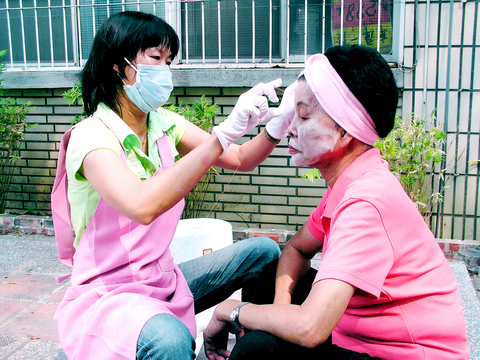
PHOTO: CHU YU-LING, TAIPEI TIMES
"Face-threading lights up your face by removing all unwanted facial hair. It's an old method, but it does more than lighting up your face. It brings you luck, too," she said.
Traditionally, face-threading was not only a beauty treatment but also a ritual for women the day before getting married. The ritual was called kaimian (
While many traditional practices have disappeared, face-threading has managed to survive, as some young ladies now embrace this traditional technique in their pursuit of natural beauty treatments.
On a sidewalk of Wenlin Road in Shilin, Mo and more than 10 other face-threading practitioners have lined up their stalls on "face-threading street," where this method has been practiced for more than 30 years.
Mo sets up her stall each day at about 8am, bringing along several chairs and her kit -- white powders, combs, hair clips and rolls of cotton thread -- and works until 5pm or 6pm in the evening regardless of customer flow.
Since more stalls have started popping up on "face-threading street," Mo said she usually had 5 to 6 customers during weekdays and more than 10 on weekends.
In addition to face-threading, which takes about 30 minutes and costs NT$200, Mo and other practitioners also provide other services, such as eyebrow threading and pedicures.
Compared to modern facial hair removal using tweezers, razors or even lasers, Mo said threading is more effective and natural, and hair regrowth becomes finer after regular treatments as the top layers of skin are not peeled or traumatized in the process.
"But of course threading could be painful for first-timers, but a little suffering for a beautiful face is definitely worth it," she said.
Sitting on a chair in Mo's stall facing the noisy street, 30-year-old Melody Chang (
"It hurt so much during my first face-threading that I burst into tears. But it doesn't hurt now, and my skin feels smooth and acne-free," she said.
The ancient method not only attracts young women like Chang, but also men and foreigners, practitioner Tina Wu (
"More and more men care about their appearance and are willing to give face-threading a try. Many foreign visitors who come to Shilin, especially Japanese, also try face-threading," she said.
Penny Tsai (
Wu said face-threading normally does not hurt the skin, but people with sensitive skin may feel uncomfortable. Unprofessional practitioners can also hurt a customer's skin, she said.
If the skin was still red or swollen after few days, customers should visit dermatologists and stop getting face-threading, Wu said.
Although doing face-threading does not make for an easy living, Wu, who learned the skill from her mother-in-law two years ago and now works at her stall every other day, said she is willing to pass on this traditional method so that it will not be lost.
"Face-threading is usually passed on as a family tradition and rarely taught to outsiders, so I feel privileged that my mother-in-law wanted to teach me the skill," she said.
Mo, who learned the skill from her grandmother, expressed the same concern that the technique would be lost.
In addition to her daughter, she has decided to pass on the tradition by offering courses to those who are interested.
"Many foreigners have told me that the face-threading technique in Taiwan is No.1 in the world," she said. "It's natural, it's cheap and it's effective. I can't let this tradition die with my generation."
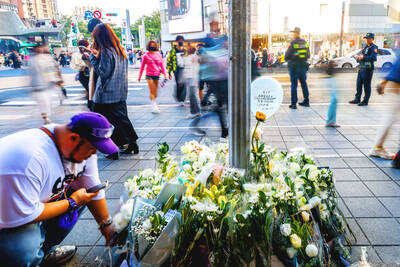
HORROR STORIES: One victim recounted not realizing they had been stabbed and seeing people bleeding, while another recalled breaking down in tears after fleeing A man on Friday died after he tried to fight the knife-wielding suspect who went on a stabbing spree near two of Taipei’s busiest metro stations, Taipei Mayor Chiang Wan-an (蔣萬安) said. The 57-year-old man, identified by his family name, Yu (余), encountered the suspect at Exit M7 of Taipei Main Station and immediately tried to stop him, but was fatally wounded and later died, Chiang said, calling the incident “heartbreaking.” Yu’s family would receive at least NT$5 million (US$158,584) in compensation through the Taipei Rapid Transit Corp’s (TRTC) insurance coverage, he said after convening an emergency security response meeting yesterday morning. National

Taiwan has overtaken South Korea this year in per capita income for the first time in 23 years, IMF data showed. Per capita income is a nation’s GDP divided by the total population, used to compare average wealth levels across countries. Taiwan also beat Japan this year on per capita income, after surpassing it for the first time last year, US magazine Newsweek reported yesterday. Across Asia, Taiwan ranked fourth for per capita income at US$37,827 this year due to sustained economic growth, the report said. In the top three spots were Singapore, Macau and Hong Kong, it said. South

PLANNED: The suspect visited the crime scene before the killings, seeking information on how to access the roof, and had extensively researched a 2014 stabbing incident The suspect in a stabbing attack that killed three people and injured 11 in Taipei on Friday had planned the assault and set fires at other locations earlier in the day, law enforcement officials said yesterday. National Police Agency (NPA) Director-General Chang Jung-hsin (張榮興) said the suspect, a 27-year-old man named Chang Wen (張文), began the attacks at 3:40pm, first setting off smoke bombs on a road, damaging cars and motorbikes. Earlier, Chang Wen set fire to a rental room where he was staying on Gongyuan Road in Zhongzheng District (中正), Chang Jung-hsin said. The suspect later threw smoke grenades near two exits
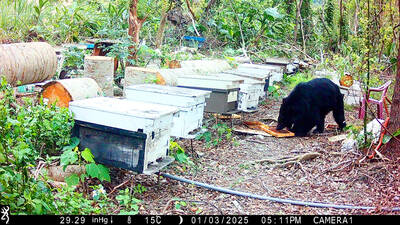
The Forestry and Nature Conservation Agency yesterday launched a gift box to market honey “certified by a Formosan black bear” in appreciation of a beekeeper’s amicable interaction with a honey-thieving bear. Beekeeper Chih Ming-chen (池明鎮) in January inspected his bee farm in Hualien County’s Jhuosi Township (卓溪) and found that more than 20 beehives had been destroyed and many hives were eaten, with bear droppings and paw prints near the destroyed hives, the agency said. Chih returned to the farm to move the remaining beehives away that evening when he encountered a Formosan black bear only 20m away, the agency said. The bear


 RSS
RSS