


A new deadline for the eviction of residents at Lo Sheng (Happy Life) Sanatorium, a leprosarium in Taipei County, sparked physical clashes between police officers and protesters yesterday.
The Taipei County Government has decided to give residents at the sanatorium until April 16 to move out.
Physical clashes broke out when protesters attempted to prevent the police from posting a notice announcing the new deadline yesterday.
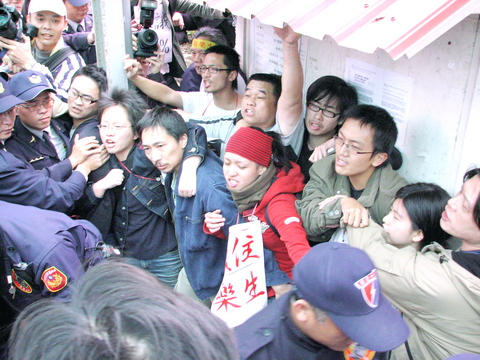
PHOTO: LIN CHIH-CHING, TAIPEI TIMES
Three protesters were arrested.
The Lo Sheng Sanatorium was built in 1929 to house leprosy patients. Leprosy was at the time believed to be easily contagious and incurable, and patients were therefore quarantined for life.
Free movement for sufferers of leprosy has only been allowed since the 1950s.
In order to build a maintenance facility for the MRT system, government authorities have decided to move residents at the sanatorium to a newly built home nearby and demolish most of the buildings at Lo S?heng.
The decision has met with opposition from some Lo Sheng residents, leprosy rights activists and preservationists.
"Save Lo Sheng. It's not just about saving historic buildings ... it's also about respecting the basic human rights of a group of disadvantaged people," the Youth Alliance for Lo Sheng said in a press release.
Tuesday was the original deadline for eviction.
But after demonstrations in front of Premier Su Tseng-chang's (
Around 40 protesters, including human-rights activists, students, residents of Lo Sheng and their families, blocked the main gate as hundreds of police officers approached the facility this morning, said Lai Che-chun (
IDEA is an international organization protecting the rights of leprosy sufferers.
"The police couldn't get in through the main gate, so they sneaked through a back gate to post the mandatory eviction notice on the bulletin board," Lai said.
"They're like thieves! Only thieves go through backdoors!" A Lo Sheng resident cried.
Another clash broke out as protesters tore down the posted notice.
"We tore down the notice and when the police saw that, the SWAT team moved in and arrested people," said Soda Masoto, a Japanese student pursuing his doctorate in Taiwan.
Three protesters were arrested and one passed out during the clash, Lai said
Meanwhile, a group of leprosy patients yesterday presented a petition to the Legislative Yuan calling on lawmakers to speed up the passage of a statute providing for their needs.
Chinese Nationalist Party (KMT) Legislator Kuo Su-chun (
"Premier Su says the statute is stalled in the legislature. We want legislators to pass it as soon as possible," said Chan Ming-chou (
The self-help group, organized with the goal of preserving Lo Sheng Sanatorium, demanded that legislators make preserving the leprosarium one of the articles of the statute.
The current version of the statue only discusses compensation for the patients.
Legislators are divided over the statute, which aims at detailing measures that must be taken to compensate for the suffering of leprosy patients.

The Ministry of Finance this afternoon announced the winning numbers for the March-April uniform invoice lottery. The winning number for the NT$10 million (US$318,060) special prize is 19531471, and the winning number for the NT$2 million grand prize is 85941329. Three numbers were drawn for the NT$200,000 first prize: 07225810, 20231230 and 83518781. Those with receipts matching the last seven digits of any of the first-prize numbers will win the NT$40,000 second prize, while those matching the last six digits will win the NT$10,000 third prize. Those whose receipts match the last five digits of the first-prize numbers can claim the NT$4,000 fourth prize,

SIX SUBSIDIES: The monthly allowance for older farmers is to increase to NT$10,000, and NT$5,000 is to be given to homemakers under the national pension system, Lai said The government is to implement major welfare policies for disadvantaged groups, including raising the monthly allowance for older farmers to NT$10,000 and providing homemakers with NT$5,000 per month, President William Lai (賴清德) said yesterday. Lai made the remarks during a visit to Wangling Temple in Chiayi County, saying that the planned increases were being introduced amid economic growth and an increase in tax revenue. Touting a policy, in which the government plans to provide a monthly allowance of NT$5,000 for every child under the age of 18 in a bid to address Taiwan’s low birthrate, Lai said that if received for the
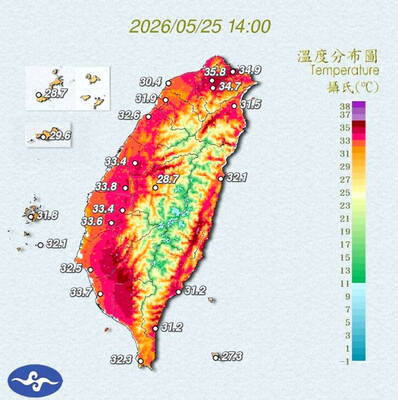
STAY COOL: The HPA recommended that people stay hydrated, use air-conditioning or fans while indoors, wear loose-fitting clothes and walk in the shade while outdoors Employers must implement measures such as installing cooling equipment, and providing drinking water and rest breaks for outdoor workers starting from Monday next week, the Taipei Department of Labor said on Sunday. Employers who fail to comply could face fines of NT$30,000 to NT$300,000 under the Occupational Safety and Health Act (職業安全衛生法), the department said. Businesses in Taipei employing fewer than 100 workers, as well as registered self-employed workers with labor insurance coverage, could receive on-site assessments and guidance from occupational safety consultants to help them apply for central government subsidies to implement or improve heat-protection measures, it said. Under the Ministry of
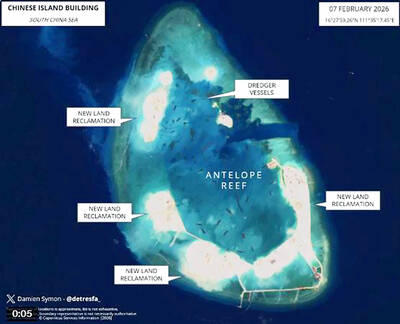
ISOLATION: The outposts would serve as support and backup bases, forcing US forces to either face China head-on or reroute, increasing travel time and operational costs China’s outposts in the South China Sea could be used to delay and constrain foreign forces during a conflict in the Taiwan Strait, giving Beijing a critical window to carry out amphibious landing and blockade operations, a report said. The Chinese Communist Party’s (CCP) forward operating bases on islands and reclaimed features in the South China Sea could delay foreign forces long enough for the Chinese People’s Liberation Army (PLA) to secure a key 48-to-72-hour window in the Taiwan Strait, a report commissioned by the Mainland Affairs Council found. The report, conducted by the Institute for National Defense and Security Research, examined


 RSS
RSS