


The US made clear its displeasure over President Chen Shui-bian's (
Speaking at a celebration of the 25th anniversary of the Formosan Association for Public Affairs on Sunday night, Chen said: "Taiwan will say yes to independence" and alluded to a change in the nation's official name to Taiwan, while discussing a new constitution for the country.
The only question for Taiwan, he added, was "independence or assimilation" with China.
US State Department spokesman Sean McCormack, when asked about Chen's comments on Monday, reiterated Washington's oft-stated non-support for independence and opposition to unilateral changes in the status quo across the strait.
He pointed to Chen's 2000 inaugural address "four noes" pledge to avoid moves related to sovereignty during his presidency and his 2004 inaugural pledge to keep sovereignty issues from any new constitution.
"Rhetoric that can raise doubts about these commitments is unhelpful," McCormack said.
McCormack later added that rhetoric that "contravened" those commitments was unhelpful.
But he avoided saying directly that Chen's remarks were unhelpful. The word "unhelpful" took on a special meaning in US-Taiwan relations after the State Department criticized China's passage of its "Anti-secession" Law in 2005 as unhelpful.
That characterization raised hackles in Taiwan, where it was felt that Washington had been too tame on a law that legitimized a military attack on Taiwan whenever the powers in Beijing felt it was justified.
In his regular press briefing, McCormack underscored the US role in creating the "four noes" and US expectations that they would survive after Chen's term ends.
"Inasmuch as these commitments flow from our policy requirements and our policy statements, [we expect] that they would continue to be abided by" future Taiwan presidents, he said.
While McCormack declined to directly criticize Chen, he also refused to criticize China's military expansion and threats to Taiwan, despite the fact that Beijing has an estimated 1,000 ballistic and cruise missiles aimed at Taiwan and continues a rapid military expansion aimed mainly at Taiwan.
"We have spoken to the Chinese military buildup separately," he said.
"Our position on that is well-known. We believe that any actions that would destabilize the status quo or threaten that status quo are not helpful and we would ask the parties to refrain from such activities," he said in answer to a question.
A department official later expanded on that statement, saying that the US opposed changes in the status quo "by either Taipei or Beijing," and that "statements and actions by either side that can raise tensions and threaten to undermine peace and stability in the Taiwan Strait."
The official also described Chen's 2000 pledge on the "four noes" and his 2004 inaugural pledge to exclude issues related to sovereignty from any reforms to the constitution as the "cornerstone of peace and stability in the Taiwan Strait."
In answer to a question, McCormack urged Chen to "make it clear" what his policy was and to make sure that "he continues to adhere to his previous commitments."
He also said Chen's adherence to his previous commitments "is a test of leadership, dependability and statesmanship, and his ability to protect Taiwan's own interests, its relations with others and to maintain peace and stability in the Strait."
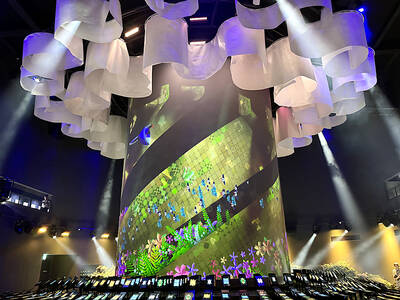
PRAISE: Japanese visitor Takashi Kubota said the Taiwanese temple architecture images showcased in the AI Art Gallery were the most impressive displays he saw Taiwan does not have an official pavilion at the World Expo in Osaka, Japan, because of its diplomatic predicament, but the government-backed Tech World pavilion is drawing interest with its unique recreations of works by Taiwanese artists. The pavilion features an artificial intelligence (AI)-based art gallery showcasing works of famous Taiwanese artists from the Japanese colonial period using innovative technologies. Among its main simulated displays are Eastern gouache paintings by Chen Chin (陳進), Lin Yu-shan (林玉山) and Kuo Hsueh-hu (郭雪湖), who were the three young Taiwanese painters selected for the East Asian Painting exhibition in 1927. Gouache is a water-based
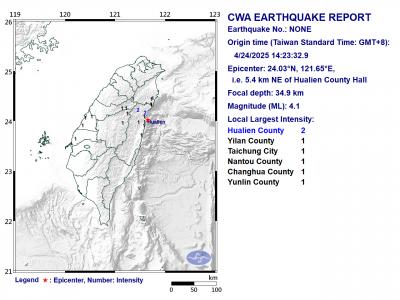
A magnitude 4.1 earthquake struck eastern Taiwan's Hualien County at 2:23pm today, according to the Central Weather Administration (CWA). The epicenter of the temblor was 5.4 kilometers northeast of Hualien County Hall, at a depth of 34.9 km, according to the CWA. The earthquake's intensity, which gauges the actual effect of a temblor, was the highest in Hualien County, where it measured 2 on Taiwan's 7-tier intensity scale. The quake also measured an intensity of 1 in Yilan county, Taichung, Nantou County, Changhua County and Yunlin County, the CWA said. There were no immediate reports of damage or injuries.
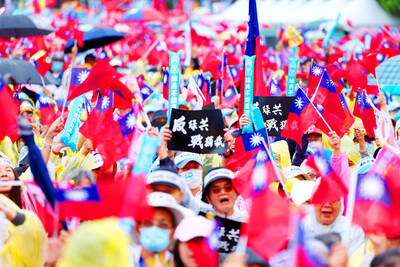
‘WORSE THAN COMMUNISTS’: President William Lai has cracked down on his political enemies and has attempted to exterminate all opposition forces, the chairman said The legislature would motion for a presidential recall after May 20, Chinese Nationalist Party (KMT) Chairman Eric Chu (朱立倫) said yesterday at a protest themed “against green communists and dictatorship” in Taipei. Taiwan is supposed to be a peaceful homeland where people are united, but President William Lai (賴清德) has been polarizing and tearing apart society since his inauguration, Chu said. Lai must show his commitment to his job, otherwise a referendum could be initiated to recall him, he said. Democracy means the rule of the people, not the rule of the Democratic Progressive Party (DPP), but Lai has failed to fulfill his

OFF-TARGET: More than 30,000 participants were expected to take part in the Games next month, but only 6,550 foreign and 19,400 Taiwanese athletes have registered Taipei city councilors yesterday blasted the organizers of next month’s World Masters Games over sudden timetable and venue changes, which they said have caused thousands of participants to back out of the international sporting event, among other organizational issues. They also cited visa delays and political interference by China as reasons many foreign athletes are requesting refunds for the event, to be held from May 17 to 30. Jointly organized by the Taipei and New Taipei City governments, the games have been rocked by numerous controversies since preparations began in 2020. Taipei City Councilor Lin Yen-feng (林延鳳) said yesterday that new measures by


 RSS
RSS