


The Chinese Nationalist Party (KMT) yesterday delayed proposing a possible amendment of anti-corruption regulations that would prevent party Chairman Ma Ying-jeou (馬英九) from running in next year's presidential election, should he be indicted over his alleged mishandling of a public fund.
It is widely expected that the party's Central Standing Committee will relax anti-corruption regulations that suspend membership if a person is indicted for a crime, to allow Ma to run in the presidential election if indicted. However, committee members yesterday said no actions should be taken until the outcome of the investigation is announced.
The KMT's "black gold exclusion clause," which originally suspended membership only if a person was found guilty of a crime by a court, was modified under Ma's chairmanship to suspend any member indicted for a crime. The goal of the change was to improving the party's image.
The latest issue of Next magazine said that the investigation into Ma's alleged misuse of his mayoral allowance during his eight-year term as Taipei mayor would be soon be completed.
The magazine said that the prosecutors would indict Ma before the Lunar New Year holiday.
Amendment
Although KMT Legislator Alex Tsai (蔡正元) has vowed to propose an amendment to the "black gold exclusion clause," no action has been taken. Other committee members have either opposed amending the clause or suggested that the issue should be discussed by more party members.
Meanwhile, Ma announced yesterday that the party would no longer use funds generated by the liquidation of party assets to pay for election expenses. These expenses would have to be paid for using funds raised for the purpose, he said.
Proceeds from asset sales would instead be used to pay staff salaries and contribute to retirement funds, Ma said.
Central Standing Committee member Lee Chuan-chiao (李全教) said the chairman's comments amounted to a significant change of policy that should have been announced well ahead of the year-end legislative election to give party members time to raise funds.
`Blindsided'
Although Ma has said on numerous occasions that once the issue of the party's assets has been resolved, election funds should be collected through fundraising activities, the party has yet to flesh out the details of the new policy. As a result Lee, who is also a legislator, said he felt that he had been "blindsided" by Ma's announcement.
KMT Secretary-General Wu Den-yih (
Information had been passed on to the effect that party fundraising would in future be overseen by KMT Vice Chairman Chiang Pin-kung (
Wu said that the KMT still employees some 1,005 people and had a long way to go in its efforts to whittle its workforce down to 600 employees.

Yangmingshan National Park authorities yesterday urged visitors to respect public spaces and obey the law after a couple was caught on a camera livestream having sex at the park’s Qingtiangang (擎天崗) earlier in the day. The Shilin Police Precinct in Taipei said it has identified a suspect and his vehicle registration number, and would summon him for questioning. The case would be handled in accordance with public indecency charges, it added. The couple entered the park at about 11pm on Thursday and began fooling around by 1am yesterday, the police said, adding that the two were unaware of the park’s all-day live

Fast food chain McDonald's is to raise prices by up to NT$5 on some products at its restaurants across Taiwan, starting on Wednesday next week, the company announced today. The prices of all extra value meals and sharing boxes are to increase by NT$5, while breakfast combos and creamy corn soup would go up by NT$3, the company said in a statement. The price of the main items of those meals, if ordered individually, would remain the same. Meanwhile, the price of a medium-sized lemon iced tea and hot cappuccino would rise by NT$3, extra dipping sauces for chicken nuggets would go up
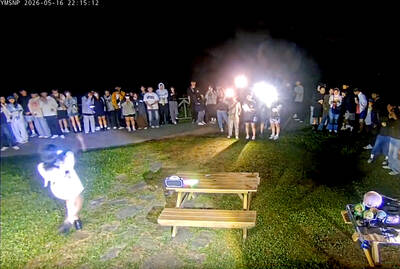
Yangmingshan National Park’s Qingtiangang (擎天崗) nature area has gone viral after a park livestream camera observed a couple in the throes of intimate congress, which was broadcast live on YouTube, drawing large late-night crowds and sparking a backlash over noise, bright lights and disruption to wildlife habitat. The area’s livestream footage appeared to show a couple engaging in sexual activity on a picnic table in the park on Friday last week, with the uncensored footage streamed publicly online. The footage quickly spread across social media, prompting a tide of visitors to travel to the site to “check in” and recreate the

Minister of Digital Affairs Lin Yi-ching (林宜敬) yesterday cited regulatory issues and national security concerns as an expert said that Taiwan is among the few Asian regions without Starlink. Lin made the remarks on Facebook after funP Innovation Group chief executive officer Nathan Chiu (邱繼弘) on Friday said Taiwan and four other countries in Asia — China, North Korea, Afghanistan and Syria — have no access to Starlink. Starlink has become available in 166 countries worldwide, including Ukraine, Malaysia, the Philippines and Vietnam, in the six years since it became commercial, he said. While China and North Korea block Starlink, Syria is not


 RSS
RSS