


The task of providing legal protection for intellectual property (IP) in the country moved a step forward yesterday after the legislature passed a bill relating to trial proceedings specially designed for intellectual property cases.
"The bill and an organic bill aimed at establishing intellectual property courts will have a major impact on legal protection for intellectual property," Democratic Progressive Party (DPP) Legislator Wu Bing-ray (
The organic bill of establishing intellectual property courts, however, is still under initial review in the legislature's Organic Laws and Statutes Committee.
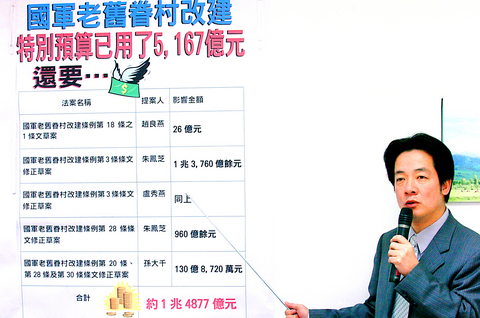
PHOTO: SEAN CHAO, TAIPEI TIMES
Legislative Speaker Wang Jin-pyng (王金平) said that the approved bill relating to IP trial proceedings would only be sent to the president for promulgation when the legislature passes the organic bill.
The Judicial Yuan had said earlier that intellectual property courts were expected to be established in March after the two bills are enacted.
A different case
Speaking in support of the bill on the legislative floor yesterday, DPP Legislator You Ching (
"In trials of intellectual property cases, promptness is of equal importance as correctness. Establishing a trial system especially designed to deal with intellectual property rights disputes will contribute to both objectives," he said.
In accordance with the approved bill, intellectual property courts will be equipped with examining attorneys possessing the know-how to assist judges in court.
"As most judges might not be familiar with controversies relating to intellectual property issues, examining attorneys will be helpful in enhancing the credibility of their verdicts," Wu said.
The approved bill stipulates that intellectual property disputes in the first and second instance of civil litigation, in the second instance of criminal litigation, and in the first instance of administrative litigation are under the jurisdiction of intellectual property courtss.
Vice Minister of Justice Chu Nan (
Separately, the legislature passed an amendment to the Statute Governing the Reconstruction of Weathered Military Communities (國軍老舊眷村改建條例) yesterday.
The amended article requires contractors that undertake government urban renewal plans in the military communities compensate residents affected by the plans even if the houses were built without a license.
Debate
Some other amendments to the Reconstruction of the Weathered Military Communities, however, may face contentious debate in the coming days in the legislature.
DPP legislators William Lai (賴清德) and Sandy Yen (莊和子) held a press conference urging KMT lawmakers to withdraw four amendments concerning the reconstruction of these communities, which they said would cost the government NT$1.49 trillion (US$45.5billion).
"The government has spent NT$517.7 billion in reconstruction of army communities over the past nine years. It is unfair to spend another NT$1,49 trillion just to take care of the veterans who number about 500,000," Lai said.

The military has spotted two Chinese warships operating in waters near Penghu County in the Taiwan Strait and sent its own naval and air forces to monitor the vessels, the Ministry of National Defense (MND) said. Beijing sends warships and warplanes into the waters and skies around Taiwan on an almost daily basis, drawing condemnation from Taipei. While the ministry offers daily updates on the locations of Chinese military aircraft, it only rarely gives details of where Chinese warships are operating, generally only when it detects aircraft carriers, as happened last week. A Chinese destroyer and a frigate entered waters to the southwest
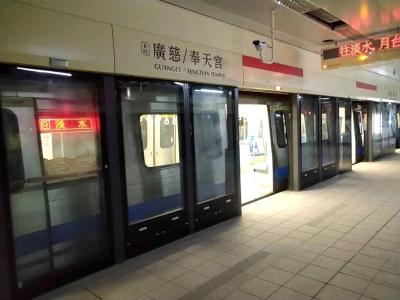
The eastern extension of the Taipei MRT Red Line could begin operations as early as late June, the Taipei Department of Rapid Transit Systems said yesterday. Taipei Rapid Transit Corp said it is considering offering one month of free rides on the new section to mark its opening. Construction progress on the 1.4km extension, which is to run from the current terminal Xiangshan Station to a new eastern terminal, Guangci/Fengtian Temple Station, was 90.6 percent complete by the end of last month, the department said in a report to the Taipei City Council's Transportation Committee. While construction began in October 2016 with an
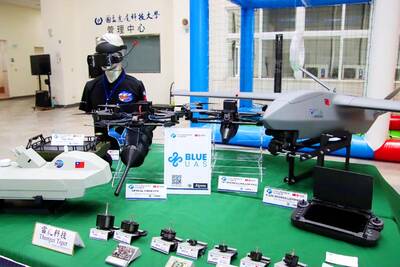
NON-RED SUPPLY: Boosting the nation’s drone industry is becoming increasingly urgent as China’s UAV dominance could become an issue in a crisis, an analyst said Taiwan’s drone exports to Europe grew 41.7-fold from 2024 to last year, with demand from Ukraine’s fight against Russian aggression the most likely driver of growth, a study showed. The Institute for Democracy, Society and Emerging Technology (DSET) in a statement on Wednesday said it found that many of Taiwan’s uncrewed aerial vehicle (UAV) sales were from Poland and the Czech Republic. These countries likely transferred the drones to Ukraine to aid it in its fight against the Russian invasion that started in 2022, it said. Despite the gains, Taiwan is not the dominant drone exporter to these markets, ranking second and fourth

Japanese Prime Minister Sanae Takaichi’s comment last year on Tokyo’s potential reaction to a Taiwan-China conflict has forced Beijing to rewrite its invasion plans, a retired Japanese general said. Takaichi told the Diet on Nov. 7 last year that a Chinese naval blockade or military attack on Taiwan could constitute a “survival-threatening situation” for Japan, potentially allowing Tokyo to exercise its right to collective self-defense. Former Japan Ground Self-Defense Force general Kiyofumi Ogawa said in a recent speech that the remark has been interpreted as meaning Japan could intervene in the early stages of a Taiwan Strait conflict, undermining China’s previous assumptions


 RSS
RSS