


The Chinese Nationalist Party (KMT) manipulated the share price of the Broadcasting Corporation of China (BCC) to entice former UFO Radio chairman Jaw Shaw-kong (趙少康) into buying a controlling stake in the broadcasting firm, industry figures alleged yesterday.
Local media reports said that Jaw stepped down as chairman of UFO Radio, a popular local radio station, in September, to take over as chairman and CEO of BCC after acquiring the radio station last month.
The KMT enjoyed a controlling stake in BCC -- originally a government-owned broadcasting corporation -- until the party sold its shares to the China Times Group's subsidiary Jung-li Investment Co (榮麗投資公司) for NT$4 billion (US$122 million) in December 2005, local media said.
Media professionals associated with the Broadcasting Development Fund (BDF), a local non-profit media watchdog, slammed the KMT for allegedly deflating BCC's share price through Hua Hsia Investment Holding Co, which reportedly manages billions of NT dollars in KMT assets.
Local media reported last month that Jaw bought the BCC shares from Jung-li Investment, but industry figures yesterday insisted that Jaw had purchased the shares from Hua Hsia Investment.
BCC vice president Lee Chien-jung (李建榮) confirmed by phone yesterday that Jaw had purchased the shares from Hua Hsia Investment, but added that Hua Hsia was owned by Jung-li Investment.
According to a recent United Daily News report, Hua Hsia is also closely affiliated with Central Investment Holding Co, a KMT-run enterprise. Central Investment brokered the BCC deal between Jaw and Hua Hsia Investment after Jung-li Investment balked at completing the December 2005 deal with the KMT to buy a controlling stake in BCC, the report said.
Through its "front companies," the KMT deflated the share price of its former radio broadcasting company from NT$108 (US$3.28) to NT$52 to persuade Jaw to buy the company, said former Economic Daily News reporter Yang Shih-jen (
Yang leveled the allegations at the KMT during a BDF press conference yesterday, saying that the deal hurt BCC's other shareholders.
He added that BCC's finances were opaque, with shareholders kept in the dark as to the financial health of the company.
"It's like taking a cup of coffee, and making four cups out of that by adding water," Yang said, referring to the KMT's alleged deflation of share prices.
The BCC vice president refused to respond to media speculation that Jaw paid somewhere between NT$600 million (US$18.215 million) and NT$700 million for a controlling stake in BCC.
Local media reports also said that neither the KMT nor Jaw were willing to go on record regarding the financial details of the deal.
Jaw is reported to have signed a contract with the KMT barring him from disclosing the price of the deal.
KMT Chairman Ma Ying-jeou (馬英九), meanwhile, was quoted by local media as saying that the deal was a private transaction between Jaw and Hua Hsia that didn't involve the KMT.
"In 1999, BCC was worth NT$19 billion [US$576.8 million]. How did it lose that much between then and now?" Hsu Chi-chi (
BCC radio personality Lai Hsiang-wei (賴祥蔚) said that the Democratic Progressive Party (DPP) government was also to blame for the allegedly shady deal as the Government Information Office (GIO) had agreed to the sale.
"The GIO should more properly define what can and cannot happen in the sale of media organizations," Lai said.
Panelists yesterday called for financial transparency in the media, saying that secret or vague financial statements were par for the course in broadcasting and print media organizations.
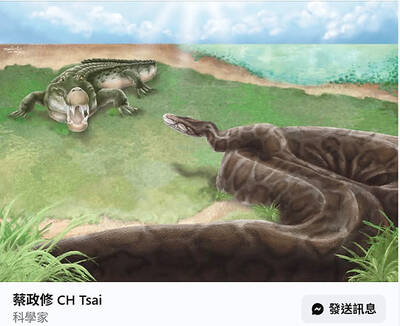
Taiwanese paleontologists have discovered fossil evidence that pythons up to 4m long inhabited Taiwan during the Pleistocene epoch, reporting their findings in the international scientific journal Historical Biology. National Taiwan University (NTU) Institute of Ecology and Evolutionary Biology associate professor Tsai Cheng-hsiu (蔡政修) led the team that discovered the largest snake fossil ever found in Taiwan. The single trunk vertebra was discovered in Tainan at the Chiting Formation, dated to between 400,000 and 800,000 years ago in the Middle Pleistocene, the paper said. The area also produced Taiwan’s first avian fossil, as well as crocodile, mammoth, saber-toothed cat and rhinoceros fossils, it said. Discoveries

Taiwanese paleontologists have discovered fossil evidence that pythons up to 4m long inhabited Taiwan during the Pleistocene epoch, reporting their findings in the international scientific journal Historical Biology. National Taiwan University (NTU) Institute of Ecology and Evolutionary Biology associate professor Tsai Cheng-hsiu (蔡政修) led the team that discovered the largest snake fossil ever found in Taiwan. A single trunk vertebra was discovered in Tainan at the Chiting Formation, dated to between 800,000 to 400,000 years ago in the Middle Pleistocene, the paper said. The area also produced Taiwan’s first avian fossil, as well as crocodile, mammoth, sabre-toothed cat and rhinoceros fossils, it said. Discoveries
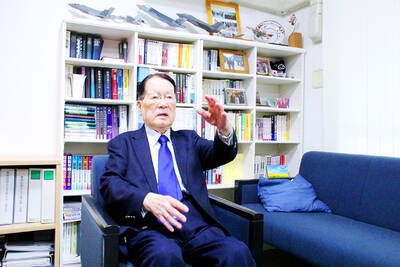
Whether Japan would help defend Taiwan in case of a cross-strait conflict would depend on the US and the extent to which Japan would be allowed to act under the US-Japan Security Treaty, former Japanese minister of defense Satoshi Morimoto said. As China has not given up on the idea of invading Taiwan by force, to what extent Japan could support US military action would hinge on Washington’s intention and its negotiation with Tokyo, Morimoto said in an interview with the Liberty Times (sister paper of the Taipei Times) yesterday. There has to be sufficient mutual recognition of how Japan could provide
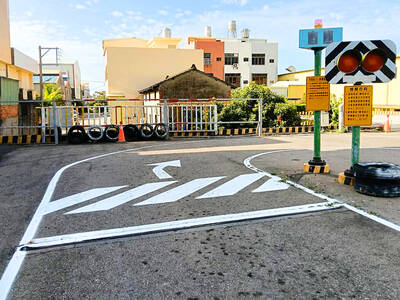
UPDATED TEST: The new rules aim to assess drivers’ awareness of risky behaviors and how they respond under certain circumstances, the Highway Bureau said Driver’s license applicants who fail to yield to pedestrians at intersections or to check blind spots, or omit pointing-and-calling procedures would fail the driving test, the Highway Bureau said yesterday. The change is set to be implemented at the end of the month, and is part of the bureau’s reform of the driving portion of the test, which has been criticized for failing to assess whether drivers can operate vehicles safely. Sedan drivers would be tested regarding yielding to pedestrians and turning their heads to check blind spots, while drivers of large vehicles would be tested on their familiarity with pointing-and-calling


 RSS
RSS