


Political pressures were likely behind the Taipei City Government's change of heart in publicizing an estimate of the size of the crowds that attended Saturday's pro-President Chen Shui-bian (陳水扁) rally on Ketagalan Boulevard, a political observer said.
"The city police are under a tremendous amount of pressure whether they make public the number or not," said Wang Kung-yi (
However, once they decide not to offer a figure, they should not change their position, he said.
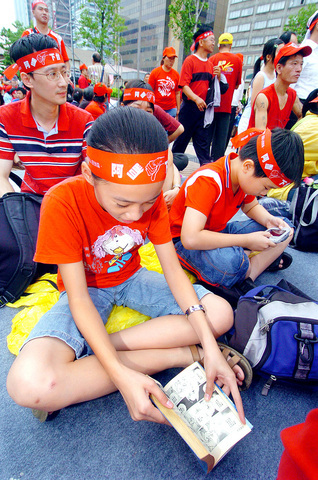
PHOTO: CHEN TSE-MING, TAIPEI TIMES
He said that pressure could have come from both the Taiwan Society, which orchestrated the pro-Chen rally, and the anti-Chen group led by former Democratic Progressive Party (DPP) chairman Shih Ming-teh (
Taipei police authorities originally refused to reveal an estimate of the number of people who attended Sat-urday's rally on the boulevard, saying that there was always a large discrepancy between crowd figures estimated by event organizers and those estimated by authorities.
However, they changed their mind later Saturday night and announced that about 55,000 people had turned up. The rally organizers put the number at more than 200,000.
Wang said that turnout was important in demonstrations orga-nized by private groups such as the Taiwan Society or Shih's group.
"Privately organized demonstrations are unlike rallies organized on the eve of elections, where candidates know the result the following day," he said. "For private organizers, the number of participants signifies power."
There is often a wide disparity between estimates given by event organizers and city police.
On Friday night, when Shih's camp staged a "siege" march from in front of the Presidential Office to the Taipei Railway Station, the organizers estimated that more than 1 million people turned up, but police had a much lower estimate of 320,000 to 360,000.
Earlier on Sept. 9, the day when the around-the-clock anti-Chen sit-in began, the organizer claimed that the turnout was 300,000, but city police put the number at around 100,000.
The next day, despite the fact that there were visibly smaller crowds than on Saturday, the organizers of the anti-Chen protest claimed that even more people showed up than on the first day of the sit-in.
They said that 500,000 protesters had shown up, while city police estimated the crowd at 10,000 people.
Lin Ming-hua (
The demonstration was orchestrated to demand the "truth" about the election-eve assassination attempt, which many pan-blue supporters believe was staged by Chen despite any solid evidence to back up their theories.
Lin said that the city police originally refused to publicize the number of participants in Satur-day's rally on Ketagalan Boulevard, but they were told by the police chief at around 10:45pm to make it public.
Lin said that the official numbers were reliable because they were calculated using a formula.
Taking Friday's "siege" march as an example, Lin said that police estimated 40,000 people could fill 1km of the road that protesters walked down. As the march stretched more than 5.5km, the police estimated that about 220,000 people were on the street. On top of that number, city authorities figured that about 140,000 more were scattered along Ketagalan Boulevard and elsewhere, making the total number 360,000.
Regarding Saturday's pro-Chen rally, Lin said that their estimate was that 20,000 to 30,000 people filled Ketagalan Boulevard from Chongqing South Road to Gongyuan Road.
About 25,000 more were added because demonstrators spilled over to Jing Fu Men (景福門), the traditional-style gate in the traffic circle at one end of the boulevard.
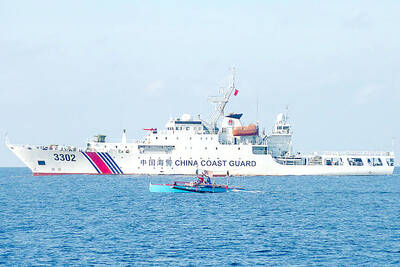
EXPANSIONIST: China deploys an average of 40 to 50 warships and coast guard vessels daily in the South China Sea, despite pledges not to militarize the region, an official said China is attempting to expand its influence across the First Island Chain and increase pressure on Japan by sending coast guard vessels into waters off of Taiwan under the pretext of maritime negotiations with Japan and the Philippines, a national security official said yesterday. China’s recent actions in the waters east of Taiwan and Japan and the Philippines’ exclusive economic zones (EEZ) are attempts to establish dominance in First Island Chain waters, said the official who declined to be named, adding that this is “expansion disguised as law enforcement.” Framing China’s actions solely as a cross-strait issue is a serious misjudgment that
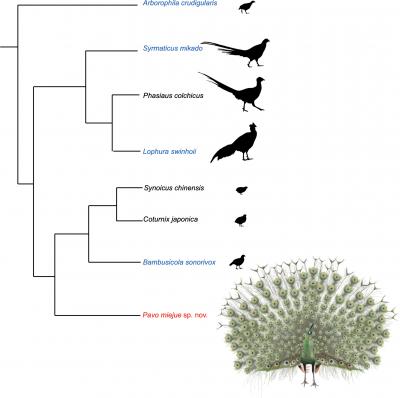
Through analyzing fossil evidence, a research team at National Taiwan University (NTU) discovered the largest endemic bird to have lived in Taiwan, naming it Pavo miejue, or extinct peafowl (滅絕孔雀). The Mikado pheasant, which is printed on the back of the NT$1,000 bank note, was previously believed to be the biggest endemic bird to Taiwan. The research team’s findings suggest that Pavo miejue lived during the Pleistocene epoch tens of thousands of years ago. It is the first endemic extinct bird species discovered and formally named in Taiwan. The study was coauthored by NTU Institute of Ecology and Evolutionary Biology professor Tsai Cheng-hsiu (蔡政修),
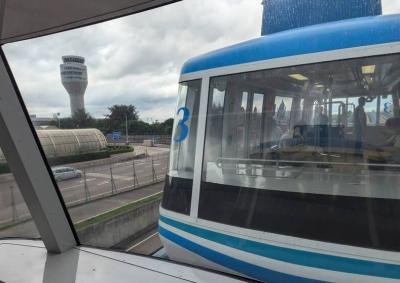
Taiwan Taoyuan International Airport is to suspend its automated Skytrain service connecting Terminal 1 and Terminal 2 starting on July 1 to facilitate connection works for the upcoming Terminal 3, the airport operator said today. Passengers and staff who need to travel between the two terminals after the suspension can instead use the Taoyuan MRT or the airport's 24-hour shuttle bus service, Taoyuan International Airport Corp said. The Taoyuan MRT Airport Line directly links the two terminals, while the shuttle buses are to operate around the clock, the company added. The Skytrain provides free transportation between the airport’s two terminals for travelers and
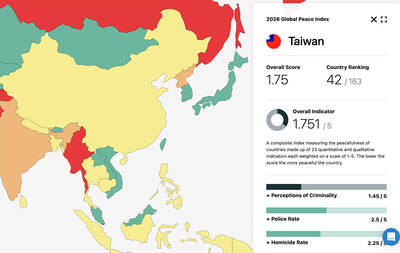
Taiwan ranked 42nd in terms of peacefulness among 163 countries, down five places from last year, according to this year’s Global Peace Index. With an overall score of 1.751, Taiwan dropped from 37th last year, the report published by the global Institute for Economics and Peace showed. The overall score measures a country’s level of peacefulness using 23 quantitative and qualitative indicators across three domains — ongoing domestic and international conflict, societal safety and security, and militarization. While Taiwan ranked 42nd worldwide, it was listed in ninth place among the 19 Asian-Pacific countries in the report, after New Zealand, Singapore, Japan, Malaysia,


 RSS
RSS