


Cats are traditionally viewed as wicked and unlucky in Taiwanese culture.
This may be the reason why cat lovers sometimes feel secluded in modern society.
However, feline aficianadoes may have noticed a slight change of mood over the past few years, as evidenced by the emergence of a shelter network for stray cats run by cat lovers on the Internet.
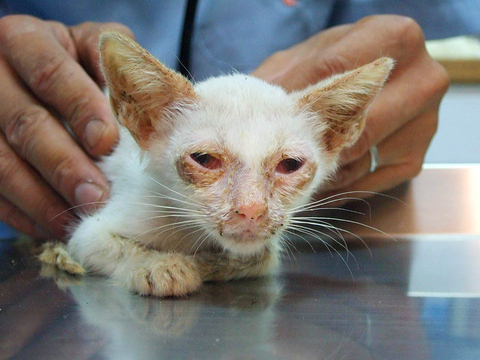
PHOTO COURTESY OF HALFWAY ANGELS FOR CATS PROJECT
There are no statistics that show how many "members" take part in the network, but one thing is for sure: If you issue a virtual cry for help for kittens you find on the street, you will probably be overwhelmed with heart-warming responses online.
Discussion boards on university bulletin board systems (BBS) served as the cradle for the loose-knit network. For instance, the "Cats Board" on a BBS called "PTT" -- short for Professional Technology Temple -- run by National Taiwan University's Department of Computer Science and Information Engineering, exemplifies this trend. On this site, people like Kelly Lai (賴凱俐) will greet you with surprising hospitality.
Lai, a graduate student of the Graduate Institute of Land Economics at National Chengchi University, started a halfway home for stray cats last August. She has cared for about 13 cats since then, and she said most of them were tough to take care of.
Running a "halfway house" for cats can sometimes mean great financial burdens, as the expenses for food, medication and inoculations add up.
In an interview last week, Lai said that she once spent NT$7,000 (US$212) a month on special formula milk powder and medication to save two newborn kittens.
Though she has seven part-time jobs to make ends meet, she said such a burden left her with no choice but to seek help from the network.
"It is very important to remain connected to other moms and dads, because in a situation like this, you can get financial help from others," she said, adding that the canned food for kittens she received from others helped her get through a few weeks before she got her next paycheck.
This is also why the founders of Meetpets.com, Su Sheng-chieh (蘇聖傑) -- better known to other animal lovers as "KT" -- and "Leaf" (who wished to remain anonymous), launched their "Halfway Angels for Cats Project" four years ago.
There have been numerous halfway parents registering their personal information in the project. The Web site, run by Su and Leaf, offers detailed and easily accessible cat and dog adoption information.
Su quit his job and now runs the Web site full-time, living off of his savings, he said. He said that although the Web site is not a registered non-profit organization, it does use all of its donations to help stray animals.
"We would like to establish an information exchange platform where the halfway parents' power can be concentrated," Leaf told the Taipei Times last Sunday in Su's apartment in Taipei, where at least 30 sheltered cats were lodging.
"Halfway parents can also apply for the Web site's subsidies in order to neuter or provide inoculations for cats," Leaf said. "[By so doing], we can reduce their burden."
Since being part of the network is not likely to make these "cat angels" independently wealthy, what is the force driving them to continue their work?
For Leaf, who has been a halfway mom for cats for nearly 10 years, her passion and love for animals keeps her going, she said. In addition to the cats she is temporarily sheltering, Leaf also has 10 cats of her own.
However, for Lai, being a halfway mom for cats is a mission.
"Though sometimes I feel a little bothered by the halfway work, I tell myself: `It's OK. It's a sacrifice,'" she said.
She started to pass on the knowledge of how to run a halfway home for cats to others on the BBS, instead of bringing every single cat home.
Su and Leaf say they have achieved the goal of establishing a halfway network for the animals they love. Therefore they have moved on, and are trying to realize a bigger dream -- putting together a "TNR" -- trap, neuter and release -- project into practice for stray cats. Such a program could effectively reduce the number of newborn strays, Su said.
The Taipei City Government has initiated a trial of the program this year in Da-an District with their help.
"Our dream is to create a harmonic world between human beings and cats," said Su, the 30-something Web site founder.
Visit the Web site at www.meetpets.idv.tw.
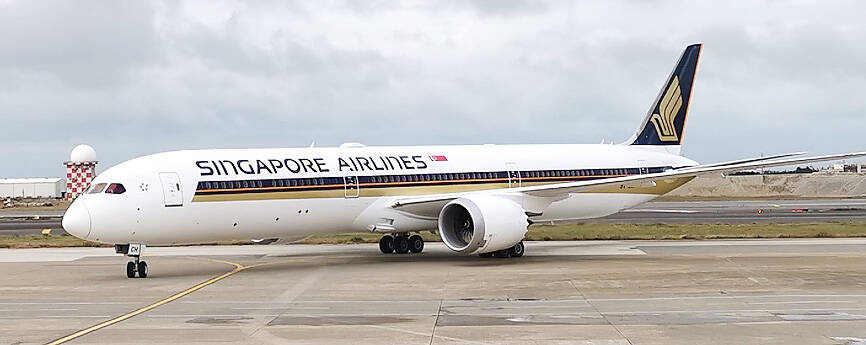
INCREASED CAPACITY: The flights on Mondays, Wednesdays, Fridays and Sundays would leave Singapore in the morning and Taipei in the afternoon Singapore Airlines is adding four supplementary flights to Taipei per week until May to meet increased tourist and business travel demand, the carrier said on Friday. The addition would raise the number of weekly flights it operates to Taipei to 18, Singapore Airlines Taiwan general manager Timothy Ouyang (歐陽漢源) said. The airline has recorded a steady rise in tourist and business travel to and from Taipei, and aims to provide more flexible travel arrangements for passengers, said Ouyang, who assumed the post in July last year. From now until Saturday next week, four additional flights would depart from Singapore on Monday, Wednesday, Friday

Taiwan’s three major international carriers are increasing booking fees, with EVA Airways having already increased the charge to US$28 per flight segment from US$25, while China Airlines (CAL) and Starlux Airlines are set to follow suit. Booking fees are charged by airlines through a global distribution system (GDS) and passed on to passengers. Carriers that apply the fees include CAL, EVA, Starlux and Tigerair Taiwan. A GDS is a computerized network operated by a company that connects airlines with travel agents and ticketing platforms, allowing reservations to be made and processed in real time. Major players include Amadeus, Sabre and Travelport. EVA Air began

WATCH FOR HITCHHIKERS: The CDC warned those returning home from Japan to be alert for any contagious diseases that might have come back with them People who have returned from Japan following the World Baseball Classic (WBC) games during the weekend are recommended to watch for symptoms of infectious gastroenteritis, flu and measles for two weeks, the Centers for Disease Control (CDC) said. Flu viruses remain the most common respiratory pathogen in Taiwan in the past four weeks and the influenza B virus accounted for 55.7 percent of the tested cases, exceeding the percentage of influenza A (H3N2) infections and becoming the local dominant strain, CDC Epidemic Intelligence Center Deputy Director Lee Chia-lin (李佳琳) said at a news conference on Tuesday. There were 82,187 hospital visits for
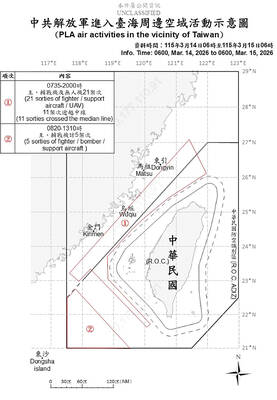
The Ministry of National Defense yesterday reported the return of large-scale Chinese air force activities after their unexplained absence for more than two weeks, which had prompted speculation regarding Beijing’s motives. China usually sends fighter jets, drones and other military aircraft around the nation on a daily basis. Interruptions to such routine are generally caused by bad weather. The Ministry of National Defense said it had detected 26 Chinese military aircraft in the Taiwan Strait over the previous 24 hours. It last reported that many aircraft on Feb. 25, when it spotted 30 aircraft, saying Beijing was carrying out another “joint combat


 RSS
RSS