


Dog experts believe that incorrect ideas regarding the treatment of dogs is one of the main reasons that there are so many homeless puppies in Taiwan today.
"Many people think they are treating their dogs correctly but in actual fact they are not," said experienced trainer King Wang (王昱智), who owns two labrador retrievers.
Wang is a trainer at Taiwan Dr. Dog (
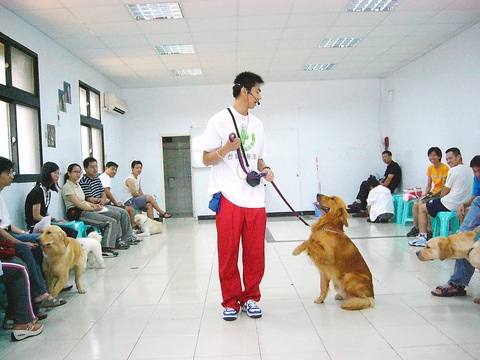
PHOTO COURTESY OF TAIWAN DR. DOG
The organization gives patients the opportunity to receive love and affection from the animals while promoting awareness of abandoned dogs and other pet-related problems.
As a staff member of the group, Wang is responsible for training puppies for "animal assistance therapy."
He embarked upon a career with dogs because he wanted to understand what his pooches were thinking and also to prove that they were useful, Wang said.
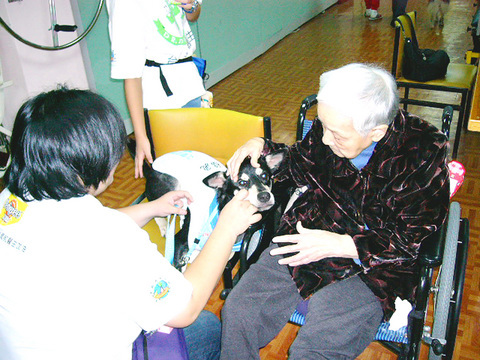
PHOTO COURTESY OF TAIWAN DR. DOG
"My own family members used to believe that dogs were simple animals. I wanted to prove them wrong," Wang said. "Actually, dogs can do a lot for human beings."
Piper Hsieh (
"We encourage owners to have their dogs on a leash and also to carry out crate training, but many owners oppose it," Hsieh said.
Leashes help to tame dogs so they do not feel easily threatened and "crate training" helps the dogs to develop good habits in their living quarters, Hsieh said.
Taiwan Dr. Dog was created to promote animal-assistance activities and therapy with the goal of improving the physical, mental and spiritual quality of society through companionship with animals.
Jill Sheng (
The dogs have to pass health and hygiene examinations, obedience evaluation and the "Dr. Dog Screening Test," which focuses on testing behavior in different conditions and their manner around other dogs and people.
After the dogs pass the tests, their owners are required to complete dog handler workshops and practical training before the owner and dog team is certified as a Dr. Dog team volunteer.
Wang's work is to train the dogs and their owners.
He said that obedience training would also be good for homeless dogs and that he would love to dedicate himself to this task as most people love obedient puppies.
"If I trained homeless dogs, they would be more obedient and it may help them to find an owner," Wang said.
"When you say I am training dogs, I would actually say that I am training their owners," He added. "We encourage owners to take advantage of positive reinforcement when training puppies, instead of negative reinforcement or punishment. It means that we encourage our dogs to follow orders instead of forcing them to do so."
Chief Executive Officer of the organization, Ho Cheng-chien (
Currently, there are 70 qualified canines. These dogs and their owners team up every weekend for volunteer services at 19 different organizations, including homes for the elderly, hospitals and centers for the mentally handicapped.
"In total, there have been almost 200 `Dr. Dogs' since the organization was established four years ago," Ho said.
One incident at a Keelung home for the elderly is Ho's most unforgettable memory, when a beagle helped an old lady to complete her therapy after medical personnel had failed.
Ho said that the grandmother needed to stretch her arms back and forth as part of her exercise routine but she refused to do so because it hurt.
The beagle, however, ran back and forth to pick up a ball she threw to it and doing this encouraged her to perform the exercise that she did not like.
"Although she said, `It hurts,' she still kept doing it because she was enjoying the dog's company," Ho said. "It was then that I felt that my work really did begin to mean something."

Starlux Airlines, Taiwan’s newest international carrier, has announced it would apply to join the Oneworld global airline alliance before the end of next year. In an investor conference on Monday, Starlux Airlines chief executive officer Glenn Chai (翟健華) said joining the alliance would help it access Taiwan. Chai said that if accepted, Starlux would work with other airlines in the alliance on flight schedules, passenger transits and frequent flyer programs. The Oneworld alliance has 13 members, including American Airlines, British Airways, Cathay Pacific and Qantas, and serves more than 900 destinations in 170 territories. Joining Oneworld would also help boost

A new tropical storm formed late yesterday near Guam and is to approach closest to Taiwan on Thursday, the Central Weather Administration (CWA) said. Tropical Storm Pulasan became the 14th named storm of the year at 9:25pm yesterday, the agency said. As of 8am today, it was near Guam traveling northwest at 21kph, it said. The storm’s structure is relatively loose and conditions for strengthening are limited, WeatherRisk analyst Wu Sheng-yu (吳聖宇) said on Facebook. Its path is likely to be similar to Typhoon Bebinca, which passed north of Taiwan over Japan’s Ryukyu Islands and made landfall in Shanghai this morning, he said. However, it

Taiwan's Gold Apollo Co (金阿波羅通信) said today that the pagers used in detonations in Lebanon the day before were not made by it, but by a company called BAC which has a license to use its brand. At least nine people were killed and nearly 3,000 wounded when pagers used by Hezbollah members detonated simultaneously across Lebanon yesterday. Images of destroyed pagers analyzed by Reuters showed a format and stickers on the back that were consistent with pagers made by Gold Apollo. A senior Lebanese security source told Reuters that Hezbollah had ordered 5,000 pagers from Taiwan-based Gold Apollo. "The product was not

COLD FACTS: ‘Snow skin’ mooncakes, made with a glutinous rice skin and kept at a low temperature, have relatively few calories compared with other mooncakes Traditional mooncakes are a typical treat for many Taiwanese in the lead-up to the Mid-Autumn Festival, but a Taipei-based dietitian has urged people not to eat more than one per day and not to have them every day due to their high fat and calorie content. As mooncakes contain a lot of oil and sugar, they can have negative health effects on older people and those with diabetes, said Lai Yu-han (賴俞含), a dietitian at Taipei Hospital of the Ministry of Health and Welfare. “The maximum you can have is one mooncake a day, and do not eat them every day,” Lai


 RSS
RSS