


Former president Lee Teng-hui (
Lee said that the challenge was in giving power back to the Chinese people, for then they may question the rationality and legitimacy of the communist authoritarian regime's existence.
Alaska Governor Frank Murkowski had lunch with Lee and members of the World Affairs Council (WAC) at the Hotel Captain Cook in Anchorage, where he stayed yesterday.

PHOTO: LEE HSIN-FANG, TAIPEI TIMES
Lee gave a public speech on Taiwan and the Asia-Pacific's democratization.
Lee said that the establishment of democratic systems and values was a challenging reform for Taiwan, which continues to face China's bullying and intention to annex Taiwan. China is uneasy about Taiwan's democracy, Lee said, simply because such democratic achievements serve as an example for the Chinese people and even the entire Asia-Pacific region. Such achievements represent the hopes and future of democratization in the region, he added.
Lee also recounted the process of Taiwan's democratization during his more than 12-year presidency, stressing that the support of the international community was a key factor, and that the US had played the most important role during this process -- including during the 1996 missile crisis and the presidential election in 2000.
Thanks to international and US support, and the Taiwanese people's pursuit of democracy and their faith in being their own masters, Beijing was forced to restrain itself, Lee said.
Lee reminded the outside world that the true intention of China's threat to attack Taiwan by force under its fake purpose of unification was actually to cover up the irrationality and fragility of its authoritarian rule, which was highlighted by Taiwan's democratization.
Lee urged the US to help Taiwan break free of its international isolation, so that it can build normal relations with neighboring countries and become a full member of international society.
He said that Taiwan is fighting for peace and stability in the face of China's military threat. For the continuance of Taiwan's democracy, the US has to stand up in East Asia in order to uphold human rights and democracy, he said.
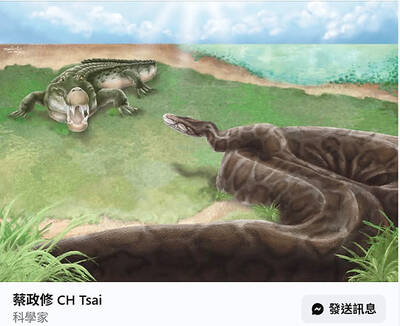
Taiwanese paleontologists have discovered fossil evidence that pythons up to 4m long inhabited Taiwan during the Pleistocene epoch, reporting their findings in the international scientific journal Historical Biology. National Taiwan University (NTU) Institute of Ecology and Evolutionary Biology associate professor Tsai Cheng-hsiu (蔡政修) led the team that discovered the largest snake fossil ever found in Taiwan. The single trunk vertebra was discovered in Tainan at the Chiting Formation, dated to between 400,000 and 800,000 years ago in the Middle Pleistocene, the paper said. The area also produced Taiwan’s first avian fossil, as well as crocodile, mammoth, saber-toothed cat and rhinoceros fossils, it said. Discoveries

Taiwanese paleontologists have discovered fossil evidence that pythons up to 4m long inhabited Taiwan during the Pleistocene epoch, reporting their findings in the international scientific journal Historical Biology. National Taiwan University (NTU) Institute of Ecology and Evolutionary Biology associate professor Tsai Cheng-hsiu (蔡政修) led the team that discovered the largest snake fossil ever found in Taiwan. A single trunk vertebra was discovered in Tainan at the Chiting Formation, dated to between 800,000 to 400,000 years ago in the Middle Pleistocene, the paper said. The area also produced Taiwan’s first avian fossil, as well as crocodile, mammoth, sabre-toothed cat and rhinoceros fossils, it said. Discoveries
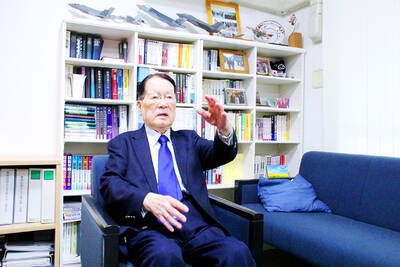
Whether Japan would help defend Taiwan in case of a cross-strait conflict would depend on the US and the extent to which Japan would be allowed to act under the US-Japan Security Treaty, former Japanese minister of defense Satoshi Morimoto said. As China has not given up on the idea of invading Taiwan by force, to what extent Japan could support US military action would hinge on Washington’s intention and its negotiation with Tokyo, Morimoto said in an interview with the Liberty Times (sister paper of the Taipei Times) yesterday. There has to be sufficient mutual recognition of how Japan could provide
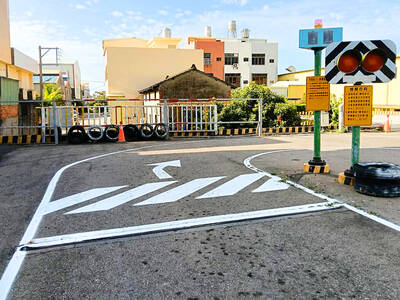
UPDATED TEST: The new rules aim to assess drivers’ awareness of risky behaviors and how they respond under certain circumstances, the Highway Bureau said Driver’s license applicants who fail to yield to pedestrians at intersections or to check blind spots, or omit pointing-and-calling procedures would fail the driving test, the Highway Bureau said yesterday. The change is set to be implemented at the end of the month, and is part of the bureau’s reform of the driving portion of the test, which has been criticized for failing to assess whether drivers can operate vehicles safely. Sedan drivers would be tested regarding yielding to pedestrians and turning their heads to check blind spots, while drivers of large vehicles would be tested on their familiarity with pointing-and-calling


 RSS
RSS