


Taiwan's Child Welfare League Foundation yesterday released its first report on mobile-phone use by children, which has pinpointed a number of negative impacts.
The report shows that cellphone addiction has become a common problem, with some children running up bills in excess of NT$3,000 a month. It indicates that children also received messages with adult content and that phones were furthermore used to play video games.
Speaking about the report, Wang Yu-ming (
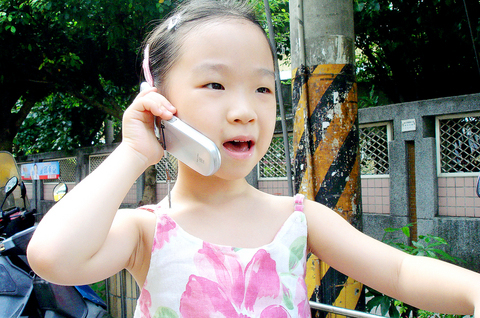
PHOTO: GEORGE TSORNG, TAIPEI TIMES
The report targeted students from senior primary school classes to those in their first year of secondary school in the cities of Taipei, Taichung and Kaohsiung. Of the 1,177 respondents, 51.1 percent were male and 48.9 percent female.
"In the same way that water can both support the weight of a boat and sink it, mobile telephones have their benefits, but can also have a negative psychological impact on children when not used in the right way" Wang said.
The report showed that the proportion of children using mobile phones in Taiwan is higher than that in the US and Japan (53 percent of junior-high students and 37 percent of primary school students). The proportion of girls with phones was higher than that of boys (56 percent to 44 percent). As to how the phone was acquired, 68 percent replied that the phone had been provided by and on the initiative of their parents.
The uses to which the phones were put were predominantly to facilitate appointments with friends and family (76.8 percent), reporting home (55.5 percent) and for sending SMS messages (44.5 percent).
While 60.3 percent of children with phones used them for under 10 minutes a day, in a small number of cases there were signs of addiction. A total of 9.2 percent of respondents said that they "needed" to speak on the phone for over an hour a day, while three respondents said they used the phone for three hours a day, and one child reportedly spoke on the phone for seven hours a day.
While 32 percent of children spent NT$100 to NT$300 a month on talk time, in some instances monthly charges reached NT$3,000. Over 16 percent of the children had no idea how much their telephone charges were, saying that bills where "paid by mum and dad."
"Parent should teach children to understand the financial costs of using a mobile phone, otherwise children will use the phone without restraint," Wang said.
The report came to the conclusion that parents should not necessarily provide children with a mobile phone for their personal use and should look into other methods of communication. It said that as the effects of mobile phones on our physical health has not been conclusively established, usage of mobile phones by children should be kept to a minimum.
The report indicated that the relationship between parents and children can be affected by mobile phones, with 58 percent of respondents saying they had been scolded by their parents for reasons connected to mobile-phone use, including for talking too long on the phone, not answering the phone or losing a phone.
Wang said that while a mobile phone could offer considerable convenience for communication between parents and children, inappropriate use could create tension between parents and children and disrupt family relationships.

Starlux Airlines, Taiwan’s newest international carrier, has announced it would apply to join the Oneworld global airline alliance before the end of next year. In an investor conference on Monday, Starlux Airlines chief executive officer Glenn Chai (翟健華) said joining the alliance would help it access Taiwan. Chai said that if accepted, Starlux would work with other airlines in the alliance on flight schedules, passenger transits and frequent flyer programs. The Oneworld alliance has 13 members, including American Airlines, British Airways, Cathay Pacific and Qantas, and serves more than 900 destinations in 170 territories. Joining Oneworld would also help boost

A new tropical storm formed late yesterday near Guam and is to approach closest to Taiwan on Thursday, the Central Weather Administration (CWA) said. Tropical Storm Pulasan became the 14th named storm of the year at 9:25pm yesterday, the agency said. As of 8am today, it was near Guam traveling northwest at 21kph, it said. The storm’s structure is relatively loose and conditions for strengthening are limited, WeatherRisk analyst Wu Sheng-yu (吳聖宇) said on Facebook. Its path is likely to be similar to Typhoon Bebinca, which passed north of Taiwan over Japan’s Ryukyu Islands and made landfall in Shanghai this morning, he said. However, it

Taiwan's Gold Apollo Co (金阿波羅通信) said today that the pagers used in detonations in Lebanon the day before were not made by it, but by a company called BAC which has a license to use its brand. At least nine people were killed and nearly 3,000 wounded when pagers used by Hezbollah members detonated simultaneously across Lebanon yesterday. Images of destroyed pagers analyzed by Reuters showed a format and stickers on the back that were consistent with pagers made by Gold Apollo. A senior Lebanese security source told Reuters that Hezbollah had ordered 5,000 pagers from Taiwan-based Gold Apollo. "The product was not

COLD FACTS: ‘Snow skin’ mooncakes, made with a glutinous rice skin and kept at a low temperature, have relatively few calories compared with other mooncakes Traditional mooncakes are a typical treat for many Taiwanese in the lead-up to the Mid-Autumn Festival, but a Taipei-based dietitian has urged people not to eat more than one per day and not to have them every day due to their high fat and calorie content. As mooncakes contain a lot of oil and sugar, they can have negative health effects on older people and those with diabetes, said Lai Yu-han (賴俞含), a dietitian at Taipei Hospital of the Ministry of Health and Welfare. “The maximum you can have is one mooncake a day, and do not eat them every day,” Lai


 RSS
RSS