


The race to become the Chinese Nationalist Party's (KMT) next chairman heated up yesterday, with both Taipei Mayor Ma Ying-jeou (馬英九) and Legislative Speaker Wang Jin-pyng (王金平) making moves to consolidate support.
Yesterday, Wang launched his first wave of campaign ads with front-page spreads in several local newspapers.
"The KMT needs Wang's courage, ability, intelligence and breadth of mind to win," the campaign ad said.
Speaking about his late campaign start, Wang told reporters while in Kaohsiung that although he began campaigning later than his competitor, he feels confident of victory. His comprehensive vision, ideals and plans for the party have helped him gain increasing support from party members, Wang said.
Getting a head-start, Ma began running campaigns ads at the end of last month, calling on supporters to sign petitions endorsing his campaign.
Ma spent the yesterday morning campaigning on the outlying island on Kinmen
Besides pledging to support the interests of Kinmen residents, Ma told supporters that independence was not an option for Taiwan.
"The party's chairman should attract young people and have a good public image. Even more important, [a KMT chairman] must be able to unite the pan-blue camp, stabilize cross-strait relations, oppose Taiwan's independence and help the KMT regain administrative power in 2008," Ma said.
While in Kinmen, Ma also said that he considered it important to expand the scope of the "small three links" in the interest of helping Taiwanese businesspeople in China.
The "small three links," which refer to shipping, postal and trade links between Taiwan's outlying islands - -- Kinmen and Matsu -- and China were established in 2001 in accordance with the Offshore Islands Development Act (離島建設條例). The act was passed in 2000 to boost the economies of the two islands.
What is convenient for Taiwanese businesspeople is not necessarily good for China; rather, it is good for us, Ma said, referring to the expansion of the links.
Ma also emphasized that if he is made KMT chairman, he will work to build up Kinmen's airports and harbors.
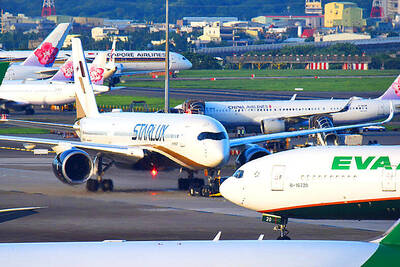
Trips for more than 100,000 international and domestic air travelers could be disrupted as China launches a military exercise around Taiwan today, Taiwan’s Civil Aviation Administration (CAA) said yesterday. The exercise could affect nearly 900 flights scheduled to enter the Taipei Flight Information Region (FIR) during the exercise window, it added. A notice issued by the Chinese Civil Aviation Administration showed there would be seven temporary zones around the Taiwan Strait which would be used for live-fire exercises, lasting from 8am to 6pm today. All aircraft are prohibited from entering during exercise, it says. Taipei FIR has 14 international air routes and
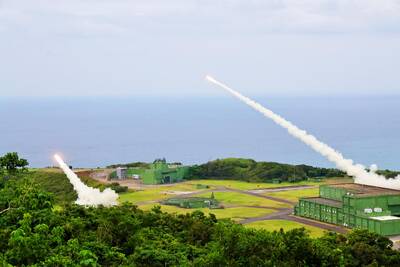
Taiwan lacks effective and cost-efficient armaments to intercept rockets, making the planned “T-Dome” interception system necessary, two experts said on Tuesday. The concerns were raised after China’s military fired two waves of rockets during live-fire drills around Taiwan on Tuesday, part of two-day exercises code-named “Justice Mission 2025.” The first wave involved 17 rockets launched at 9am from Pingtan in China’s Fujian Province, according to Lieutenant General Hsieh Jih-sheng (謝日升) of the Office of the Deputy Chief of the General Staff for Intelligence at the Ministry of National Defense. Those rockets landed 70 nautical miles (129.6km) northeast of Keelung without flying over Taiwan,
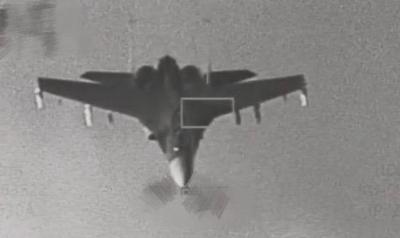
The Ministry of National Defense (MND) today released images of the military tracking China’s People's Liberation Army (PLA) movements during the latest round of Chinese drills around Taiwan. The PLA began "Justice Mission 2025" drills today, carrying out live-fire drills, simulated strikes on land and maritime targets, and exercises to blockade the nation's main ports. The exercises are to continue tomorrow, with the PLA announcing sea and air space restrictions for five zones around Taiwan for 10 hours starting from 8:30am. The ministry today released images showing a Chinese J-16 fighter jet tracked by a F-16V Block 20 jet and the
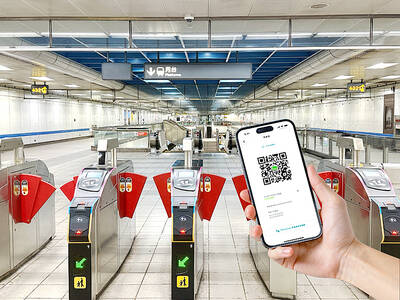
City buses in Taipei and New Taipei City, as well as the Taipei MRT, would on Saturday begin accepting QR code payments from five electronic payment providers, the Taipei Department of Transportation said yesterday. The new option would allow passengers to use the “transportation QR code” feature from EasyWallet, iPass Money, iCash Pay, Jkopay or PXPay Plus. Passengers should open their preferred electronic payment app, select the “transportation code” — not the regular payment code — unlock it, and scan the code at ticket readers or gates, General Planning Division Director-General Liu Kuo-chu (劉國著) said. People should move through the


 RSS
RSS