


Pages full of despair and fear could be written about the era known as the White Terror in Taiwan. In those days, many perished mysteriously, and their stories have been buried under the decades that followed. To this day, relatives and friends of the victims of that political oppression continue to live in the shadow of grief and agony. In many cases, they still do not know why their loved ones were killed, or even where their remains might be.
"I have tried to keep the memory alive. I have tried to fight those who would forget. Because if we forget, we are guilty ... not to remember would turn us into accomplices of the killers, to remember would turn anyone into a friend of the victims," said Holocaust survivor and world-renowned author Elie Wiesel in his 1986 Nobel Peace Prize acceptance speech.
In keeping with the same notion that "history ought not to be forgotten," an exhibition that is a testament to the suffering during that dark era has been put together by the Presidential Office's Human Rights Advisory Committee, the National Archives Bureau and the Council of Cultural Affairs, and is now on display in the hall area of the Taipei Railway Station.
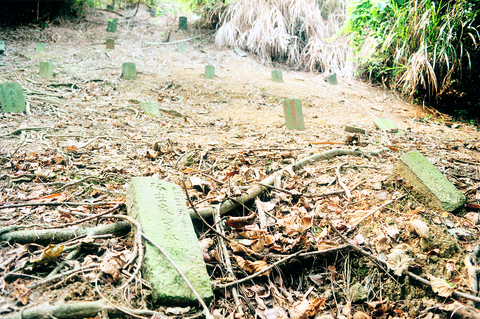
PHOTO: COURTESY OF TSAO CHIN-JUNG
Featuring what was once highly classified information, all documents and photos on display bear witness to the White Terror era with the story behind each photo and document collectively illustrating a tragic chapter in Taiwan's history.
"Although it is painful to recall the injustices of the past, doing so is our best defense against them being repeated," said Yang Hsien-hung (
`Subversion'
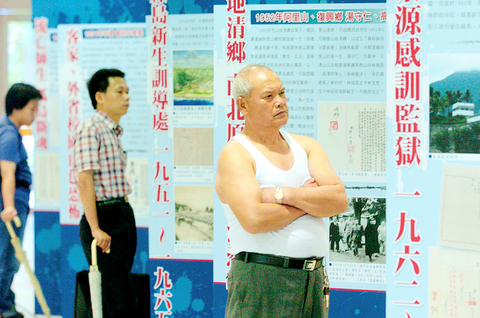
PHOTO: SEAN CHAO, TAIPEI TIMESN
The opening of the display was chosen to coincide with the anniversary of the promulgation of Martial Law on May 19, 1949, and the location of the display was specifically chosen as well.
In the White Terror era, the bulletin board in front of the Taipei Railway Station was where lists of names were posted. Names with a red check next to it meant that those people had recently been executed on the grounds of "subversion."
"People should forgive but shall never forget such a tragic page in Taiwan's history," said the vice president at the opening of the exhibition yesterday.
The exhibition will run for 10 days at the Taipei Railway Station before it goes on a nationwide tour at other railway stations around Taiwan.
Some of the main features of the exhibition present 10 of the most unjust political episodes which the committee had chosen from the numerous cases of the Martial Law era.
Prior to the staging of the exhibition, the committee on Wednesday also released a list of "Human Rights Persecutors" who had played roles in these cases.
"We need to continue to look into these issues for history's sake," said committee member Chen I-shen (
The White Terror period began soon after the 228 Incident in 1947, during which a brutal military crackdown took place against dissidents protesting against the corrupt administration of Chen Yi (陳儀), a governor appointed by Chiang-Kai-shek (蔣介石) to help rebuild Taiwan after World War II.
The Chinese Nationalist Party (KMT) massacred tens of thousands of people, mainly the island's intellectual and social elite, for fear that they might be communist sympathizers or resist Nationalist rule.
On May 19, 1949, the Taiwan Provincial Government, headed by Chen Cheng (陳誠), implemented Martial Law.
During following years of the White Terror, thousands of people were arrested, imprisoned, tortured and murdered through the web-like secret agent system of the KMT's KGB-style security apparatus, the Taiwan Garrison Command.
The scene could take place anywhere at any hour, day or night: family or friends would watch their loved ones being dragged off by armed men, or passers-by would witness a person being seized by armed men off the street, tied up, blindfolded, bundled into a car and driven to police headquarters.
The reason for arrest was usually on suspicion of being "subversive." Many of the victims underwent brutal torture, beatings and violations of their human rights.
In many cases the victims were executed on fabricated or groundless charges of espionage or treason without a fair trial, and would simply vanish after being taken away by government intelligence agents.
"In those days, many people perished," said Lee Shiao-feng (
"They would disappear and never be found again," he said.
According to a study that was conducted by former DPP legislator and political prisoner Hsieh Tsung-min (
Martial Law was not lifted until July 15, 1987.
Ten cases in point
Among the ten cases chosen by the committee, some are familiar to most people, while others are less known. Yet, to those who lived through the era, these incidents are indelibly etched in their hearts and minds.
The 10 cases include the Shantung student refugee incident of 1949; the Chungli Yimin Middle School incident of 1952; the Luku incident (鹿窟事件) of 1952; the arrest of Aborigines Tang Shou-jen (湯守仁) and Kao Yi-sheng (高一生) in 1953; the Su Tung-chi (蘇東啟) case of 1961; the arrest of writer Chen Yin-chen (陳映真) and Chiu Yen-liang (丘延亮) in 1968 for supporting Taiwan's independence; and the case against Huang Chi-nan (黃紀男) and Chung Chien-hsun (
Lei, a founder and publisher of the Free China Journal was arrested on Sept. 4, 1960, for treason and sentenced to 10 years in prison at the behest of former president Chiang Kai-shek (
The magazine, which was launched in 1950, was then closed. Peng was the co-author of the 1964 Declaration of Taiwan Self-Salvation. Publication of the declaration landed him in jail. He later spent more than 20 years in exile.
The Kaohsiung Incident occurred on Dec. 10, 1979 when the Chinese Nationalist Party (KMT) government imprisoned participants of an anti-government parade organized by Formosa magazine; the crackdown is also known as the Formosa Incident.
The Kaohsiung Incident galvanized Taiwanese on the island and overseas into political action. The dangwai ("outside the party") democratic opposition started to question the KMT's anachronistic claim of representing all of China, and began to work towards lifting the 40-year old Martial Law.
In September 1986, this movement culminated in the formation of the Democratic Progressive Party (DPP), which soon grew into a full-fledged opposition party.
The selection of the cases was based on the number of victims involved, the significance of the case and level of absurdity, among others factors, said committee member Chen I-shen.
Lee said that cases committed during the White Terror could be divided into several categories: to strike down pro-Communists or left wing rhetoric and conduct; to crush Taiwanese independence movements and ideas; to purge the Aboriginal elite and to oppress dissenters within the democratic movement; in-fighting within the intelligence agencies; rhetoric used -- ?whether privately or in public -- ?that ran counter to the interests of authorities; and fabricated cases made up by secret agents solely for the purpose of competing for personal benefit.
Unsolved cases
Of all political cases that took place between 1949 and 1960, approximately 2,000 people were executed and 8,000 were sentenced to severe punishment.
Save the less than 900 people who were really members of the Communist Party, the remaining 9000 people were victims of fabricated evidence and injustice, according to research conducted by members of the committee.
Lee said the Kaohsiung Incident taught the ruling dictator a lesson -- that is, political questions cannot be resolved mathematically.
"Ten minus five equals five is a mathematical equation. However, arresting five dissidents out of 10 won't necessarily leave five of them. Many more dissidents will rise to take their places," Lee said.
Since taking office in 2000, the DPP administration under President Chen Shui-bian (陳水扁) has emphasized its commitment to protecting and respecting human rights and building Taiwan into a human rights-oriented nation. The best way to fulfil that promise is to start uncovering the truth and bring justice to the victims and their families.
"Investigations into these cases of injustice are not to seek retaliation but to uncover the truth," said the Vice President.
"It is the hope that through reviewing Taiwan's tragic past that we can gain a more objective understanding of the history and to cherish the fruits of democracy that we have today," Lu added.
To this day, there are many unresolved cases from the White Terror. Among these are the murder of Chen Wen-cheng (陳文成), who was found dead on the lawn of National Taiwan University after being taken away by the secret police, and the murder of family members of former DPP chairman Lin I-hsiung (林義雄). These are just two of the most commonly cited of many unsolved cases.
Chen last December vowed to push the legislature to set up investigation committees to look into cases such as the 1947 228 Incident, the Kaohsiung Incident and unresolved cases from the White Terror era.
"The more we know, the better we forgive," Swiss author Germaine de Stael once said.
With the pain of not knowing what happened, or in some cases even the location of the victim's burial site, loved ones left behind can only heal when the truth is finally unearthed, Yang said.

Taiwanese can file complaints with the Tourism Administration to report travel agencies if their activities caused termination of a person’s citizenship, Mainland Affairs Council Minister Chiu Chui-cheng (邱垂正) said yesterday, after a podcaster highlighted a case in which a person’s citizenship was canceled for receiving a single-use Chinese passport to enter Russia. The council is aware of incidents in which people who signed up through Chinese travel agencies for tours of Russia were told they could obtain Russian visas and fast-track border clearance, Chiu told reporters on the sidelines of an event in Taipei. However, the travel agencies actually applied
Japanese footwear brand Onitsuka Tiger today issued a public apology and said it has suspended an employee amid allegations that the staff member discriminated against a Vietnamese customer at its Taipei 101 store. Posting on the social media platform Threads yesterday, a user said that an employee at the store said that “those shoes are very expensive” when her friend, who is a migrant worker from Vietnam, asked for assistance. The employee then ignored her until she asked again, to which she replied: "We don't have a size 37." The post had amassed nearly 26,000 likes and 916 comments as of this

New measures aimed at making Taiwan more attractive to foreign professionals came into effect this month, the National Development Council said yesterday. Among the changes, international students at Taiwanese universities would be able to work in Taiwan without a work permit in the two years after they graduate, explainer materials provided by the council said. In addition, foreign nationals who graduated from one of the world’s top 200 universities within the past five years can also apply for a two-year open work permit. Previously, those graduates would have needed to apply for a work permit using point-based criteria or have a Taiwanese company
The Shilin District Prosecutors’ Office yesterday indicted two Taiwanese and issued a wanted notice for Pete Liu (劉作虎), founder of Shenzhen-based smartphone manufacturer OnePlus Technology Co (萬普拉斯科技), for allegedly contravening the Act Governing Relations Between the People of the Taiwan Area and the Mainland Area (臺灣地區與大陸地區人民關係條例) by poaching 70 engineers in Taiwan. Liu allegedly traveled to Taiwan at the end of 2014 and met with a Taiwanese man surnamed Lin (林) to discuss establishing a mobile software research and development (R&D) team in Taiwan, prosecutors said. Without approval from the government, Lin, following Liu’s instructions, recruited more than 70 software


 RSS
RSS