


Sha Zukang (
Speaking to Taiwanese reporters at the World Health Assembly (WHA), the WHO's highest decision-making body, Sha noted that the memorandum is the first China has ever signed with an international organization to handle the cross-strait problem.
The memorandum, signed by China and the WHO Secretariat last Saturday, stipulates that Taiwan has to apply for the WHO's technical assistance through China and that all exchanges between Taiwan and the WHO have to be approved by Beijing.
Neither China nor the WHO Secretariat consulted Taiwan over the contents of the memorandum, in which Taiwan is treated as a part of China. Taiwan's Ministry of Foreign Affairs has said it will never accept the memorandum if the document denigrates Taiwan's national status in any way.
Sha, however, argued that the contents of such memorandums are often kept secret.
"We will inform Taiwan of the details of the memo through proper channels in due course. We haven't done that yet," Sha said. "Only China and Taiwan can solve cross-strait problems."
Chinese Minister of Health Gao Qiang (高強) was to hold a press conference yesterday evening to explain the details of the memorandum.
The memorandum is significant for Taiwan because "diseases do not wait for political problems to be solved," Sha said.
Those comments were in marked contrast to Sha's harsh response to Taiwan's SARS problem in 2003. Two years ago, while Taiwan was struggling to contain the SARS epidemic, Sha snapped at Taiwanese reporters as they approached him in that year's WHA, saying: "Who cares about you?"
Meanwhile, a group of Taiwanese, including doctors, nurses and Aborigines, staged a protest yesterday morning outside the Palais des Nations in Geneva -- where the WHA is meeting -- against the WHO's isolation of Taiwan
Holding banners with slogans in several languages appealing for support for Taiwan's bid to join the WHO, the Taiwanese sang songs, including a song named Victory for Taiwan
It was cold and rainy in Geneva yesterday, but the bad weather did not douse the Taiwanese campaigners' passion for the WHO bid.
Members of the North America Taiwanese Women's Association (NATWA) also went to the Chinese embassy in Geneva around 30 minutes before the opening of the WHA to protest against China's obstruction of Taiwan's WHO bid.
They handed a letter to the embassy requesting that China relent in its opposition to Taiwan's bid. Overseas Chinese Affairs Commission Minister Chang Fu-mei (
"China always lies to the international community about how Beijing has taken care of the Taiwanese people's health. We feel very bad about that and hope China understands our feelings," Chang said.

NATIONAL SECURITY: Authorities are working to confirm the identities of the military personnel involved and investigating possible illegal conduct and regulatory violations Authorities are probing possible national security implications after Kinmen police and immigration officers on Sunday found a Chinese woman allegedly posing as a tourist while engaging in prostitution involving more than 10 military personnel. The woman, surnamed Chen (陳), has since been deported, authorities said, adding that investigators are still working to confirm the identities of those implicated, as the records only listed code names and aliases. The case stemmed from a report received by the Kinmen District Prosecutors’ Office on Friday last week from the Jinhu Precinct of the Kinmen County Police Bureau. On Sunday, police, along with the National Immigration

GLOBALGIVING: ‘ Caving to external pressure is not acceptable for an organization that has cultivated justice reform and human rights for 30 years,’ one NGO said A slew of non-government organizations (NGOs) have withdrawn from the GlobalGiving fundraising platform after it announced it would use “Chinese Taipei” instead of “Taiwan” from next month. The Taiwan Good Rice Association wrote on Facebook on Friday that it was informed on April 28 via a teleconference call of the change, which was made because the platform wanted to operate in China. Taiwan Good Rice is to terminate all cooperative relationships with GlobalGiving in response to the platform’s “unilateral and non-negotiable” decision to remove references to Taiwan, the NGO said. “Taiwan is in the official name of Taiwan Good Rice Association and the

HEAVY WEATHER: Typhoon Jangmi is due to crash straight into the Ryukyus as airlines look to shift flights to larger aircraft or cancel flights to Okinawa entirely Taiwan’s international air carriers announced flight adjustments over the weekend as Typhoon Jangmi is forecast to hit the Ryukyu Islands today and tomorrow. The Central Weather Administration (CWA) upgraded Jangmi from a tropical storm to a typhoon at 8am yesterday, with the eye located 580km south of Naha city. It was moving north at 19kph. Today, China Airlines’ CI-120, CI-121, CI-122 and CI-123 flights between Taoyuan and Naha, Okinawa, have been canceled as well as CI-132 and CI-133 between Kaohsiung and Naha. EVA Air’s BR-112, BR-113, BR-186 and BR-185 flights between Taoyuan and Naha are also canceled. Low-cost carrier Tigerair Taiwan canceled IT-230,
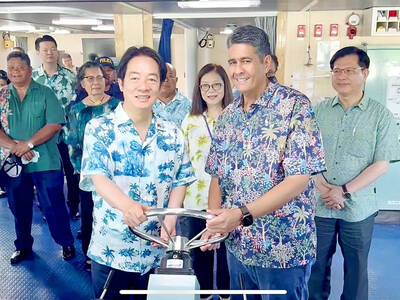
MULTIPRONGED APPROACH: China has sought to pressure Palau across a number of fronts, but the island nation has staunchly resisted overtures to ditch Taiwan Palau has been firm in backing Taiwan despite Chinese pressure that uses tourism economics, cyberattacks and criminal infiltration as tools to threaten the Pacific ally into renouncing its recognition of Taiwan as a sovereign state. The Presidential Office yesterday announced that Vice President Hsiao Bi-khim (蕭美琴) would visit Palau from Saturday to Wednesday next week at the invitation of Palauan President Surangel Whipps Jr. Whipps in April said in an interview that China had outspokenly asked Palau to “denounce Taiwan.” “And we have said: ‘We have no enemies, but nobody tells us who our friends are,’” he said. Whipps has told reporters multiple times


 RSS
RSS