


Taipei Times: Having been responsible for defense policy toward Taiwan for almost seven years under the Clinton and Bush administrations, you are widely considered to be the architect of US defense relations with Taiwan, and are often credited with playing a role in the release of the items contained in the special budget by the Bush administration. Now that you are retired and in the defense business, how do you and your company stand to profit from the items contained in the special budget?
Mark Stokes (
TT: Opponents of the special budget have asserted that the procurement of the PAC-3 missile defense system, eight diesel-powered submarines and 12 P-3C maritime patrol aircraft will spark an arms race. Is this a valid assertion?
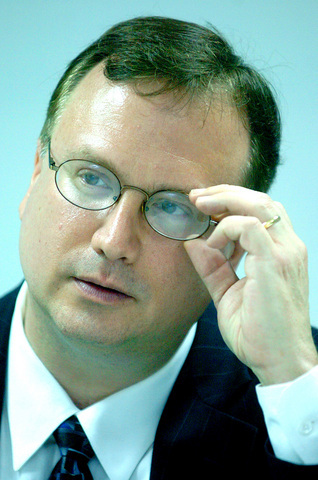
PHOTO: SEAN CHAO, TAIPEI TIMES
Stokes: There is already an arms race in the Taiwan Strait that has been underway for years. But only one side is racing, and it is not Taiwan. Taiwan cannot compete with China in an arms race. The idea is to raise the costs to Beijing of using force against Taiwan, and to lengthen the amount of time that Taiwan can sustain a defense.
TT: While in government, the conservative Washington Times dubbed you the Pentagon's leading expert on the Chinese military. From your perspective, how serious is the military threat to Taiwan?
Stokes: Extremely serious and growing more serious by the day. The nature of the threat has been discussed at length in US Department of Defense reports to Congress and through Director of Central Intelligence testimony to Congress. Since 1999, the People's Republic of China [PRC] has embarked on a concentrated and aggressive campaign to diversify its options in order to force Taiwan's political and military capitulation in an increasingly brief period of time.
First, as US Defense Department reports have indicated, the PRC could invade and occupy Taiwan today -- barring US intervention -- and assuming it were willing to bear high political and military costs. Beijing's objectives in its force modernization are to lower these costs by reducing warning time, decapitating Taiwan's political and military leadership, causing as much confusion as possible, and inserting a sizable force into Taipei before the US could even make a decision on how to respond. Beijing also is diversifying its options for the use of limited force to achieve limited political objectives. The PRC is focused on ways to keep the US at bay while it attains its military objectives in Taiwan.
TT: But isn't this just alarmist rhetoric? Military capabilities aside, do you really believe that Beijing has the political will to attack Taiwan?
Stokes: Beijing's political will to use force against Taiwan depends upon a range of factors. The so-called "red lines" are not so clear. Much depends on specific actions taken by Taiwan's political leadership that could precipitate a crisis, internal factors within China, how confident the PRC is in its ability to achieve its political and military objectives at minimum cost, Taiwan's military strength and national will, Beijing's perception of the willingness and ability of the United States to intervene quickly and effectively.
TT: So is there a valid requirement for submarines, PAC-3s and P-3Cs?
Stokes: Yes. Let's look at these one by one.
First, submarines are a very effective means to complicate PRC strategy. Submarines are highly survivable in the face of a massive People's Liberation Army [PLA] first strike intended to cripple Taiwan's armed forces at the outset of a conflict. China has a relatively weak anti-submarine warfare [ASW] capability, and submarines provide an asymmetrical means to put the PLA's surface assets at risk. If part of an integrated ASW architecture, which would include some type of undersea surveillance system, surface and air based surveillance assets, and associated command and control -- submarines can be effective in countering the PLA Navy's increasingly capable submarine force.
In addition, a submarine force could cripple China's economy by targeting shipping into and out of Chinese ports, assuming that these ships could be positively identified as Chinese vessels and not other countries' assets.
Secondly, Taiwan needs to take decisive and visible measures to counter the growing PRC ballistic missile threat. Ballistic missiles are not only tools of political intimidation, they also have potentially devastating military utility. Acquisition of missile defense systems such as PAC-3 would undercut the limited, coercive use of ballistic missiles. Development of a comprehensive, leak-proof missile defense architecture that would defend against a full-scale attack associated with an invasion is economically infeasible. However, a limited architecture, such as that proposed in the special arms budget, would provide an effective defense against limited strikes against Taiwan's main urban areas and key military facilities.
Finally, ASW surveillance is critical to monitoring and localizing the growing PRC submarine threat. P-3Cs certainly are useful in this regard, especially if supported by some means of strategic cueing, or the capability to monitor a broad expanse of the ocean to tip off the P-3s to search in a specific area. Detecting and localizing enemy submarines is the priority. There are a wide variety of means to destroy them after they've been detected.
TT: In light of the growing military imbalance in the Strait, many experts say that Taiwan's military needs more than just the items contained in the special arms budget request. Do you think the US government believes these special budget systems are priorities?
Stokes: Taiwan needs to determine its own priorities. However, I think most US policymakers probably view missile defense as perhaps the most important of the three.
TT: A lot of people have criticized the effectiveness of the PAC-3 system against ballistic missiles and land attack cruise missiles. Does the PAC-3 really work?
Stokes: The PAC-3 proved its effectiveness in the recent war in Iraq. The missile itself performed superbly. The "friendly fire" incidents in the war have been attributed the radar and fire control system, which have subsequently been corrected. The PAC-3 also is highly effective against cruise missiles.
TT: You cite the PAC-3s effectiveness in the 1991 Gulf War, but some reports have claimed that the hit-to-kill rate of the PAC-3s was less than was originally claimed. What are the actual numbers?
Stokes: The US Army reported in December last year that the Patriot system destroyed all nine of nine missiles that it engaged.
TT: So why is the US so interested in the special arms budget?
Stokes: I think the special budget has become symbolic in terms of representing a decisive and visible measure to do something in response to the PRC's unprecedented military buildup directed in large part against Taiwan. While the US has an interest in preserving Taiwan's democracy, Taiwan needs to dedicate sufficient resources and develop the will to defend itself.
Let me also say that the special arms budget mechanism was not the idea of US policymakers. In early 2003, senior Bush administration officials offered suggestions on what capabilities could be best suited to counter the growing PRC military threat.
These included [command and control] systems that would shore up the survivability of Taiwan's national and operational command and control, enhance the speed, efficiency and effectiveness of joint operations, and increase warning time. The second was missile defense, to include PAC-3s, which could provide a viable means to undercut the limited, coercive utility of China's growing ballistic missile force. The third was ASW surveillance.
These suggestions were intended to start a dialogue on priorities and break the paralysis that has plagued Taiwan's defense establishment since the Bush administration's approval of the 2001 arms package. During the summer of 2003, Taiwanese officials relayed to the US that it intended to pursue submarines, PAC-3, and P-3Cs through a special budget request.
Breaking the impasse with regard to the special budget and coming up with an agreeable solution is crucial. The budget issue has become politically symbolic. I think there would be repercussions for those that oppose the budget, particularly at the senior-most levels of the opposition parties, since it reflects a negative attitude regarding the defense of Taiwan. And Taiwan's having a strong self-defense capability is in the US' interests. I don't think the US expects the entire budget to pass, and it understands the need for trade-offs and compromise.
TT: Some have accused the US of bullying Taiwan and forcing it to pay "protection money," saying that the special budget will bankrupt the economy. So how can the Chen Shui-bian (
Stokes: If you consider US interests in Taiwan investing the resources necessary for sufficient self-defense as bullying, then so be it. With regards to "protection money," I think the US would respond to Chinese attack in some form regardless, so this is an unfair accusation. But Taiwan needs to share the burden of its own defense and invest in the proper resources.
With regard to "bankrupting" the economy, Taiwan, which faces perhaps one of the most significant military threats in the world, spends less on defense than other countries that face much less of a threat and whose economies are less well-developed than Taiwan's. It is a matter of priorities and resource allocation.
One last point on the economy issue. Taiwan imposes significant industrial cooperation or "offset" requirements that accompany the procurement of foreign weapon systems. Taiwan requires US companies to provide technology or other goods and services that can be as much as 70 percent of the value of a weapon system.
For example, spending US$10 billion on submarines would be linked with a US company's having to provide technology or other forms of assistance to Taiwan to the value of US$7 billion. In short, there is a return on Taiwan's investment that goes well beyond the weapon system itself. Oddly enough, these "offsets" from the purchase of US systems assist in Taiwan's overall economic and technological development.
TT: I noticed that you said "ASW surveillance," which implies that submarines are not included. Is the US government fully behind Taiwan's procurement of submarines?
Stokes: In April 2001, President [George W.] Bush committed to assisting Taiwan in its acquisition of diesel-electric submarines. I think the US government stands behind this pledge today. However, having said that, I sense there may be some elements within the government who question the cost of and long time-line of acquiring new submarines.
Some may believe there are cheaper solutions that could be fielded sooner rather than later, and could be explored in more detail. For example, one suggestion that I have heard is to defer spending on the submarines and only invest a limited amount just to keep the program alive. But the bottom line is that I think the US stands behind its pledge to assist Taiwan in procuring submarines.
TT: Do you think that President Chen and the Presidential Office have done enough to articulate to the public the importance of the special budget?
Stokes: I think that more could be done. However, the ultimate responsibility for coming up with a compromised solution falls squarely on the shoulders of the Chinese Nationalist Party (KMT) and People First Party leadership, specifically chairmen Lien Chan (
TT: Some have asserted that the Taiwan Relations Act requires the US to provide weapons of a defensive character, meaning that Taiwan shouldn't have to pay for them. Is this a correct assertion?
Stokes: US policy with regard to security assistance and arms transfers are spelled out clearly in two pieces of legislation -- the Arms Export Control Act and the Foreign Assistance Act. The Foreign Assistance Act restricts grants and loans through the Foreign Military Financing (FMF) Program only for poorer, developing nations. Taiwan's economic prosperity -- reflected in part by having one of world's largest foreign currency reserves -- disqualified it for the FMF many years ago.
TT: Would the US come to Taiwan's aid if attacked?
Stokes: Yes, I am confident it would, but the form of assistance would depend on the situation. There are a number of policy factors that would determine the nature and scope of US intervention in the event China used force against Taiwan. These factors would include: what specifically precipitated PRC use of force; the amount of warning time that the US has; PRC military capabilities; Taiwan's national will and defense capabilities; the US' ability to interoperate with Taiwan; what commitments the US has in other parts of the world; and US military capabilities.
Having said this, given the scope and pace of PRC force modernization, it is no longer a question of whether or not the US would decide to assist Taiwan. It is now a question of capabilities, specifically whether or not the US has the ability to intervene before Taiwan's defenses collapse. Taiwan's ability to sustain a resistance used to be measured in terms of months or weeks. Now it is measured in terms of days. This is why Taiwan needs to invest in a force that can sustain itself long enough for the US to come to its aid.
TT: So how long is "long enough?"
Stokes: This is not a precise science, but I would say ideally two weeks. Realistically, though, in the face of a concerted PRC attempt to launch a minimum warning invasion, I would say Taiwan's armed forces need to maintain a viable defense of Taipei for five-to-seven days after the initiation of hostilities.
TT: With regards to US policy toward Taiwan, what are the implications of a failure to pass the special arms budget?
Stokes: I would not be surprised if the failure to pass the special budget, in one form or another, sparked some type of policy review within the US government. Should such a review take place, the results could be irreversible, meaning that the effects would continue through to a KMT administration should it win the presidency in 2008.
There is a very strong likelihood that the US government would be less willing to approve future requests from Taiwan for other major weapon systems. One has to remember that simply approving a weapon system that Taiwan has requested carries with it political and sometimes even economic costs with regard to US relations with the PRC. After policy approval of a system, and after the US bears the brunt of the PRC's response, there is an expectation that Taiwan would follow through with the procurement.
Otherwise, it appears that Taiwan is seeking political symbolism in its competition with the PRC, with the US incurring costs in its relations with Beijing -- without any real benefit to Taiwan's defense. The US has an interest in a healthy relationship with the PRC. It also has a fundamental interest in Taiwan's ability to defend itself.
No one should expect the US to enthusiastically risk the lives of its own young sailors, airmen, soldiers and marines to defend a Taiwan that is not willing to take the steps necessary to provide for a strong defense. And having said that, should some crisis occur say five or 10 years from now and Taiwan had not taken the necessary steps to provide for a proper defense, future historians are very likely to place part of the blame on a KMT leadership that sacrificed long-term interests for short-term political gains.

Starlux Airlines, Taiwan’s newest international carrier, has announced it would apply to join the Oneworld global airline alliance before the end of next year. In an investor conference on Monday, Starlux Airlines chief executive officer Glenn Chai (翟健華) said joining the alliance would help it access Taiwan. Chai said that if accepted, Starlux would work with other airlines in the alliance on flight schedules, passenger transits and frequent flyer programs. The Oneworld alliance has 13 members, including American Airlines, British Airways, Cathay Pacific and Qantas, and serves more than 900 destinations in 170 territories. Joining Oneworld would also help boost

A new tropical storm formed late yesterday near Guam and is to approach closest to Taiwan on Thursday, the Central Weather Administration (CWA) said. Tropical Storm Pulasan became the 14th named storm of the year at 9:25pm yesterday, the agency said. As of 8am today, it was near Guam traveling northwest at 21kph, it said. The storm’s structure is relatively loose and conditions for strengthening are limited, WeatherRisk analyst Wu Sheng-yu (吳聖宇) said on Facebook. Its path is likely to be similar to Typhoon Bebinca, which passed north of Taiwan over Japan’s Ryukyu Islands and made landfall in Shanghai this morning, he said. However, it

Taiwan's Gold Apollo Co (金阿波羅通信) said today that the pagers used in detonations in Lebanon the day before were not made by it, but by a company called BAC which has a license to use its brand. At least nine people were killed and nearly 3,000 wounded when pagers used by Hezbollah members detonated simultaneously across Lebanon yesterday. Images of destroyed pagers analyzed by Reuters showed a format and stickers on the back that were consistent with pagers made by Gold Apollo. A senior Lebanese security source told Reuters that Hezbollah had ordered 5,000 pagers from Taiwan-based Gold Apollo. "The product was not

COLD FACTS: ‘Snow skin’ mooncakes, made with a glutinous rice skin and kept at a low temperature, have relatively few calories compared with other mooncakes Traditional mooncakes are a typical treat for many Taiwanese in the lead-up to the Mid-Autumn Festival, but a Taipei-based dietitian has urged people not to eat more than one per day and not to have them every day due to their high fat and calorie content. As mooncakes contain a lot of oil and sugar, they can have negative health effects on older people and those with diabetes, said Lai Yu-han (賴俞含), a dietitian at Taipei Hospital of the Ministry of Health and Welfare. “The maximum you can have is one mooncake a day, and do not eat them every day,” Lai


 RSS
RSS