


Calling the meeting between President Chen Shui-bian (
"If the Democratic Progressive Party (DPP) abandons its ideals about the nation's official name, I'm here to declare that we will end the partnership with the DPP and pursue the cause by ourselves," TSU caucus whip Lo Chih-ming (
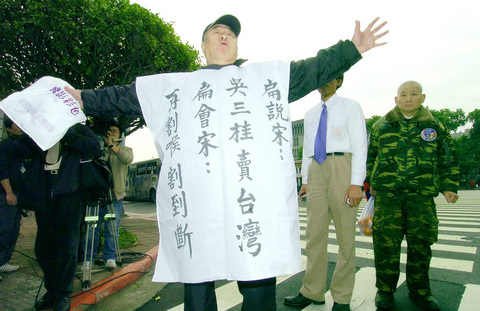
PHOTO: WANG MIN-WEI, TAIPEI TIMES
"We pledge to continue down the road to strive for the nation's consciousness and a normal and undivided country," he said. Lo also rebuked Chen for "seriously sabotaging" the nation's consciousness by reiterating the "four noes and one not" during yesterday's meeting.
The "four noes" are: no declaration of independence; no change of Taiwan's formal name from the Republic of China; no enshrining the description of cross-strait relations as "state-to-state" in nature in the Constitution; and no holding of a referendum on formal independence. The "one not" is not to abolish the National Reunification Council or the National Reunification Guidelines, both established by former president Lee Teng-hui (
Chen's avoidance of politically sensitive issues only proves that Chen has reneged on his own promise to hand the people of Taiwan a new version of the Constitution that is "timely, relevant and viable," Lo added. In addition to berating Chen for "wanting to make a name for himself in history" and betraying the Taiwanese people, Lo said that Soong took advantage of the meeting to upgrade his political status.
"A-bian's [Chen's nickname] declaration that he does not rule out accepting any possibility for the nation's future is tantamount to bringing the nation to the verge of annexation by China," Lo said.
TSU lawmaker Mark Ho (
He also called on Taiwanese people to switch their support to the TSU to help the party push the campaign for a name change and new Constitution.
PFP and DPP lawmakers, on the other hand, lauded the "achievements" made during yesterday's meeting.
Calling the meeting an "extravaganza of truth," PFP legislative caucus whip Liu Wen-hsiung (劉文雄) said that his caucus fully supports the conclusion reached by Soong and Chen.
"From today on, we hope to see more dialogue than opposition between the ruling and opposition parties, as well as more supervision than confrontation," he said.
PFP Legislator Chou Hsi-wei (
"We hope they realize the fact that the meeting is aimed at pursuing the national interest with the most practical approach," he said.
DPP New Tide faction (
"As the Republic of China is already a sovereign state, it is misleading for the president to say that he will not -- rather than there is no need to -- declare independence," he said.
Meanhwile, the PFP's erstwhile ally was also critical. The Bian-Soong meeting was unnecessary, KMT Chairman Lien Chan (
"The contents of Chen-Soong's 10-point consensus needs to be approved by the legislature to become law. If the KMT and the PFP unite closely together, then they can all pass. There is no need to seek the DPP," Lien said yesterday at a party discussion for new legislators.
However, Lien added, he trusts Soong, because both he and Soong have "swallowed Chen Shui-bian's bait" before.
Also speaking at the meeting, Legislative Speaker Wang Jin-pyng (
"Because the governing camp is the minority and the opposition camp is the majority [in the legislature], the DPP is trying to think of ways to make the pan-blue camp disintegrate and to weaken the pan-blue camp. The PFP's central committee should be careful and unite with the pan-blue camp," Wang said.
While the KMT welcomes any positive developments from the Chen-Soong meeting, emphasized the KMT yesterday, it maintains its own position.
"The pan-blue camp achieved a majority in the legislature [in last December's legislative elections] because the KMT promised before to balance and supervise the DPP. If Chairman Lien is to meet with Chen in the future, Chairman Lien will have to take more time to understand what the people want. For now, the KMT will not participate in the talks," said KMT Secretary-General Lin Feng-cheng (
Meanwhile, the Mainland Affairs Council remained reserved in its enthusiasm regarding the 10-point consensus, saying that "it's unclear whether they will help, but at least it is not for the worse."
Council Vice Chairman Chiu Tai-san (邱太三) pointed out that the significance of the 10-point consensus had been made on a topic on which agreement was very difficult. Chiu said that the council was already working to realize the policies set out in the 10-point consensus' conclusion, especially those laid out in the fourth and fifth points.
additional reporting by Joy Su

The military has spotted two Chinese warships operating in waters near Penghu County in the Taiwan Strait and sent its own naval and air forces to monitor the vessels, the Ministry of National Defense (MND) said. Beijing sends warships and warplanes into the waters and skies around Taiwan on an almost daily basis, drawing condemnation from Taipei. While the ministry offers daily updates on the locations of Chinese military aircraft, it only rarely gives details of where Chinese warships are operating, generally only when it detects aircraft carriers, as happened last week. A Chinese destroyer and a frigate entered waters to the southwest

The eastern extension of the Taipei MRT Red Line could begin operations as early as late June, the Taipei Department of Rapid Transit Systems said yesterday. Taipei Rapid Transit Corp said it is considering offering one month of free rides on the new section to mark its opening. Construction progress on the 1.4km extension, which is to run from the current terminal Xiangshan Station to a new eastern terminal, Guangci/Fengtian Temple Station, was 90.6 percent complete by the end of last month, the department said in a report to the Taipei City Council's Transportation Committee. While construction began in October 2016 with an

NON-RED SUPPLY: Boosting the nation’s drone industry is becoming increasingly urgent as China’s UAV dominance could become an issue in a crisis, an analyst said Taiwan’s drone exports to Europe grew 41.7-fold from 2024 to last year, with demand from Ukraine’s fight against Russian aggression the most likely driver of growth, a study showed. The Institute for Democracy, Society and Emerging Technology (DSET) in a statement on Wednesday said it found that many of Taiwan’s uncrewed aerial vehicle (UAV) sales were from Poland and the Czech Republic. These countries likely transferred the drones to Ukraine to aid it in its fight against the Russian invasion that started in 2022, it said. Despite the gains, Taiwan is not the dominant drone exporter to these markets, ranking second and fourth

Japanese Prime Minister Sanae Takaichi’s comment last year on Tokyo’s potential reaction to a Taiwan-China conflict has forced Beijing to rewrite its invasion plans, a retired Japanese general said. Takaichi told the Diet on Nov. 7 last year that a Chinese naval blockade or military attack on Taiwan could constitute a “survival-threatening situation” for Japan, potentially allowing Tokyo to exercise its right to collective self-defense. Former Japan Ground Self-Defense Force general Kiyofumi Ogawa said in a recent speech that the remark has been interpreted as meaning Japan could intervene in the early stages of a Taiwan Strait conflict, undermining China’s previous assumptions


 RSS
RSS