


Although it yesterday became apparent that Taiwan has failed in its bid to be included in the World Health Organization's (WHO) International Health Regulations (IHR), China and a host of other countries have agreed to discuss the proposal further in the future.
The meeting in Geneva to revise the regulations draws to a close today.
"Although we did not achieve our original goal, we are encouraged by what happened over the past 10 days. Our bid has drawn attention and recognition, which will create more space for future efforts," said Shen Lyu-shun (
The WHO started a 12-day revision of the IHR on Nov. 1. Taiwan's diplomatic ally Nicaragua proposed amending Article 65 in the draft revision of the regulations, which regulates how states that are not members of the WHO may become parties to the IHR.
During the course of the meetings, 42 WHO member states supported or identified with Taiwan's appeal, whereas 16 nations took China's side in opposing it. Only the US and 16 of Taiwan's allies publicly voiced support for Nicaragua's proposal. Canada and EU countries did not reveal their position on the matter but stressed that they recognize the WHO's principle of universality, the Central News Agency (CNA) reported.
Over the years, Taiwan has been put in an "absolutely unfavorable" position on all occasions associated with the WHO, Shen said.
"This time, however, the situation has been partly favorable to our cause. Although Taiwan's delegation was barred from all the meetings over the past two weeks, we were fully informed of what went on in the discussions. We need to thank our allies, the US and EU nations for their support," the diplomat said.
In a subgroup meeting on Wednesday, Nicaragua's representative told participating WHO members that it would not exclude the possibility of continued negotiations to amend Article 65 outside the WHO.
Members discussing the possible amendment of Article 65 finally decided to subject the proposal to further consultation, CNA reported. China's representative to the meeting also agreed to discuss the matter in the future, according to CNA.
"We still face daunting challenges ahead. However, there will always be room for efforts if the door of opportunity is not totally shut," Shen said.

LOUD AND PROUD Taiwan might have taken a drubbing against Australia and Japan, but you might not know it from the enthusiasm and numbers of the fans Taiwan might not be expected to win the World Baseball Classic (WBC) but their fans are making their presence felt in Tokyo, with tens of thousands decked out in the team’s blue, blowing horns and singing songs. Taiwanese fans have packed out the Tokyo Dome for all three of their games so far and even threatened to drown out home team supporters when their team played Japan on Friday. They blew trumpets, chanted for their favorite players and had their own cheerleading squad who dance on a stage during the game. The team struggled to match that exuberance on the field, with
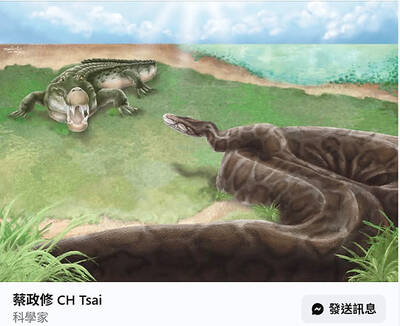
Taiwanese paleontologists have discovered fossil evidence that pythons up to 4m long inhabited Taiwan during the Pleistocene epoch, reporting their findings in the international scientific journal Historical Biology. National Taiwan University (NTU) Institute of Ecology and Evolutionary Biology associate professor Tsai Cheng-hsiu (蔡政修) led the team that discovered the largest snake fossil ever found in Taiwan. The single trunk vertebra was discovered in Tainan at the Chiting Formation, dated to between 400,000 and 800,000 years ago in the Middle Pleistocene, the paper said. The area also produced Taiwan’s first avian fossil, as well as crocodile, mammoth, saber-toothed cat and rhinoceros fossils, it said. Discoveries

Taiwanese paleontologists have discovered fossil evidence that pythons up to 4m long inhabited Taiwan during the Pleistocene epoch, reporting their findings in the international scientific journal Historical Biology. National Taiwan University (NTU) Institute of Ecology and Evolutionary Biology associate professor Tsai Cheng-hsiu (蔡政修) led the team that discovered the largest snake fossil ever found in Taiwan. A single trunk vertebra was discovered in Tainan at the Chiting Formation, dated to between 800,000 to 400,000 years ago in the Middle Pleistocene, the paper said. The area also produced Taiwan’s first avian fossil, as well as crocodile, mammoth, sabre-toothed cat and rhinoceros fossils, it said. Discoveries

Whether Japan would help defend Taiwan in case of a cross-strait conflict would depend on the US and the extent to which Japan would be allowed to act under the US-Japan Security Treaty, former Japanese minister of defense Satoshi Morimoto said. As China has not given up on the idea of invading Taiwan by force, to what extent Japan could support US military action would hinge on Washington’s intention and its negotiation with Tokyo, Morimoto said in an interview with the Liberty Times (sister paper of the Taipei Times) yesterday. There has to be sufficient mutual recognition of how Japan could provide


 RSS
RSS