


After nearly five months without a deputy, the Mainland Affairs Council was finally able to fill the position this past week with Vice Chairman David Huang (
While Huang has spent most of his career in academic circles, his family is no stranger to politics. He is perhaps better known as the son of former Central Election Commission Chairman Huang Shih-cheng (
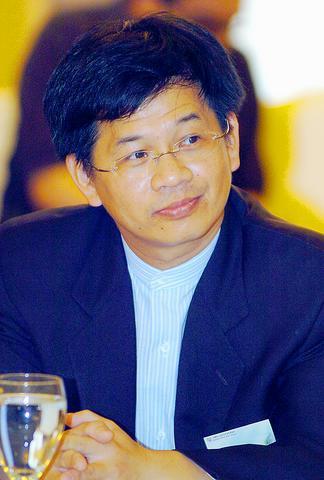
TAIPEI TIMES FILE PHOTO
"The words of advice my father gave to me [about the position] were: Do not be late, be honest, and be cooperative when possible," Huang said.
Huang's sister, Lisa Huang (黃文玲), is also involved in local politics, running in Chuanghua county for a seat in the legislature in the December elections as an independent. Huang has no party affiliations and expressed no desire to join one of the major parties.
In academia, David Huang is also known for his research on the European Union, referendum procedures and the British electoral processes. Given the emphasis generally placed on ties with the US in cross-strait efforts, Huang is generally considered to be one of the few researchers with an expertise on Europe.
His educational credentials are impeccable, with degrees in political science from the Massachusetts Institute of Technology and Oxford.
He has also held various teaching and research positions in Europe and Japan and has been published in academic journals.
His former co-workers at the Academia Sinica Institute of European and American Studies are also respectful of his Huang. His colleagues told the Taipei Times that his research was very "solid" and that his ability to articulate ideas in both Chinese and English made him a good choice for the position.
However, asked whether he had ever visited China or had any concrete contact with Chinese officials, Huang said that he'd only been to China once in the late 1990s. Huang had apparently suffered from indigestion during the trip and was treated at a local hospital.
Council Chairman Joseph Wu (
Huang joins the council just months after announcements of possible revisions to its structure. The reorganization is expected to dissolve the council and erect a new government agency as part of the Premier's Office.
The revisions would be an influential factor in the nation's cross-strait policymaking mechanism and although it has been called a bureaucratic "upgrade" for the council, the council's future remains uncertain.
"I know what my profession is -- this is just a job change," Huang said.
He also said that his focus is still research and teaching, but taking on a government position was his duty as a citizen of a democratic society.
"I will do what I can in my capacity. Time is not a problem for me," he said.

FUKUOKA SITUATION: Japanese media reported that the pathogen is expected to be identified by the summer, while the CDC downplayed the idea that it was hMPV A “mysterious cold-like illness” reported in Japan’s Fukuoka Prefecture does not seem to be a new disease, but Japanese authorities have been asked about the situation, the Centers for Disease Control (CDC) said yesterday. The Fukuoka Prefectural Medical Association on Wednesday told a news conference that a “mystery cold” that has become a hot topic on social media is “highly likely to be caused by some kind of viral infection,” Japan’s KBC News reported. “Many people are experiencing symptoms starting with a sore throat, followed by a runny nose, phlegm and a severe cough,” KBC News reported, citing association officials. Health authorities are

Nvidia Corp CEO Jensen Huang (黃仁勳) arrived in Taiwan yesterday ahead of upcoming AI and technology events, saying he plans to meet with clients and Taiwan Semiconductor Manufacturing Co Chairman C.C. Wei (魏哲家) during his visit. After landing at Taipei Songshan Airport, Huang posed for photos with fans and handed out Yakult drinks to reporters and supporters waiting at the scene, saying he has “a lot to do” during the trip. Asked about reports that Nvidia’s planned headquarters site in Taipei’s Beitou Shilin Technology Park could break ground on May 27, Huang said that if the company holds an event, he would

Carrefour Taiwan is to begin using a new name from the start of July, but it cannot divulge the name until then, the chairman of the supermarket chain's parent company said today. President Chain Store Co chairman Lo Chih-hsien (羅智先) was asked by reporters after a shareholders' meeting to confirm whether the company has settled on a new name for the supermarket brand. In March, the government-registered name of two Carrefour Taiwan branches was quietly changed to "Le Chia Kang" (樂家康) in Chinese, raising speculation that has been selected as the name. Lo said that because of local regulations and contractual obligations, the
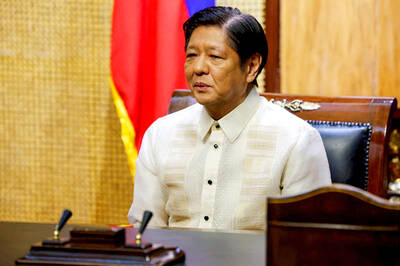
The Philippines would likely be involved in any conflict over Taiwan due to its proximity to the democracy claimed by China, President Ferdinand Marcos Jr said, reiterating a stance that risks angering Beijing. “In the Philippines, we do not have a choice because Taiwan is so close to the Philippines and we have almost 200,000 Filipino nationals living and working in Taiwan,” Marcos said in an interview with Japanese media in Manila on Monday. The Philippine leader’s comments come ahead of a state visit to Japan next week, where he is to meet with Japanese Prime Minister Sanae Takaichi to discuss security


 RSS
RSS