


Taiwan suffered two recent humiliations in its public relations war with rival China -- embarrassment that might eventually haunt the communist giant.
The president's wheelchair-bound wife was briefly stripped of her credentials to lead the Taiwanese delegation at the ongoing Paralympic Games in Athens, Greece. And for the 12th straight year, the island was blocked from joining the UN last week.
China is usually successful at snuffing out Taiwan's efforts to win the world's recognition. It seems the strategy is to wear down the Taiwanese, convince them that their efforts to play a role on the global stage are ridiculous and futile. Bei-jing says Taiwan should face the inevitable and just unify with China.
But the intense rivalry could turn into a classic case of winning all the battles but eventually losing the war. Each time China embarrasses the nation in front of the world, Taiwan drifts further away from it, Taiwanese leaders frequently say. Public opinion shifts more toward the independence movement -- a group once viewed as reckless zealots but now viewed as increasingly mainstream.
Beijing is facing a serious problem with Taiwan. More than five decades have passed since the two sides split amid civil war, and Taiwan is developing its own national identity. More and more people are considering themselves to be Taiwanese, not Chinese.
Just before Taiwan lost its latest bid Thursday to join the UN, President Chen Shui-bian (
Earlier last week, when first lady Wu Shu-jen (吳淑珍) led the Taiwanese Paralympics delegation to Athens, she proudly wore around her neck her credentials as the group's leader. A few days later, Taiwanese media began reporting that Beijing was pressuring Paralympics officials to yank the credentials, which they eventually did.
"China probably used its indirect influence to remind Taiwan that the one-China idea still has to be respected," said Philip Yang (楊永明), professor of international studies at Taipei's prestigious National Taiwan University.
Each hour on Wednesday, the island's cable news stations showed images from Greece of the frail first lady, paralyzed from the waist down since being hit by a truck in 1985. The networks also replayed the protests of Presidential Office official James Huang (黃志芳), who said, "The humiliation is just too deep."
Another top Taiwanese official, Joseph Wu (吳釗燮), said, "This kind of thing will only make the distance between Taiwan and China larger and larger, for Taiwan it's very unfavorable, but for China's long-term aims it's also not the right direction."
After a few rounds of discreet negotiations, the Paralympics organizers allowed the first lady to lead the delegation at the opening ceremony, but she didn't lead Taiwan's team in the ceremony's parade. On the streets in the capital, some Taiwanese agreed that China's move against the first lady would backfire.
"China is being shortsighted. If they hadn't stopped Wu, nobody would've talked about her. Now everyone sees how unreasonable they are," said Tony Liu, 36, an accountant who was enjoying his afternoon tea at a coffee shop.
Wallis Cheng, a 42-year-old teacher, said, "It is hard for us to receive attention, but China is helping us by pushing us too far."
Beijing likely sees itself on a slippery Great Wall. Allowing Taiwan's first lady to play a high-profile role at the Paralympics might embolden the Taiwanese to try other things and create the impression that China is growing soft. It might also send signals to other groups that it's now OK to work closely with the country.
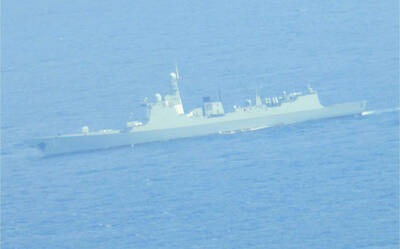
The military has spotted two Chinese warships operating in waters near Penghu County in the Taiwan Strait and sent its own naval and air forces to monitor the vessels, the Ministry of National Defense (MND) said. Beijing sends warships and warplanes into the waters and skies around Taiwan on an almost daily basis, drawing condemnation from Taipei. While the ministry offers daily updates on the locations of Chinese military aircraft, it only rarely gives details of where Chinese warships are operating, generally only when it detects aircraft carriers, as happened last week. A Chinese destroyer and a frigate entered waters to the southwest
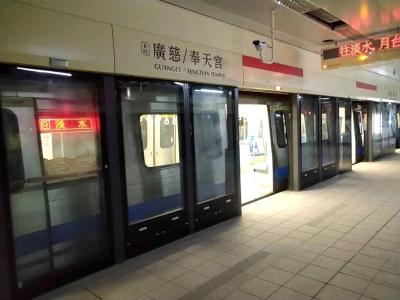
The eastern extension of the Taipei MRT Red Line could begin operations as early as late June, the Taipei Department of Rapid Transit Systems said yesterday. Taipei Rapid Transit Corp said it is considering offering one month of free rides on the new section to mark its opening. Construction progress on the 1.4km extension, which is to run from the current terminal Xiangshan Station to a new eastern terminal, Guangci/Fengtian Temple Station, was 90.6 percent complete by the end of last month, the department said in a report to the Taipei City Council's Transportation Committee. While construction began in October 2016 with an
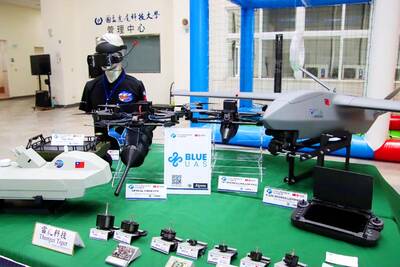
NON-RED SUPPLY: Boosting the nation’s drone industry is becoming increasingly urgent as China’s UAV dominance could become an issue in a crisis, an analyst said Taiwan’s drone exports to Europe grew 41.7-fold from 2024 to last year, with demand from Ukraine’s fight against Russian aggression the most likely driver of growth, a study showed. The Institute for Democracy, Society and Emerging Technology (DSET) in a statement on Wednesday said it found that many of Taiwan’s uncrewed aerial vehicle (UAV) sales were from Poland and the Czech Republic. These countries likely transferred the drones to Ukraine to aid it in its fight against the Russian invasion that started in 2022, it said. Despite the gains, Taiwan is not the dominant drone exporter to these markets, ranking second and fourth
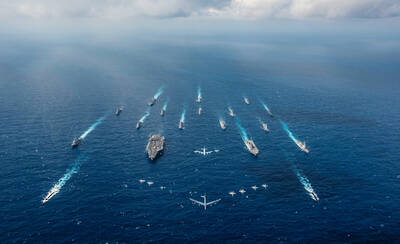
Japanese Prime Minister Sanae Takaichi’s comment last year on Tokyo’s potential reaction to a Taiwan-China conflict has forced Beijing to rewrite its invasion plans, a retired Japanese general said. Takaichi told the Diet on Nov. 7 last year that a Chinese naval blockade or military attack on Taiwan could constitute a “survival-threatening situation” for Japan, potentially allowing Tokyo to exercise its right to collective self-defense. Former Japan Ground Self-Defense Force general Kiyofumi Ogawa said in a recent speech that the remark has been interpreted as meaning Japan could intervene in the early stages of a Taiwan Strait conflict, undermining China’s previous assumptions


 RSS
RSS